The archaeological title "Andernach Obsidian Mine" requires an important correction.
Andernach was not a prehistoric obsidian mine.
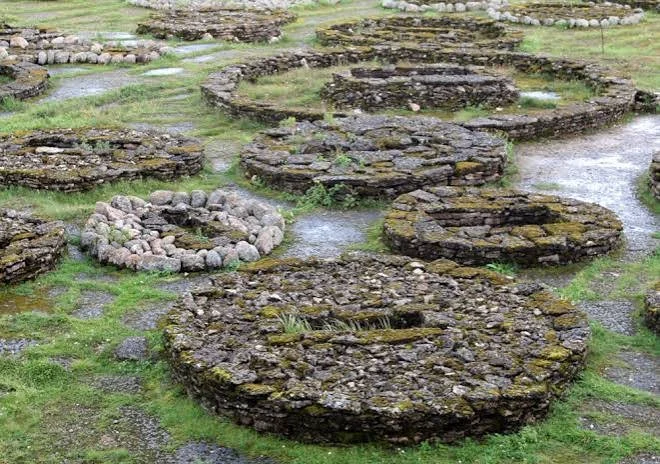
The major prehistoric quarrying tradition associated with the Andernach region concerns volcanic basalt lava from the Mayen/Bellerberg area of the Eifel, particularly material used to manufacture grinding stones and querns.
Andernach itself became especially important because its Rhine harbor provided a route through which these volcanic stone products could be transported over long distances.
The archaeological history is therefore more accurately understood as the Mayen volcanic quarrying complex and the Andernach trade network, rather than an Andernach obsidian mine.
This distinction is important because obsidian and basalt are different volcanic materials.
The Eifel Volcanic Landscape
The Eifel region of western Germany contains a remarkable concentration of volcanic formations.
Among these is the Bellerberg volcanic complex near Mayen.
The volcanic activity produced lava with properties particularly suitable for grinding grain.
The prehistoric inhabitants of the region recognized these properties and exploited the material.
Research indicates that volcanic stone from the Mayen region was exploited for grinding implements for approximately 7,000 years.
Why Was the Stone Valuable?
The volcanic basalt lava had a useful combination of characteristics.
Its vesicular texture made it particularly effective as a grinding surface.
When grain was repeatedly rubbed against the stone, the surface maintained useful abrasive properties.
This made Mayen lava highly suitable for:
grinding stones,
querns,
hand mills,
and later larger millstones.
Agricultural societies depended upon grinding technology because cereals had to be processed before they could become an important component of the human diet.
The Neolithic Connection
The earliest exploitation of the Mayen volcanic material dates to the Neolithic.
This is significant because the Neolithic marks a fundamental transformation in European subsistence.
Communities increasingly relied upon:
cultivated plants,
domesticated animals,
permanent or semi-permanent settlements,
and food-processing technologies.
Grinding stones were therefore essential.
The Mayen region became a source of a valuable technological resource.
Archaeological research places the earliest production of grinding stones from the volcanic lava at roughly 7,000 years ago.
Why Andernach Matters
If the quarries were near Mayen, why does Andernach appear in the title?
Because of transport and trade.
Andernach lies on the Rhine.
The Rhine was one of Europe's major transportation corridors.
Stone products from the Eifel could be moved toward the river and transported to distant communities.
Cambridge research specifically notes that "Andernach" was historically used as a name for the volcanic stone source because the city was the nearest major town, even though the actual prehistoric quarries were at Mayen.
Andernach as an Export Port
The Andernach harbor became an important distribution point.
Eifel millstones could be transported down the Rhine and into wider European trade networks.
The Mayen quarrying district therefore represents an early example of large-scale resource extraction linked to long-distance exchange.
The importance of this network increased considerably during later periods.
A Prehistoric Industrial Landscape
It is tempting to think of prehistoric mining as primitive.
The Mayen evidence complicates that assumption.
Large quantities of useful stone were extracted, shaped, transported, and exchanged.
The process required:
identifying suitable geological resources;
extracting them;
shaping them into useful forms;
transporting them;
exchanging them with communities far away.
This represents organized economic activity.
Basalt Versus Obsidian
The distinction between basalt and obsidian deserves particular attention.
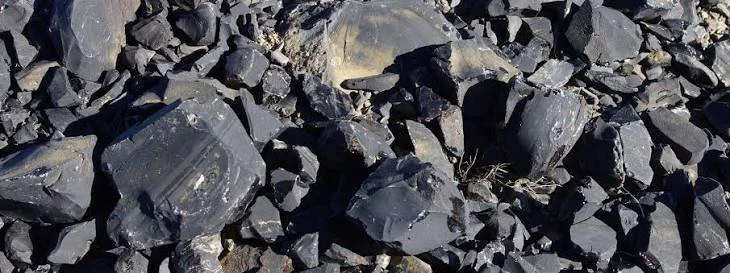
Obsidian is volcanic glass formed when silica-rich lava cools rapidly.
Basalt is a dark volcanic rock with a very different mineralogical structure.
The Mayen/Bellerberg material used for querns was volcanic basaltic lava rather than obsidian.
Therefore, describing the site as an "obsidian mine" would create an incorrect geological and archaeological picture.
The Millstone Industry
Over time, the quarrying industry expanded.
During later prehistoric periods, Mayen basalt became increasingly important.
The production of querns and millstones eventually became a major economic activity.
By the Roman period, the industry had expanded dramatically.
Archaeological research indicates that Roman quarrying at Mayen reached an enormous scale.
Long-Distance Trade
Mayen stone traveled far beyond the immediate Eifel region.
The Rhine made transportation comparatively efficient.
Stone products could move:
Mayen → Andernach → Rhine → distant European markets
This network illustrates how geography can transform a local geological resource into a major economic commodity.
Neolithic Communities and Economic Organization
The earliest exploitation is especially interesting because Neolithic communities did not possess modern machinery.
Extraction relied upon human labor and relatively simple tools.
Yet the economic result could be substantial.
The production of grinding stones demonstrates that prehistoric societies could organize labor around resource extraction and specialized manufacturing.
The Archaeology of Quarries
Quarries provide a different type of archaeological evidence from settlements.
A settlement tells us about:
houses,
food,
tools,
domestic activities.
A quarry tells us about:
geological knowledge,
extraction techniques,
specialized labor,
transportation,
and economic exchange.
The Mayen complex therefore provides information about prehistoric production systems.
Why the Resource Became Important
Agriculture created demand.
Once communities depended heavily upon cereals, they required reliable ways to process them.
Grinding stones were therefore not luxury objects.
They were essential infrastructure.
The availability of high-quality volcanic material made the Mayen region economically valuable.
The Development of Trade
Over thousands of years, the scale of exchange increased.
What began as local use eventually developed into long-distance distribution.
This demonstrates an important principle:
Technological specialization can create trade networks.
A community does not need to produce everything it consumes.
It can exchange local resources for materials from other regions.
The Andernach-Martinsberg Site
It is also important not to confuse the volcanic quarrying network with Andernach-Martinsberg, another important prehistoric archaeological site near Andernach.
Andernach-Martinsberg contains a Late Glacial Magdalenian settlement associated with hunting, tools, art, and other archaeological remains.
The two topics belong to the same broad region but represent different archaeological phenomena.
Conclusion
There is no well-established "Andernach Obsidian Mine" corresponding to the title.
The more accurate story is the remarkable Mayen/Bellerberg basalt quarrying tradition and its connection to Andernach's Rhine trade network.
For approximately 7,000 years, communities exploited volcanic material in the Eifel for grinding stones and related technologies.
Andernach became important as a transport and export center.
The resulting network demonstrates that prehistoric communities possessed sophisticated knowledge of geology, manufacturing, transportation, and trade.
The story is therefore not really about obsidian.
It is about something arguably more revealing: how a local geological resource became the foundation of one of Europe's longest-lived prehistoric and historic stone industries.