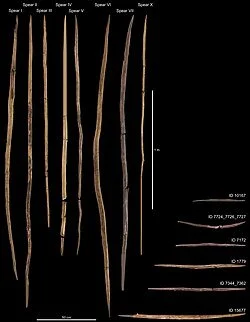
The Schöningen spears are among the most famous prehistoric wooden weapons ever discovered.
Excavated near Schöningen in Lower Saxony, Germany, the weapons were preserved in waterlogged sediments associated with a Middle Pleistocene archaeological horizon.
For decades, they were widely described as approximately 300,000–400,000 years old, making them extraordinary evidence for ancient hunting technology.
However, recent research has significantly complicated the chronology.
A 2025 study published in Science Advances proposed that the spear-bearing horizon dates to approximately 200,000 years ago, based on amino-acid geochronology and regional chronostratigraphic reassessment.
The new date has major implications because it places the weapons closer to the period of Neanderthal populations.
The Discovery
The spears were discovered during excavations associated with a former open-cast lignite mine.
The preservation conditions were exceptional.
Wood normally decomposes rapidly.
But waterlogged, oxygen-poor sediments can prevent microorganisms from completely destroying organic material.
As a result, wooden objects from hundreds of thousands of years ago survived.
The Spear Horizon
The famous weapons came from what archaeologists call the Spear Horizon.
The archaeological context included numerous horse remains.
The association between weapons and animal bones immediately raised an important question:
Were these animals hunted using the wooden weapons?
The evidence strongly supports intensive hunting and processing activity at the site.
What Do the Spears Look Like?
The weapons were made primarily from carefully selected coniferous wood, including spruce and pine.
The makers shaped the wood deliberately.
The spears were not simply sharpened branches.
They show evidence of technological planning.
Their points were carefully formed.
The bodies were shaped to create balanced weapons.
Throwing Spears or Thrusting Spears?
Experimental archaeology has played an important role in understanding the Schöningen weapons.
Researchers have constructed replicas and tested their aerodynamic properties.
Some of the spears appear suitable for throwing.
Others may have been used for thrusting.
The possibility that prehistoric hunters could throw wooden spears effectively demonstrates a sophisticated understanding of weapon design.
The Horse Assemblage
The site contained remains of numerous horses.
Some bones display evidence of human processing.
This makes the hunting interpretation particularly compelling.
A successful hunt requires more than a weapon.
Hunters need:
knowledge of animal behavior,
coordination,
planning,
timing,
suitable weapons,
and strategies for approaching dangerous prey.
Cooperative Hunting
One of the most important implications of the Schöningen discoveries concerns cooperation.
Large-scale hunting is difficult for a solitary individual.
Groups can:
drive animals,
surround them,
restrict escape routes,
coordinate attacks,
and process carcasses afterward.
The 2025 dating study specifically interpreted the Schöningen evidence as part of a broader development toward communal hunting strategies.
The Dating Controversy
The chronology is crucial.
Early research placed the site around 400,000 years ago.
Later dating revised this to approximately 300,000 years.
The 2025 study proposed approximately 200,000 years.
This demonstrates that archaeological dates are not always permanent numbers.
Dating methods improve.
Regional geological sequences are reassessed.
New samples become available.
Interpretations change.
Who Used the Spears?
The original attribution was often associated with Homo heidelbergensis or related Middle Pleistocene populations.
The revised age proposed in 2025 raises the possibility that the weapons were made or used by Neanderthals.
However, this attribution should be presented cautiously.
The revised dating is an important scientific proposal, but independent researchers have expressed reservations and called for additional evidence before treating the new chronology and user attribution as completely settled.
Why the Revised Date Matters
If the weapons really are approximately 200,000 years old and were used by Neanderthals, their significance becomes even greater.
They would demonstrate that Neanderthals possessed:
sophisticated wooden technology,
planned hunting strategies,
cooperative behavior,
and effective projectile or thrusting weapons.
This would further challenge outdated portrayals of Neanderthals as technologically primitive.
Wood as Technology
Stone tools dominate prehistoric archaeology partly because stone survives.
Wood is usually lost.
This creates a major bias in the archaeological record.
If wooden objects survived as frequently as stone, our understanding of prehistoric technology would probably be very different.
Schöningen gives researchers a rare glimpse into this invisible technological world.
Why Wood Was Excellent for Spears
Wood has several useful properties.
It is:
relatively light,
strong,
workable,
resilient,
and widely available.
A skilled prehistoric craftsperson could select a straight branch or trunk section and shape it into an effective weapon.
The absence of a stone point does not mean the weapon was technologically simple.
The wooden shaft itself can be engineered.
Manufacturing Skill
Creating a functional spear requires understanding:
wood grain,
straightness,
balance,
symmetry,
point geometry,
and durability.
The Schöningen weapons demonstrate that these properties were deliberately controlled.
The makers were not simply sharpening sticks.
They were manufacturing hunting equipment.
The Broader Meaning
The weapons demonstrate that complex hunting technology predates the Upper Paleolithic.
This is important because older narratives sometimes associated advanced technology with much later modern humans.
Schöningen shows that sophisticated technological behavior existed much earlier.
Ancient Hunting Strategy
The archaeological evidence suggests that prehistoric hunters understood animal behavior.
Horses are fast and highly alert.
Successfully hunting them requires strategy.
The hunters may have used environmental features to restrict movement.
They could have attacked from close range or thrown weapons from a distance.
The precise hunting sequence remains uncertain.
But the archaeological pattern demonstrates successful large-animal exploitation.
Schöningen and Neanderthal Social Organization
If the revised chronology is correct, the site provides another line of evidence for Neanderthal cooperation.
Cooperative hunting requires communication.
Hunters must coordinate movements.
They must recognize roles.
They must respond to changing animal behavior.
This implies sophisticated social cognition.
Conclusion
The Schöningen spears remain extraordinary regardless of whether their final date is approximately 400,000, 300,000, or 200,000 years.
They are among the oldest and most complete prehistoric wooden hunting weapons known.
The traditional "400,000-year-old" description reflects the earliest age estimates, but current research has proposed a substantially younger date of approximately 200,000 years.
If that revised chronology is confirmed, the implications for Neanderthal hunting behavior will be profound.
The weapons demonstrate that ancient humans could transform wood into carefully engineered hunting tools and use them within coordinated hunting strategies.
Schöningen therefore represents one of archaeology's clearest reminders that technological sophistication does not begin with metal, writing, or civilization.
It begins with the ability to understand materials, anticipate problems, cooperate with others, and transform natural resources into tools designed for a purpose.