Learn how ancient DNA from human remains provided the first direct evidence that a common childhood virus has been part of the human genome since the Iron Age.
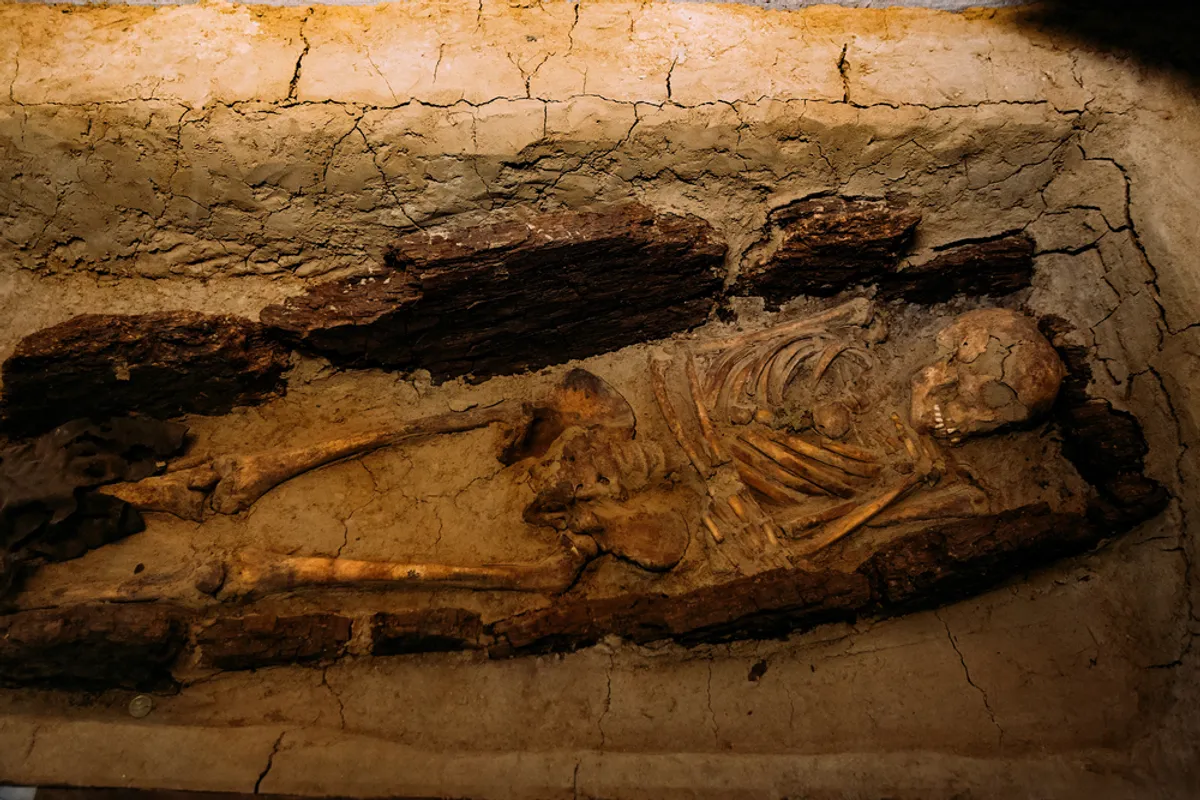
Ancient human remains, not associated with the study.
Human herpesvirus 6 is now almost universal, with most people becoming infected in early childhood. New evidence suggests that this relationship is much older than previously demonstrated—and in some cases far more permanent than once believed.
A study published in Science Advances presents the first direct genetic proof that this relationship dates back thousands of years. By reconstructing ancient genomes of human herpesvirus 6A and 6B (HHV-6A/B) from archaeological remains across Europe, researchers show that these viruses have infected humans—and in rare cases permanently integrated into human chromosomes—since at least the Iron Age.
The results confirm that some herpesviruses did more than coexist with early humans; they became part of the human genome itself.
“Modern genetic data suggested that HHV-6 may have been evolving with humans since our migration out of Africa,” said lead researcher Meriam Guellil in a press release. “These ancient genomes now provide the first concrete evidence of their presence in the deep human past.”
From Childhood Infection to Inherited Virus
HHV-6B typically infects children within their first two years of life and causes roseola infantum, a common childhood illness and the leading cause of febrile seizures in young children. Together with its close relative HHV-6A, the virus usually remains dormant in the body after the initial infection.
What distinguishes these viruses is their ability to insert their DNA into human chromosomes. When this occurs, the viral DNA can be passed from parent to child and is present in about one percent of people today.
Tracing Human Herpesvirus Across Millennia
For the study, researchers screened nearly 4,000 human skeletal remains from archaeological sites across Europe for traces of viral DNA. From these samples, they reconstructed eleven ancient HHV-6 genomes, including the oldest from a young girl who lived in Italy during the Iron Age, between 1100 and 600 B.C.E. Additional genomes came from individuals in medieval England, Belgium, Estonia, Italy, and Russia.
“While HHV-6 infects nearly 90 percent of people at some point in their lives, only about one percent carry the virus inherited from their parents in all of their cells,” Guellil said. “These cases are the most likely to be detected using ancient DNA, which makes identifying viral sequences particularly difficult.”
Several individuals from England carried inherited forms of HHV-6B, making them the earliest known humans with chromosomally integrated herpesviruses. One site in Sint-Truiden, Belgium, stood out for producing the highest number of cases, with both HHV-6A and HHV-6B present in the same population.
“Based on our data, the evolution of these viruses can now be traced across Europe for more than 2,500 years, from the 8th–6th centuries BCE to the present,” Guellil added.
How a Virus Became Part of the Human Genome
By comparing ancient viral genomes with modern ones, researchers identified where HHV-6 integrated into human chromosomes and how long those integrations persisted. Some events occurred thousands of years ago and continued across many generations, providing dated records of long-term interactions between viruses and humans.
The analysis also showed that the two closely related viruses did not evolve in parallel. HHV-6A appears to have lost its ability to integrate into human DNA relatively early, while HHV-6B retained this ability, showing how closely related viruses can diverge as they adapt to the same host.
Rather than relying solely on patterns in modern genomes, the study provides direct genetic evidence of when—and how—a common childhood virus transitioned from temporary infection to inherited presence.