The Halafian culture of northern Mesopotamia arranged floral depictions on pottery with symmetry and numerical sequences, displaying one of the earliest pieces of evidence of mathematical thinking.
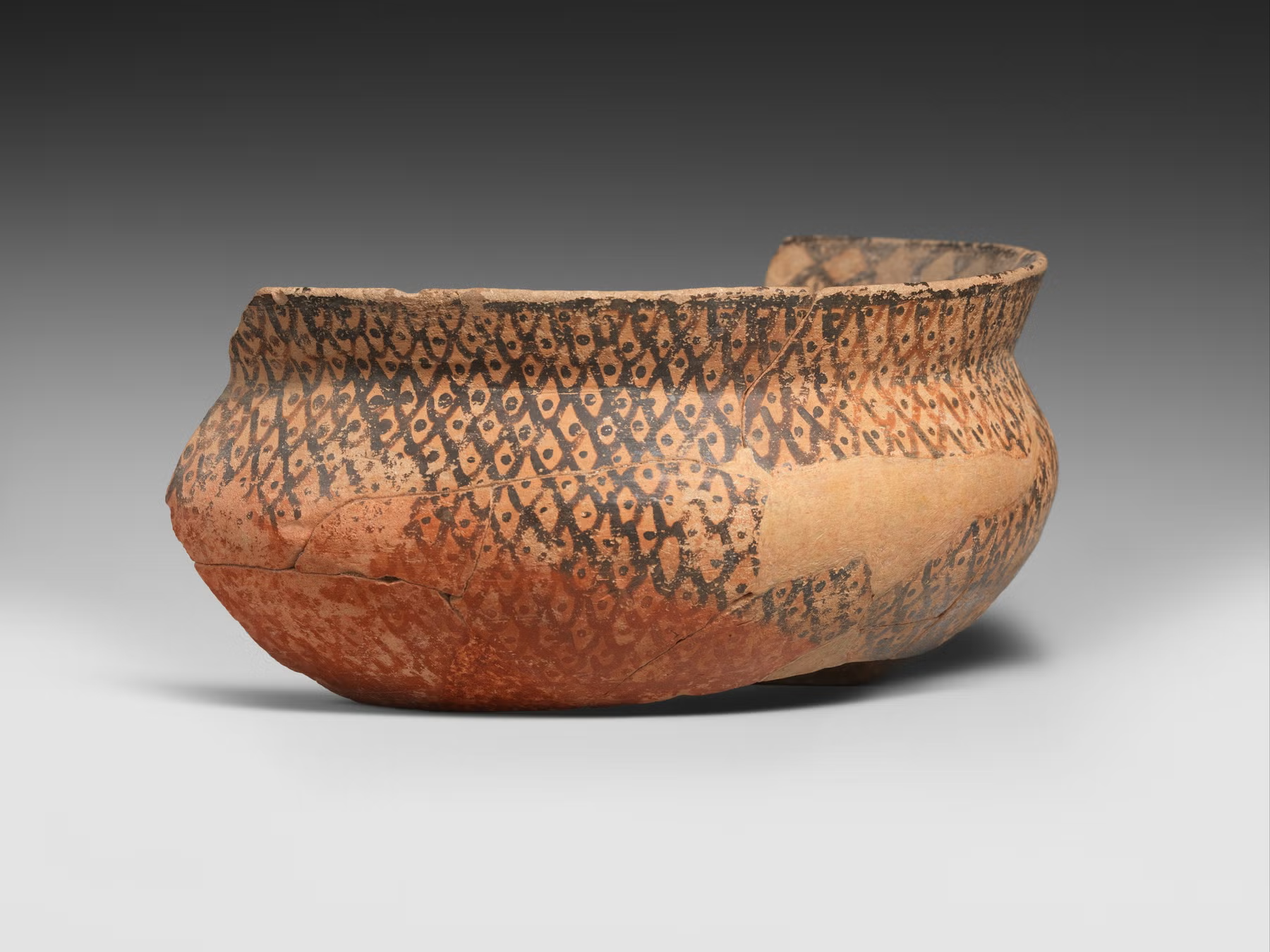
The Metropolitan Museum of Art
Here’s what you’ll discover in this story:
Uncovering signs of ancient mathematics is difficult without written sources, but new research suggests that floral designs on pottery from the Halafian culture of northern Mesopotamia reveal an understanding of geometry, symmetry, and spatial division that predates formal number systems.
The findings also mark the earliest known point at which plants became subjects of human art, as earlier artistic expressions mainly focused on animals and people.
Across 700 pottery fragments, artists depicted non-edible plants such as flowers, indicating they were selected for visual appeal rather than practical use.
Mathematics functions as a universal language—not Esperanto, but a system grounded in shared principles across cultures. This universality explains why mathematics often appears in science fiction as a means of communicating with extraterrestrials. The same logic applies across time. While archaeologists rely on reference texts like the Rosetta Stone to interpret ancient languages, mathematical patterns can be recognized and understood even millennia later.
In a study published in the Journal of World Prehistory, researchers from the Hebrew University of Jerusalem examined floral motifs painted on pottery by the Halafian culture, which inhabited northern Mesopotamia between 6200 and 5500 B.C.E., revealing sophisticated mathematical thinking embedded in prehistoric art.