• MAIN PAGE
  • LATEST NEWS
    • Lost Cities
    • Archaeology's Greatest Finds
    • Underwater Discoveries
    • Greatest Inventions
    • Studies
    • Blog
  • PHILOSOPHY
  • HISTORY
  • RELIGIONS
    • Africa
    • Anatolia
    • Arabian Peninsula
    • Balkan Region
    • China - East Asia
    • Europe
    • Eurasian Steppe
    • Levant
    • Mesopotamia
    • Oceania - SE Asia
    • Pre-Columbian Civilizations of America
    • Iranian Plateau - Central Asia
    • Indus Valley - South Asia
    • Japan
    • The Archaeologist Editor Group
    • Scientific Studies
    • Aegean Prehistory
    • Historical Period
    • Byzantine Middle Ages
    • Predynastic Period
    • Dynastic Period
    • Greco-Roman Egypt
  • Rome
  • PALEONTOLOGY
  • About us
Menu

The Archaeologist

  • MAIN PAGE
  • LATEST NEWS
  • DISCOVERIES
    • Lost Cities
    • Archaeology's Greatest Finds
    • Underwater Discoveries
    • Greatest Inventions
    • Studies
    • Blog
  • PHILOSOPHY
  • HISTORY
  • RELIGIONS
  • World Civilizations
    • Africa
    • Anatolia
    • Arabian Peninsula
    • Balkan Region
    • China - East Asia
    • Europe
    • Eurasian Steppe
    • Levant
    • Mesopotamia
    • Oceania - SE Asia
    • Pre-Columbian Civilizations of America
    • Iranian Plateau - Central Asia
    • Indus Valley - South Asia
    • Japan
    • The Archaeologist Editor Group
    • Scientific Studies
  • GREECE
    • Aegean Prehistory
    • Historical Period
    • Byzantine Middle Ages
  • Egypt
    • Predynastic Period
    • Dynastic Period
    • Greco-Roman Egypt
  • Rome
  • PALEONTOLOGY
  • About us

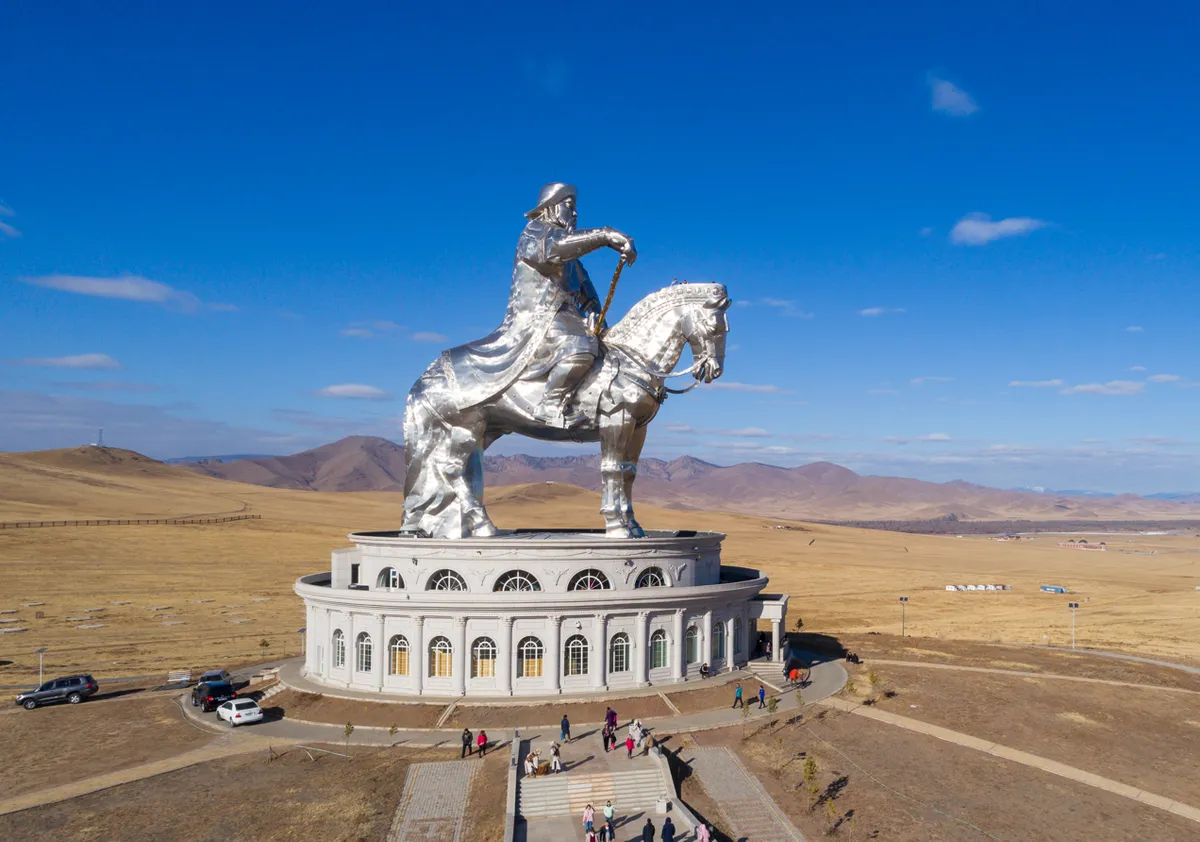
A big statue for the Big Man himself: Genghis Khan.

Are 1 In 200 Men Descended From Genghis Khan? New DNA Evidence Says Maybe Not

February 25, 2026

The Myth and Mystery of Genghis Khan’s Genetic Legacy

It’s widely cited that about 1 in 200 men worldwide (0.5% of all men) are direct male-line descendants of Genghis Khan, making him their 25th-great-grandfather. But recent genetic studies suggest the story may be more complicated than this simple statistic implies.

A Mongol Empire of Massive Reach

Born in 1162 CE, Genghis Khan founded the Mongol Empire, which eventually became the largest contiguous land empire in history, stretching from the Sea of Japan to Eastern Europe. His campaigns caused immense death, yet also facilitated the Pax Mongolica, stabilizing trade along the Silk Road and enabling a massive exchange of goods, technology, and ideas across Eurasia.

The empire’s scale and the prolific reproduction of Genghis Khan and his male descendants made it plausible that his Y-chromosome lineage spread widely.

The C3* Y-Chromosome Connection

A 2003 study found that roughly 8% of men in Central Asia share a particular Y-chromosome lineage called the C3 cluster*, also present across East and Southeast Asia, parts of Eastern Europe, Siberia, and even some Native American populations.

This lineage appears to have originated in modern-day Mongolia around 1,000 years ago, coinciding with the Mongol Empire’s rise. The study suggested that this spread might reflect social selection: elite males fathering large numbers of children across conquered territories.

Ancient DNA Adds Complexity

A new study analyzed DNA from ruling elites of the Golden Horde, founded by Genghis Khan’s eldest son, Jochi. Researchers examined four individuals from elite tombs, including one traditionally attributed to Jochi.

  • The three male individuals were paternally related and belonged to the C3 haplogroup*.

  • However, the branch they carried is a rare sub-lineage of C3*, distinct from the dominant modern version widely attributed to Genghis Khan.

As UW–Madison geneticist John Hawks explained, the most common C3 Y-chromosome today may not be directly linked to Genghis Khan*, but rather to a related paternal line that also expanded during or before the Mongol era.

The Challenge of Genghis Khan’s Tomb

Without DNA from Genghis Khan himself, confirming the exact lineage is impossible. His burial site, often said to be at Burkhan Khaldun in the Khentii Mountains of Mongolia, remains undiscovered and steeped in legend.

Until his remains are found – if ever – the true scale and nature of Genghis Khan’s genetic legacy may remain a mix of historical fact, inference, and myth.
← Iraqi Kurdistan discovers 1,400-year-old cemeteryArcheological site with over 100 skulls discovered in Erbil →
Featured
image_2026-02-25_235113742.png
Feb 25, 2026
Rare Roman treasure found by metal detectorists
Feb 25, 2026
Read More →
Feb 25, 2026
image_2026-02-25_231102835.png
Feb 25, 2026
Iraqi Kurdistan discovers 1,400-year-old cemetery
Feb 25, 2026
Read More →
Feb 25, 2026
image_2026-02-25_225034080.png
Feb 25, 2026
Are 1 In 200 Men Descended From Genghis Khan? New DNA Evidence Says Maybe Not
Feb 25, 2026
Read More →
Feb 25, 2026
image_2026-02-25_223300237.png
Feb 25, 2026
Archeological site with over 100 skulls discovered in Erbil
Feb 25, 2026
Read More →
Feb 25, 2026
image_2026-02-25_221606695.png
Feb 25, 2026
1,000-Year-Old Chimú “Sacred Road” and Temple Complex Discovered in Northern Peru
Feb 25, 2026
Read More →
Feb 25, 2026
image_2026-02-25_220048869.png
Feb 25, 2026
Ancient tombs packed with pottery and jewelry unearthed from Egyptian necropolis
Feb 25, 2026
Read More →
Feb 25, 2026
read more

Powered by The archaeologist