The study of Aztec human sacrifice is a classic example of how archaeology can act as a corrective to historical bias. For centuries, our understanding was shaped almost entirely by Spanish Colonial accounts (like those of Bernal Díaz del Castillo or Hernán Cortés) and post-conquest codices. These sources often framed the Aztecs as bloodthirsty savages to justify the "civilizing" mission of the Spanish conquest.
Modern bioarchaeology and the ongoing excavations at the Templo Mayor in Mexico City are finally allowing us to separate the "Black Legend" propaganda from the ritual reality.
1. The Scale: Massive Slaughter or Ritual Precision?
The Propaganda: Spanish chroniclers claimed that during the rededication of the Templo Mayor in 1487, over 80,000 people were sacrificed in just four days.
The Fact: Logistically, this is impossible—it would require killing 14 people per minute, 24 hours a day. While archaeology confirms that sacrifice happened on a large scale, the numbers were likely in the low thousands per year. The discovery of the Huey Tzompantli (Great Skull Rack) in 2015 revealed roughly 650 skulls in one section; while significant, it suggests a more controlled, albeit constant, ritual cycle rather than a random massacre.
2. The Victims: Captives vs. Citizens
The Propaganda: Early accounts suggested the Aztecs sacrificed only their own people or innocent neighbors through "Flowery Wars" purely for the sake of blood.
The Fact: Isotopic analysis of the teeth found at the Templo Mayor shows that a vast majority of the victims were not local to the Valley of Mexico. They were often captured warriors or elite tributes from distant regions. Sacrifice was a sophisticated tool of psychological warfare used to intimidate subjugated provinces and demonstrate the absolute power of the Aztec state.
3. The Method: "Savage" Killing vs. Surgical Anatomy
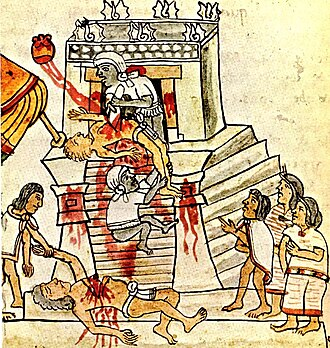
The Propaganda: Many depictions show priests clumsily hacking at chests with dull stones.
The Fact: Analysis of the skeletal remains shows incredible anatomical knowledge.
The Cut: Marks on the sternum and vertebrae show that priests used razor-sharp obsidian blades.
Precision: The cuts were often made through the soft tissue below the ribcage or via a precise thoracotomy (cutting through the ribs) to allow for the rapid extraction of the heart. The "cleanliness" of the bone fractures suggests a practiced, surgical speed that would be impossible for an untrained person.
4. The "Why": Cruelty vs. Cosmological Debt
The Propaganda: Sacrifice was portrayed as a sign of a "devil-worshipping" culture that enjoyed death.
The Fact: To the Aztecs, sacrifice was a legal and religious obligation called nextlaualli (debt payment).
They believed the gods had sacrificed themselves to create the world and the sun.
Human blood was seen as the "sacred water" (chalchiuatl) required to repay that debt and keep the universe from collapsing. It was a terrifying but essential act of maintenance, not a display of cruelty.
5. The Templo Mayor: A Sacred Map
The architecture of the Templo Mayor itself proves that sacrifice was a reenactment of myth. The temple had two sides: one dedicated to Tlaloc (God of Rain) and one to Huitzilopochtli (God of War).
At the base of the Huitzilopochtli side, archaeologists found the massive Coyolxauhqui Stone.
Victims were sacrificed at the top and their bodies cast down the stairs, landing on this stone—ritually reenacting the myth where the sun god defeated his sister and cast her body down a mountain.
By comparing the physical evidence of the bones with the exaggerated claims of the Spanish, we see a culture that used ritual violence as a highly organized, state-sponsored tool for both cosmic and political stability.