The site of Tell es-Sultan, better known as Jericho, is an archaeological marvel that challenges our understanding of human civilization. Located in the Jordan Valley, it is widely considered the oldest continuously inhabited city on earth. While its famous biblical walls capture the imagination, the archaeological reality reveals a story of Neolithic engineering that predates the invention of writing by thousands of years.
1. The Pre-Pottery Neolithic Fortifications (c. 8000 BCE)
Long before the Bronze Age, the inhabitants of Jericho constructed a fortification system that was unprecedented for its time.
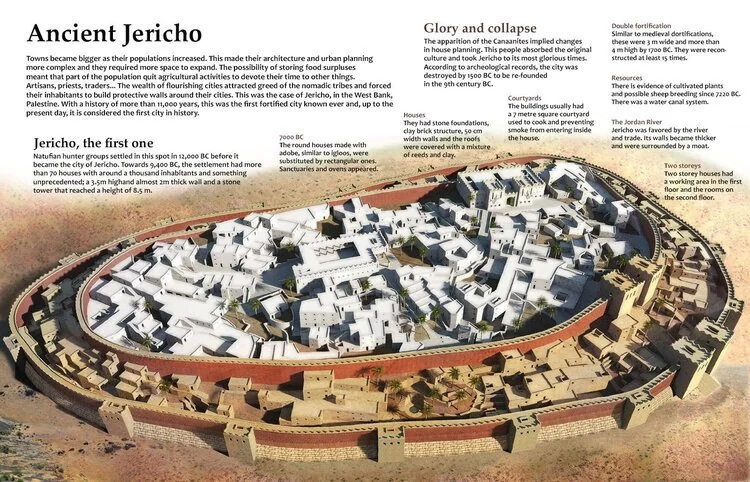
The Wall: Archaeologists found a massive stone wall standing over 3.5 meters high and 1.8 meters thick at its base. It was constructed of undressed stones, yet it was sturdy enough to protect a community of approximately 2,000 people.
The Ditch: To further bolster their defenses, the builders hacked a ditch out of solid bedrock, measuring roughly 8.2 meters wide and 2.7 meters deep. This was accomplished using only stone and antler tools.
2. The Tower of Jericho: A Mystery in Stone
The most striking feature of the Neolithic site is the Tower of Jericho. Standing nearly 8.5 meters tall, this conical stone structure is one of the oldest man-made monuments in the world.
Internal Staircase: The tower contains a remarkably preserved internal staircase with 22 stone steps.
The Purpose: While once thought to be purely military, modern archaeologists suggest it may have served a dual purpose. Recent studies show that on the summer solstice, the shadow of nearby mountains falls directly onto the tower before engulfing the entire settlement, suggesting it was an astronomical marker or a symbol of community power and prestige.
3. The Bronze Age Walls and the Biblical Tradition
By the Middle Bronze Age (c. 1700–1550 BCE), Jericho had become a heavily fortified Canaanite city-state. This is the era most often associated with the biblical story of Joshua.
The Revetment Wall: The city was surrounded by a massive "glacis" (a steep, plastered slope) held up by a stone revetment wall nearly 5 meters high. On top of this sat a secondary wall made of mudbricks.
The Collapse: Excavations by Kathleen Kenyon in the 1950s revealed that these mudbrick walls had indeed collapsed outward, creating a "ramp" of debris that could allow an invader to climb into the city.
The Burn Layer: A thick layer of ash and charred grain was found across the site, indicating the city was destroyed by a massive fire. However, the dating of this destruction remains a point of intense scholarly debate, with most archaeologists placing it around 1550 BCE—significantly earlier than the traditional biblical timeline.
4. Why Build Walls? The Environmental Theory
While defense against invaders is the obvious answer, some archaeologists, including Kenyon, suggested a different motivation: The Nile of Palestine.
Flash Floods: Jericho is situated near the Ein es-Sultan spring. The "walls" might have originally functioned as flood barriers to protect the settlement from torrential mudflows coming off the Judean hills.
The Evolution of Defense: Over centuries, what began as a functional flood wall likely evolved into a defensive fortification as the city's wealth (driven by the spring's fertility) made it a target for nomadic tribes.
5. The Plastered Skulls: Ancestor Worship
Inside the city, archaeologists discovered a unique cultural practice: plastered human skulls. The inhabitants would remove the skulls of the deceased, fill them with clay, and model lifelike features—complete with shells for eyes—over the bone.
Social Memory: These skulls were kept inside homes, suggesting that the "walls" of the city didn't just protect the living, but also served to define a sacred space for the ancestors, rooting the community to that specific patch of desert for millennia.
The layers of Jericho act like a vertical timeline of human ingenuity, from the first stone-age masons to the fall of the Canaanite kings.