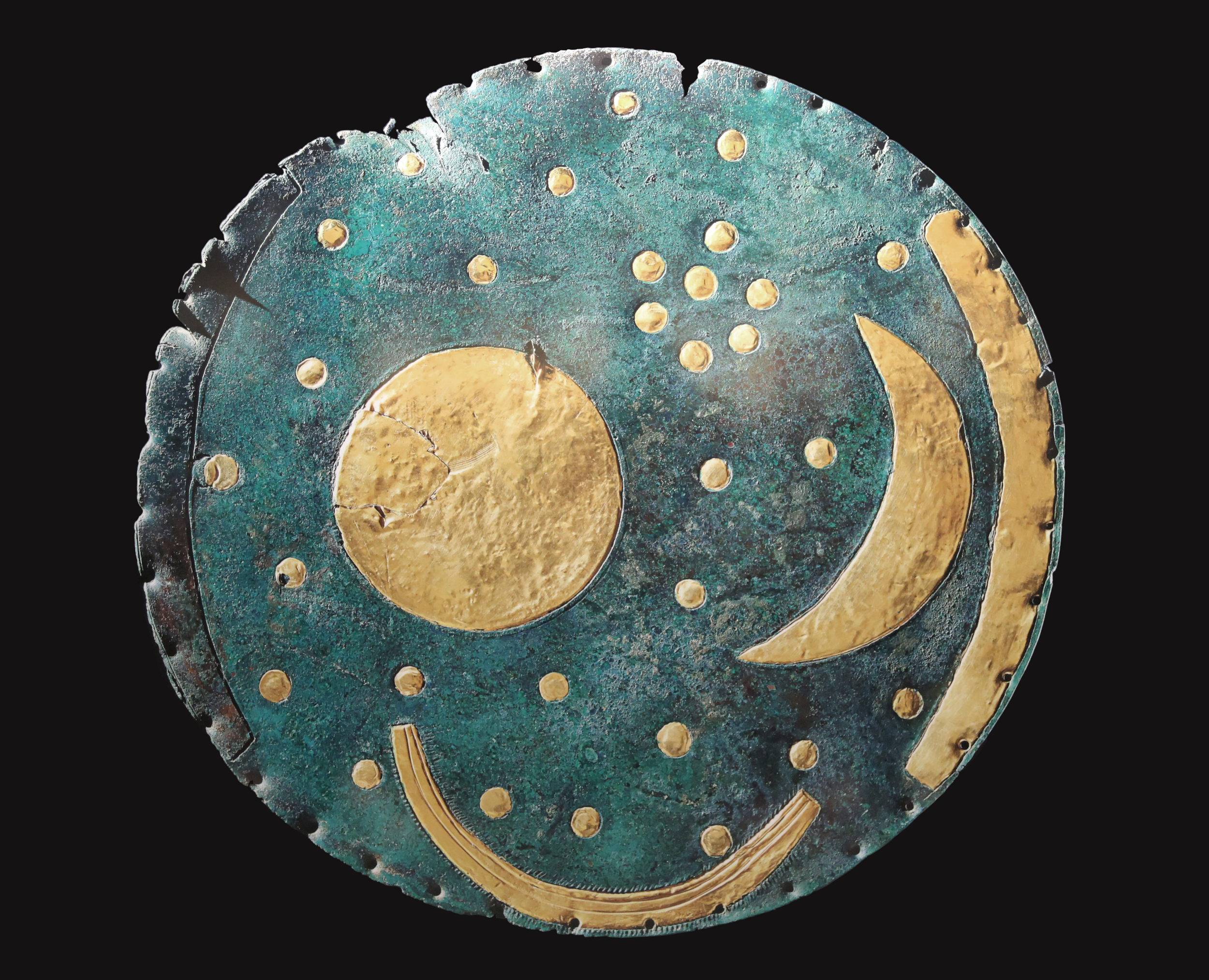
The Nebra Sky Disc is one of the most significant archaeological discoveries of the 21st century. Found in 1999 near the town of Nebra in Germany, this bronze disc—roughly 30 centimeters in diameter and weighing 2 kilograms—dates to approximately 1600 BCE.
It represents the oldest known "concrete" depiction of cosmic phenomena, serving not just as a piece of art, but as a sophisticated astronomical tool used by the Unetice culture of the European Bronze Age.
1. The Celestial Map: Decoding the Symbols
The disc is made of bronze and features gold-leaf inlays that represent specific celestial bodies.
The Sun and Moon: A large gold circle is widely interpreted as the Sun (or potentially a full moon), while a gold crescent represents the Moon in its fifth day of visibility.
The Pleiades: A cluster of seven gold dots is almost certainly the Pleiades star cluster. In the ancient world, the Pleiades were a crucial "agricultural clock"—their appearance in the sky signaled the start of the harvest and their disappearance signaled the time for planting.
The Horizon Arcs: Two curved gold bands along the edges (one is missing) represent the solstices. The angle between the ends of these arcs (roughly 82.5°) perfectly matches the angle between the sunset points of the summer and winter solstices at the specific latitude where the disc was found.
2. The Function: A Portable Calendar
Archaeologists and astronomers believe the disc was an intercalary tool.
Because a lunar year is about 11 days shorter than a solar year, ancient societies struggled to keep their calendars aligned with the seasons. The Nebra Sky Disc provided a visual rule:
The Rule: If the crescent moon appeared next to the Pleiades when the moon was exactly in its third or fifth day of the month, a leap month (intercalary month) had to be added to the year to sync the calendar back with the sun.
This allowed Bronze Age farmers to predict the correct times for sowing and harvesting with scientific precision.
3. Global Trade in the Bronze Age
The disc is a testament to the vast trade networks of the 2nd millennium BCE. Through chemical analysis of the metals, researchers have traced the "DNA" of the disc:
Copper: Originated from the Mitterberg region in Austria.
Gold and Tin: Both were traced to Cornwall, England.
Craftsmanship: The disc was found in Germany.
This proves that even 3,600 years ago, Europe was connected by high-speed trade routes where raw materials and complex astronomical knowledge traveled thousands of miles.
4. The Final Phase: The Solar Boat
Later in its life, a final gold inlay was added: a curved arc at the bottom with small "oar" markings. This is interpreted as a Solar Boat.
This reflects a shift in religious thought. The boat represents the myth that the sun travels across the sky by day and is carried through the underworld by a boat at night. This same motif is found in Ancient Egyptian and Nordic mythologies, showing a shared European-Mediterranean religious consciousness.
5. The Archaeological Cold Case
The disc was originally found by illegal treasure hunters with a metal detector. Because it wasn't excavated by professional archaeologists in its original "context," many scholars initially thought it was a forgery. It was only after a high-stakes sting operation by the Swiss police and subsequent laboratory testing of the soil and metal patina that its authenticity was confirmed.