Introduction
Blombos Cave, located along the southern Cape coast of South Africa, is one of the world's most important archaeological sites for studying the development of symbolic behavior.
The cave is particularly famous for engraved ochre pieces, beads, bone tools, and other Middle Stone Age artifacts.
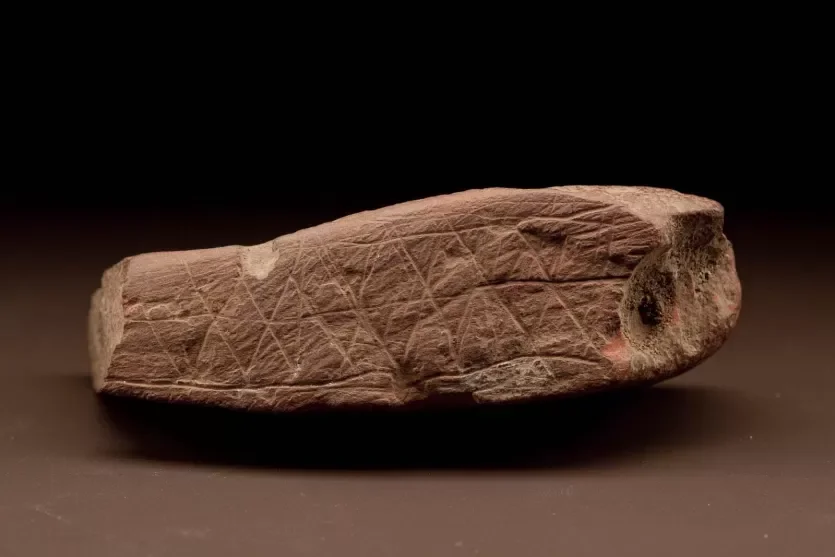
Among the most celebrated discoveries are ochre plaques bearing geometric engravings dating to approximately 75,000 years ago.
The Smithsonian Human Origins Program dates a famous engraved Blombos ochre plaque to approximately 77,000–75,000 years ago and notes that its organized markings may have represented information rather than simple decoration.
What Is Ochre?
Ochre is a naturally occurring earth pigment containing iron minerals.
It can produce red, yellow, brown, and orange colors.
Prehistoric people used ochre for numerous purposes.
It could be applied to skin.
It could be used to color objects.
It could be incorporated into adhesives.
It may have been used in symbolic practices.
Therefore, the discovery of ochre alone does not necessarily prove artistic behavior.
The Engraved Plaques
The Blombos engravings are more significant because the marks are deliberate and organized.
Some consist of intersecting lines forming geometric patterns.
The repetition suggests that the markings were intentionally produced.
Researchers have debated what they meant.
They could have been decorative.
They could have communicated identity.
They could have represented information.
They might have served social or ritual functions.
No single interpretation is universally accepted.
Symbolic Behavior
Symbolic behavior involves using an object, mark, sound, or action to represent something beyond its immediate physical function.
This is difficult to identify archaeologically.
A geometric mark does not automatically reveal its meaning.
However, repeated standardized designs suggest that cultural conventions may have existed.
That possibility makes Blombos extraordinarily important.
Beads
Blombos has also produced shell beads.
Personal ornaments are particularly significant because they may communicate social identity.
People can use beads to indicate membership in a group, age category, social status, or personal identity.
The archaeological evidence cannot always identify the exact meaning.
But the existence of repeated ornament traditions demonstrates that objects could have social significance.
Bone Tools
Bone tools from Blombos provide additional evidence of technological sophistication.
Bone is more difficult to preserve than stone.
Its survival at the site provides a rare opportunity to study organic technology.
Bone points and other implements reveal that Middle Stone Age people worked multiple materials.
The Coastal Environment
Blombos is located near a productive marine environment.
Shellfish, fish, and terrestrial resources could all be exploited.
The cave's inhabitants were therefore operating within a diverse ecological system.
Technological Planning
Some Blombos artifacts reveal multiple stages of production.
Raw materials had to be collected.
Stone had to be selected.
Ochre had to be processed.
Tools had to be manufactured.
Adhesive technologies may have required mixing different substances.
These processes imply planning beyond immediate survival.
Dating
The age of Blombos artifacts is important because it places symbolic behavior deep in the Middle Stone Age.
The famous engraved ochre pieces are roughly 75,000 years old.
This means deliberate marking and ornamentation were present long before the emergence of many later archaeological traditions.
Was Blombos the Beginning of Art?
It would be misleading to describe Blombos as the place where art "began."
Older evidence for pigment use and possible symbolic behavior exists elsewhere in Africa.
Blombos instead provides unusually clear evidence for intentional marking.
It is therefore one important chapter in a much longer history of symbolic behavior.
Archaeological Context
Context is critical.
The engravings were found within controlled archaeological deposits.
Researchers can examine their association with tools, shells, animal remains, hearths, and other materials.
This allows the artifacts to be interpreted as part of a living community rather than isolated curiosities.
Conclusion
Blombos Cave provides some of the strongest evidence for symbolic material culture in the Middle Stone Age.
Its engraved ochre pieces, beads, bone tools, and other artifacts demonstrate that humans living around 75,000 years ago manipulated objects in increasingly complex ways.
The cave does not reveal the exact meaning of every mark.
But it demonstrates something profound: long before written language, people were creating material signs that may have carried information, identity, or cultural meaning.