Introduction
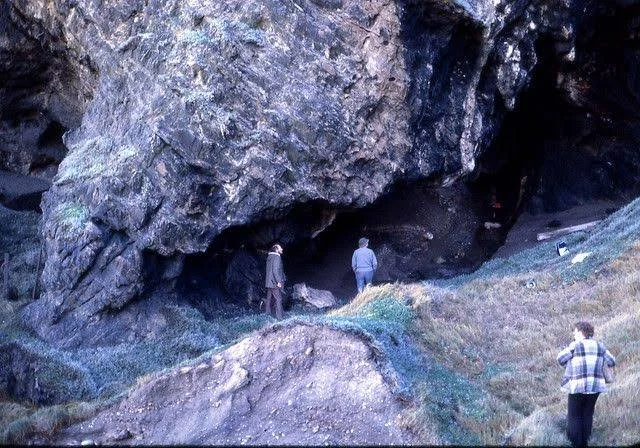
The Klasies River caves on South Africa's southern coast are among the most important sites for understanding the emergence and early history of Homo sapiens.
The caves contain Middle Stone Age archaeological deposits, human remains, animal bones, shellfish, hearths, and stone tools.
Their importance is especially strong because the archaeological sequence demonstrates repeated occupation by populations of anatomically modern humans and provides evidence for sophisticated coastal adaptation.
However, the title "Modern Human Origin" should not be interpreted as meaning that modern humans originated exclusively at Klasies River.
Human evolution was an African process involving populations across the continent.
Klasies River represents one important region within that larger story.
The Southern Cape
Klasies River lies along South Africa's southern coast.
The region provides access to marine resources, terrestrial animals, plants, and freshwater.
This ecological diversity made the coastline an attractive environment for prehistoric hunter-gatherers.
Human Remains
Klasies River has produced human remains associated with Middle Stone Age deposits.
These remains have been important in discussions about the emergence of anatomically modern humans.
Research has emphasized that some Klasies River specimens display a mixture of anatomical characteristics rather than fitting perfectly into simplistic categories.
One scholarly review notes that Klasies River remains dating to roughly 130,000 years ago display a mosaic of archaic and modern anatomical traits.
The Meaning of "Modern"
"Modern human" can mean different things.
Biologically, it may refer to anatomical characteristics associated with Homo sapiens.
Behaviorally, researchers may discuss traits such as symbolism, long-distance exchange, complex tools, and social organization.
These categories do not necessarily appear at the same time.
A population can be anatomically modern while still displaying cultural behaviors that differ from those of later societies.
Coastal Resources
Klasies River provides important evidence for the use of marine resources.
Shellfish were collected along the coast.
Marine foods expanded the available nutritional resource base.
Coastal environments could therefore provide reliable resources during periods when terrestrial foods became less predictable.
Shell Middens
Accumulations of shellfish remains form archaeological deposits known as shell middens.
These are not simply garbage heaps.
They preserve evidence about diet, seasonality, coastal ecology, and human behavior.
Species composition can reveal what people collected.
Shell size can sometimes provide information about environmental conditions.
Burning patterns can indicate cooking.
Hearths
Fireplaces occur throughout the archaeological sequence.
Hearths reveal repeated occupation.
Burned bones demonstrate cooking or other activities.
Charcoal can provide evidence for fuel selection and vegetation.
Fire also structured social activity.
People gathered around it for cooking, warmth, tool production, and social interaction.
Stone Tools
The Middle Stone Age tools at Klasies River demonstrate sophisticated stone-working strategies.
People selected appropriate raw materials.
They shaped cores.
They produced flakes and points.
They maintained tool edges.
Technological traditions changed through time.
Hunting
Animal remains reveal terrestrial hunting and scavenging.
Butchery marks can provide evidence of carcass processing.
Cut marks indicate contact with stone tools.
Burned bones may indicate cooking.
Together, these traces allow researchers to reconstruct subsistence.
Climate and Coastal Adaptation
The southern Cape experienced major climatic fluctuations during the Pleistocene.
Sea levels changed.
The coastline moved.
Vegetation shifted.
Yet humans repeatedly returned to the region.
This suggests considerable ecological flexibility.
Human Origins
The broader question of modern human origins cannot be reduced to one cave.
Africa contained multiple populations of Homo sapiens and closely related populations.
Gene flow and population movement likely occurred across large geographic areas.
Southern Africa was therefore one important part of a continental evolutionary landscape.
Cultural Significance
Klasies River is also significant because it helps demonstrate that sophisticated behavior was present among Middle Stone Age populations.
People organized their diets.
Used fire.
Made complex tools.
Exploited marine resources.
Maintained repeated occupation of coastal landscapes.
These behaviors demonstrate planning and ecological knowledge.
Conclusion
Klasies River Caves are among the most important sites for understanding early Homo sapiens in Africa.
They provide evidence of anatomically modern humans, complex Middle Stone Age technology, marine resource exploitation, fire use, hunting, and repeated occupation.
Rather than representing a single "birthplace" of modern humanity, Klasies River should be understood as one of several crucial African archives documenting the emergence and development of our species.