Introduction
Border Cave, located near the border between South Africa and Eswatini, is one of the most important archaeological sites for understanding human behavioral evolution in southern Africa.
The cave preserves an unusually long sequence of occupation.
Its archaeological deposits include stone tools, animal remains, plant materials, hearths, ornaments, human remains, and other evidence of repeated human activity.
The site is particularly valuable because it demonstrates that sophisticated human behavior developed through a long process rather than appearing suddenly during one brief "revolution."
Location and Environment
Border Cave lies within a mountainous landscape close to the Lebombo Mountains.
Its position gave prehistoric communities access to a diverse range of ecological resources.
The surrounding region included grasslands, woodland, rocky environments, and water sources.
This ecological diversity contributed to the site's long-term attractiveness.
Deep Occupation
The archaeological sequence at Border Cave extends deep into the Middle Stone Age and later periods.
Researchers have recovered evidence spanning well over 100,000 years.
The title's "200,000-year sequence" is therefore best understood as referring to the site's exceptionally long archaeological record rather than a single continuous occupation without interruptions.
Human groups came and went.
Different technologies appeared.
Environmental conditions changed.
Human Remains
Border Cave has produced several human remains.
These are important because skeletal evidence can be compared with archaeological material found in the same broader sequence.
The association between human biology and cultural behavior is central to understanding evolution.
Stone Tools
Stone artifacts at Border Cave document technological change.
Early Middle Stone Age technologies differ from later industries.
Changes in tool production reveal shifts in raw-material selection, reduction strategies, and tool design.
Technology can therefore act as a chronological marker.
Fire
Hearths are among the most important archaeological features.
Controlled fire provided heat, light, protection, and cooking.
Fire also changed the nutritional value of foods and allowed people to occupy colder environments.
Repeated hearths demonstrate that caves were used as organized living spaces.
Food
Animal remains provide evidence of hunting and consumption.
Plant remains can sometimes survive through microscopic or chemical traces.
Together, these materials allow researchers to reconstruct subsistence strategies.
The people who used Border Cave were not dependent on one resource.
They exploited diverse foods.
Symbolic Objects
One of the most important aspects of Border Cave is its evidence for symbolic behavior.
Objects such as ornaments can indicate social communication.
However, symbolism should not be reduced to a simple definition such as "art."
Symbolic behavior can include identity, social affiliation, personal decoration, ritual activity, information exchange, and cultural traditions.
Organic Technology
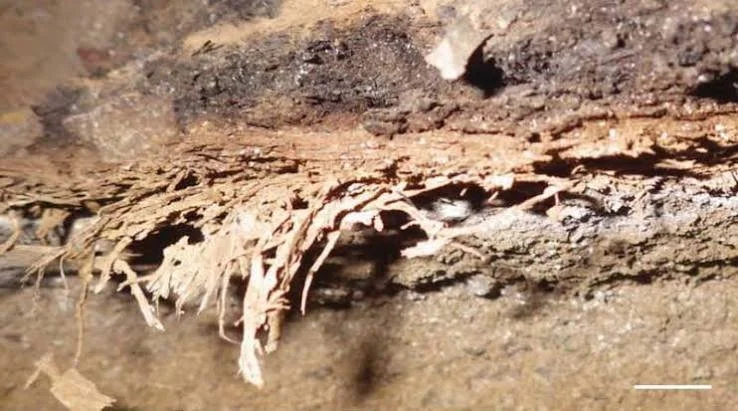
Organic materials are often missing from archaeological sites because wood, fibers, and skin decay.
Border Cave's preservation conditions have occasionally allowed unusually informative organic remains to survive.
These materials can provide evidence of technologies that stone artifacts alone cannot reveal.
Changing Technology
Over tens of thousands of years, people changed how they made tools.
This included alterations in stone selection, flaking techniques, tool forms, and composite technologies.
Composite tools are particularly important because they combine multiple materials.
A stone point may have been attached to wood.
Adhesives may have been used.
Binding materials may have held components together.
Such technologies require planning.
Human Evolution
Border Cave contributes to the debate about the emergence of modern human behavior.
Rather than assuming that "modern behavior" appeared suddenly, researchers can observe a long sequence of experimentation.
People increasingly manipulated diverse materials.
They created personal ornaments.
They used fire systematically.
They developed specialized tools.
These behaviors reveal growing technological flexibility.
Climate Change
The site's long sequence also records environmental fluctuations.
Southern Africa experienced repeated climatic changes during the Pleistocene.
Periods of colder or drier conditions altered vegetation and animal populations.
Human communities adapted to these changes.
This makes Border Cave important not only for archaeology but also for paleoenvironmental reconstruction.
Conclusion
Border Cave is valuable because it preserves a long record of human adaptation.
Its archaeology shows that technology, subsistence, fire use, and symbolic behavior developed through extended periods of experimentation.
Rather than revealing one dramatic moment when humans suddenly became "modern," Border Cave documents a long and complicated process of biological and cultural change.