Introduction
Makapansgat, located in South Africa's Limpopo Province, is one of the most important archaeological and paleoanthropological landscapes associated with early hominin evolution.
The site belongs to the broader Makapan Valley, which contains caves and deposits preserving evidence of hominins, animals, environmental change, and early technological behavior.
UNESCO identifies Makapan Valley as part of the Fossil Hominid Sites of South Africa and notes archaeological and evolutionary evidence extending to approximately 3.3 million years ago.
The title "3M-Year-Old Tools" requires an important qualification, however. Very early stone artifacts around three million years old are now known from Africa, but identifying the exact toolmaker is difficult, and the evidence traditionally associated with Makapansgat includes objects whose intentional manufacture and interpretation have been debated.
Makapan Valley
The Makapan Valley contains multiple cave sites.
These sites formed through geological processes involving limestone and groundwater.
Over long periods, caves accumulated sediments, animal remains, and other materials.
The result is a complex stratigraphic record.
Early Hominins
Makapansgat has produced fossil evidence of early australopithecines.
These fossils are important because they demonstrate that hominins were living in southern Africa millions of years ago.
The region therefore contributes to a broader understanding of the geographic distribution of early hominins.
The Famous Pebble
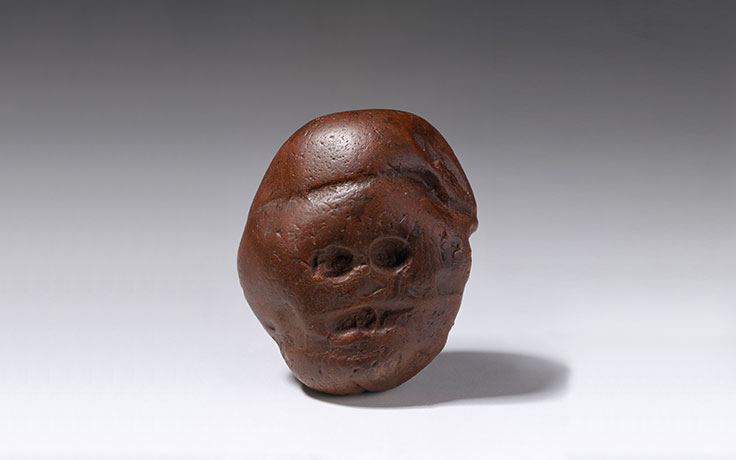
Makapansgat is particularly famous for a reddish-brown stone sometimes called the "Makapansgat pebble."
The object has naturally occurring patterns that some researchers argued resemble a face or animal-like form.
This led to speculation that an australopithecin may have selected it because of its visual resemblance.
Such interpretations are fascinating but controversial.
Natural Object or Artifact?
Archaeologists distinguish between naturally modified objects and intentionally manufactured artifacts.
A stone can look meaningful to a modern observer without having been intentionally selected by a prehistoric person.
To demonstrate deliberate selection, researchers ideally need evidence of:
unusual location;
repeated selection;
modification;
transport;
associated artifacts;
use-wear;
archaeological context.
The Makapansgat pebble does not provide an unambiguous demonstration of symbolic thought.
The Problem of Pareidolia
Humans naturally recognize familiar forms in random patterns.
We see faces in clouds, rocks, shadows, and stains.
This phenomenon is called pareidolia.
Because prehistoric objects are interpreted through modern perception, archaeologists must be particularly cautious when claiming that a naturally shaped object had symbolic significance.
Stone Technology in Deep Time
The broader question of early stone technology is nevertheless extremely important.
The archaeological record now demonstrates that stone toolmaking is older than many twentieth-century scholars once believed.
The Smithsonian notes that the earliest known stone tools currently extend to approximately 3.3 million years ago.
This means technological behavior appeared much earlier than the genus Homo.
Who Made the Earliest Tools?
This remains one of the major questions.
Multiple hominin species lived in Africa during the period when early stone tools appeared.
The discovery of approximately three-million-year-old tools in Kenya, for example, has reinforced the possibility that hominins other than early Homo may have been capable of toolmaking. The Smithsonian notes that determining which hominin species made early tools is difficult because several hominins could occupy the same landscape.
The same caution applies when interpreting southern African evidence.
Makapansgat and Behavior
Makapansgat is valuable because it provides an opportunity to study early hominin behavior at a time when anatomical evolution and technological evolution were both changing.
The site helps researchers ask broader questions:
How early did hominins manipulate objects?
When did stone technology become systematic?
When did selection of unusual objects become meaningful?
When did symbolic behavior emerge?
These questions cannot always be answered by one artifact.
Cave Stratigraphy
Makapansgat's importance also lies in its geological record.
Different layers preserve different periods.
Researchers can examine sediment composition, animal fossils, environmental indicators, and hominin remains together.
This creates a chronological framework for interpreting behavior.
Climate and Environment
Three million years ago, southern Africa was not identical to the modern landscape.
Vegetation patterns shifted over time.
Large mammals inhabited different ecological zones.
Climate fluctuations influenced resource availability.
Hominins adapted to these changing environments.
Archaeological Method
The history of Makapansgat illustrates why archaeology requires careful distinction between observation and interpretation.
An object can be described objectively.
Its possible purpose is an interpretation.
Its symbolic meaning is an even more difficult interpretation.
Good archaeological scholarship keeps these levels separate.
Conclusion
Makapansgat is an important window into the deep history of southern African hominins.
The site is associated with some of the earliest evidence relevant to questions of object selection and technological behavior, but claims about three-million-year-old tools or symbolic artifacts must be treated carefully.
Its real importance lies in the broader record: Makapan Valley preserves evidence of hominin evolution extending millions of years and contributes to the increasingly complex picture of how early humans and their relatives interacted with their environments.