Introduction
In the rugged landscape of central Utah's San Rafael Swell, the sandstone walls of Buckhorn Wash preserve one of the region's most impressive concentrations of ancient rock imagery. The canyon is particularly famous for a large panel containing human and animal figures associated with ancient Indigenous traditions.
Buckhorn Wash demonstrates why rock art is so important to Southwestern archaeology. These images are not simply decorative paintings on canyon walls. They are archaeological evidence of how people represented themselves, animals, supernatural beings, social identities, and perhaps aspects of their cosmology.
The canyon also illustrates an important archaeological principle: rock art should be understood within its landscape.
The cliffs, water sources, travel routes, shelters, hunting grounds, and archaeological sites surrounding the images all contribute to their meaning.
The San Rafael Swell
Buckhorn Wash lies within the enormous geological formation known as the San Rafael Swell.
The Swell is characterized by dramatic sandstone cliffs, mesas, canyons, ridges, and natural formations created through millions of years of geological processes.
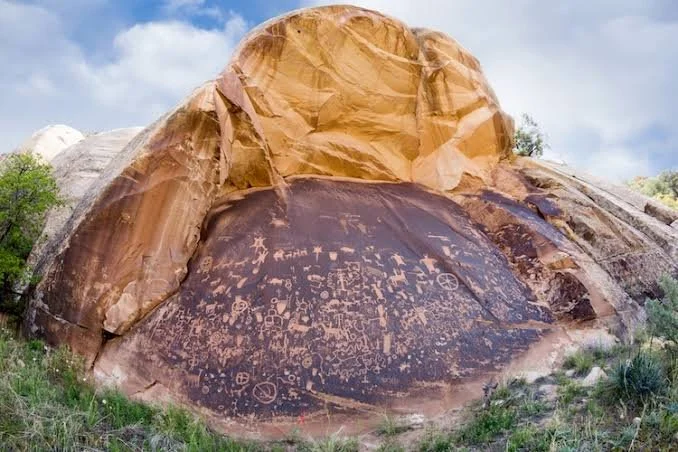
The exposed sandstone provided an ideal canvas for ancient artists.
Its surfaces could preserve both painted images and pecked or carved figures.
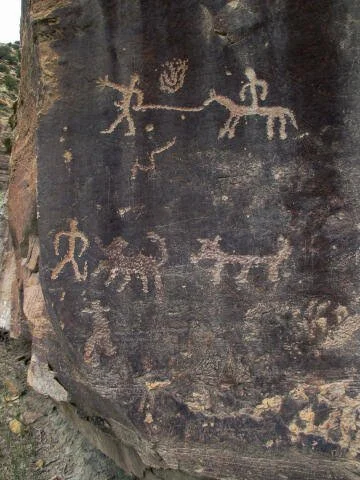
Pictographs and Petroglyphs
The distinction between pictographs and petroglyphs is fundamental.
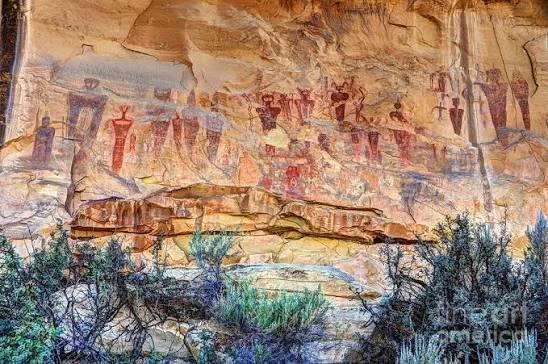
A pictograph is an image applied to a rock surface using pigment.
A petroglyph is created by modifying the rock itself through pecking, carving, scraping, or related techniques.
Buckhorn Wash contains important examples of rock imagery, and the distinction helps archaeologists understand how different images were produced.
Pigments could contain mineral materials such as iron oxides, which produce reddish colors.
Other pigments could produce black, white, or yellow tones.
Organic binders may have helped pigments adhere to rock.
The Buckhorn Wash Panel
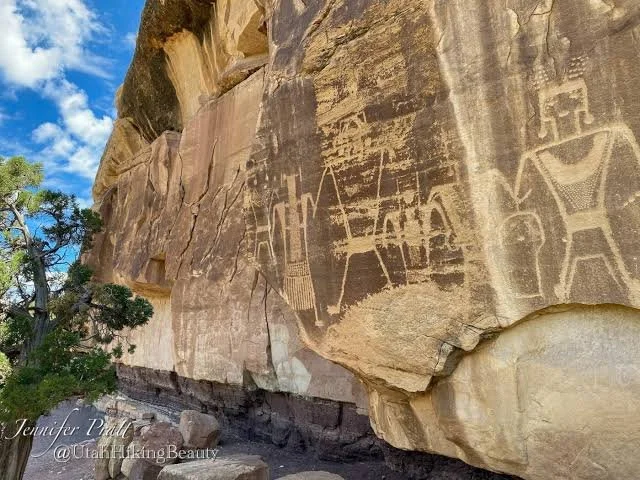
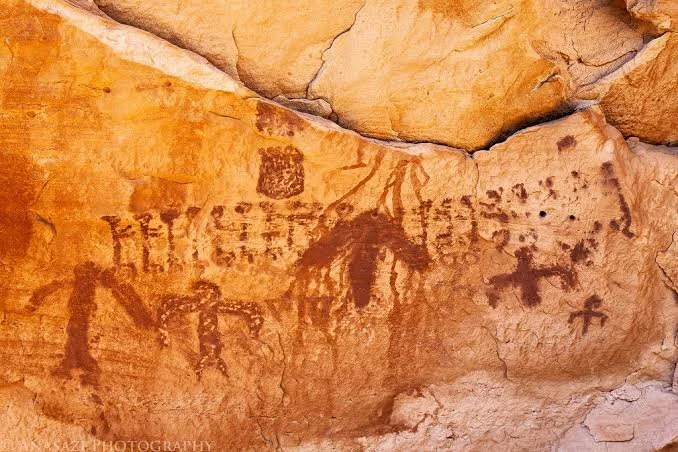
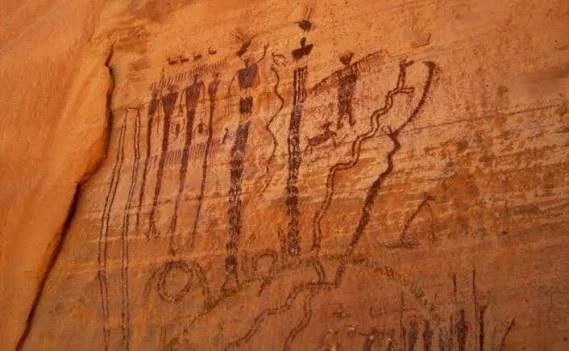
The most famous rock-art panel contains large anthropomorphic figures and animals.
The human figures are visually striking because of their unusual proportions.
Some appear to have elaborate head features.
Others appear alongside animals.
The figures belong to traditions that archaeologists associate with ancient Indigenous populations of the region, including the broader traditions often called Barrier Canyon Style.
Barrier Canyon Style
Barrier Canyon Style rock art is particularly associated with Utah.
Its most recognizable feature is the presence of large anthropomorphic figures with elongated or simplified bodies.
Some figures are nearly life-sized or larger.
They can appear ghostlike to modern observers.
However, the modern word "ghost" should not automatically be interpreted as an ancient meaning.
The figures may have represented supernatural beings, ancestors, ritual participants, or other culturally important concepts.
Their precise meanings remain uncertain.
Why Are the Figures So Large?
Scale may have been significant.
Creating an image several meters high requires substantial effort.
The size would make the image visible from a considerable distance.
This raises questions about audience.
Was the panel intended for people traveling through the canyon?
Was it associated with ceremonial gatherings?
Did the artists deliberately choose the location because of its visibility?
Archaeology cannot always provide definitive answers, but the location itself suggests that the images were meaningful within the landscape.
Dating Buckhorn Wash
Dating rock art is notoriously difficult.
Unlike pottery or wooden structures, rock art often lacks organic material that can be directly dated.
Researchers therefore use several approaches.
These include:
stylistic comparison
superimposition
weathering
pigment analysis
archaeological association
radiocarbon analysis of suitable organic pigment components where available
These methods can produce chronological estimates, but they rarely provide the simple certainty of a tree-ring date.
Fremont Connections
Later Fremont communities also occupied central Utah.
Their rock art is often recognizable by distinctive anthropomorphic figures with trapezoidal bodies and elaborate headdresses.
At Buckhorn Wash and elsewhere in Utah, researchers must therefore distinguish between different artistic traditions.
A single canyon can preserve imagery produced over hundreds or thousands of years.
The Landscape Around the Art
The canyon itself was an important resource.
Water could be found seasonally.
Wild plants grew in suitable locations.
Animals traveled through the surrounding terrain.
Shelters provided protection from weather.
Travelers could follow natural canyon routes.
The rock-art panels therefore existed within a living landscape rather than on an isolated wall.
Archaeological Context
Rock art becomes much more informative when studied alongside nearby archaeological evidence.
A nearby habitation site might reveal what people ate.
A tool scatter might reveal hunting or manufacturing.
A hearth might provide chronological evidence.
A pottery fragment might indicate later occupation.
Together, these materials help establish who used the landscape and when.
Preservation
Pictographs are particularly vulnerable to deterioration.
Water can wash pigment away.
Mineral deposits can obscure images.
Wind erosion can alter rock surfaces.
Biological growth can damage pigments.
Human contact is also a serious problem.
Touching painted surfaces can transfer oils and moisture from skin.
Modern graffiti can permanently destroy archaeological information.
Modern Indigenous Significance
Rock art should not be treated solely as an archaeological curiosity.
The descendants of ancient Indigenous populations continue to live throughout the Southwest.
Places containing ancestral imagery can have cultural significance beyond what archaeology alone can reconstruct.
This makes respectful preservation especially important.
Conclusion
Buckhorn Wash is an extraordinary archaeological landscape because its sandstone walls preserve visual evidence of ancient Indigenous traditions.
The large anthropomorphic figures are among the most striking examples of ancient rock art in Utah.
Yet their greatest importance lies not simply in their appearance.
They demonstrate that ancient people used landscapes as places of communication, memory, ceremony, and identity.
The meaning of the figures may never be fully recoverable.
But the fact that generations of people chose this canyon and these rock surfaces tells us that Buckhorn Wash was more than a route through the desert.
It was a meaningful cultural landscape.