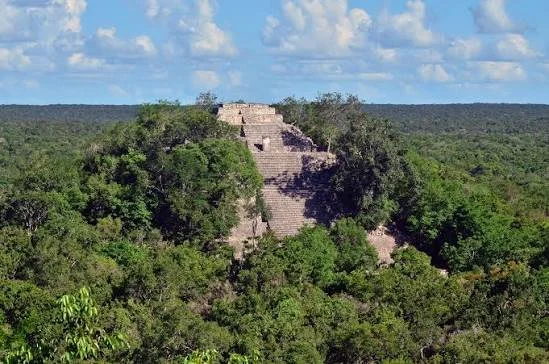
Deep within the Tierras Bajas region of Campeche, Mexico, the ancient ruins of Calakmul lie enveloped by a vast biosphere reserve. During the Classic Maya period (c. 250–900 CE), Calakmul was the capital of the formidable Kaanul Dynasty—the "Kingdom of the Snake"—operating as the direct, bitter rival to Tikal. This city was an expansive, low-density superpower urban center that controlled a vast network of vassal states across the Maya world through strategic marriages, diplomatic gifts, and military force.
The architectural centerpiece of Calakmul is Structure II, one of the largest pyramids ever built by the Maya civilization. This massive temple-pyramid base covers an area of over two hectares and rises 50 meters above the jungle floor, housing multiple elite tombs and structural phases stacked on top of one another across centuries. From the upper terraces of this monument, rulers could look out over the flat canopy, visually confirming their control over the landscape.
What sets Calakmul apart is its immense wealth of historical records. The site has yielded 117 carved stone monuments (stelae), the highest concentration in the Maya area. Although the soft local limestone has suffered significant erosion, advanced epigraphic methods have deciphered these carvings, revealing a detailed history of the Snake Kingdom's geopolitics. The inscriptions detail the exploits of great kings like Yuknoom the Great, who built a complex network of political alliances to encircle and isolate Tikal, showing that Calakmul relied on sophisticated international diplomacy just as much as military strength to maintain its empire.