Introduction
Utah's archaeological landscape contains thousands of rock-art panels, many of which remain difficult to interpret.
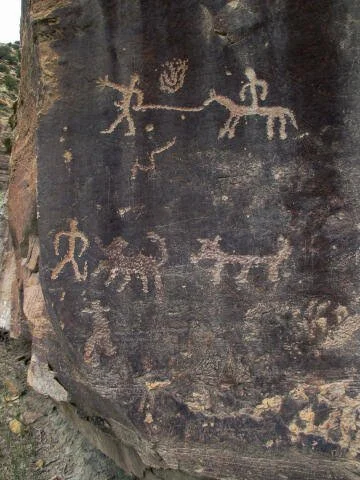
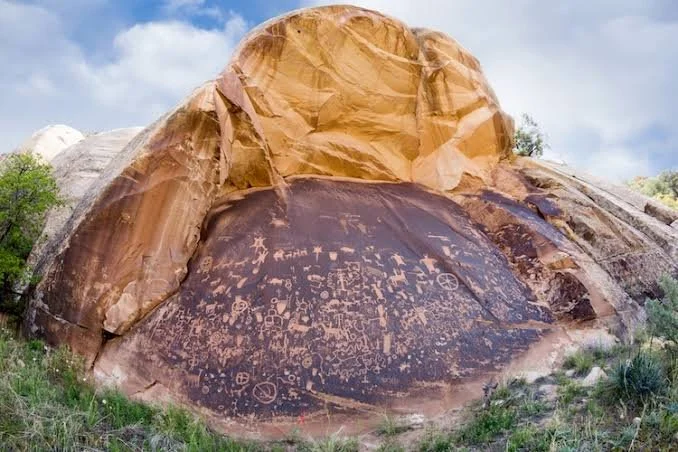
The Camelot Petroglyphs belong to this broader tradition of sandstone imagery in the Colorado Plateau.
The site's importance comes from its figure panels and the wider archaeological landscape in which they occur.
Like other Utah rock-art sites, Camelot demonstrates that ancient Indigenous artists used exposed sandstone surfaces to create images that could communicate identity, animals, social relationships, and ideas that modern archaeology can only partially reconstruct.
Figure Panels
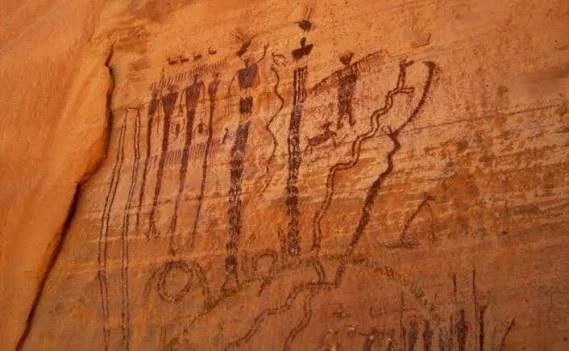
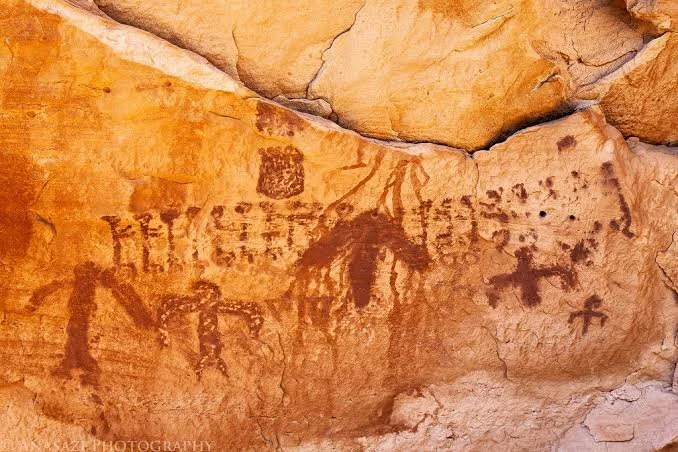
Human and anthropomorphic figures are among the most visually compelling forms of Southwestern rock art.
Some appear realistic.
Others are highly stylized.
Some have exaggerated heads or bodies.
Others are reduced to geometric outlines.
These differences reflect changing artistic traditions.
Fremont Influence
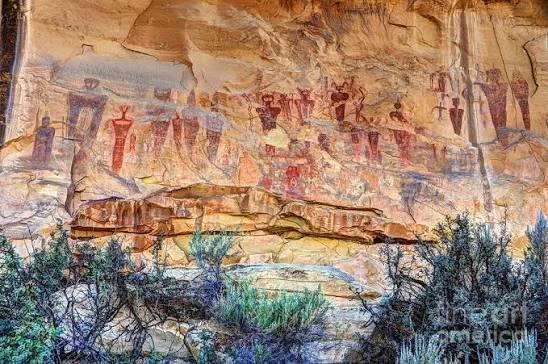
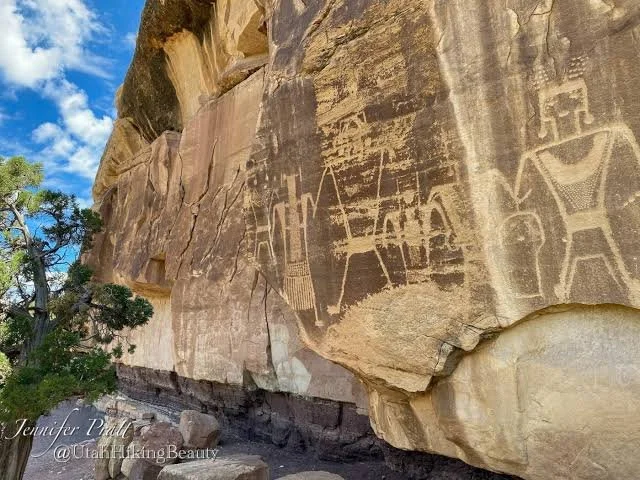
Many anthropomorphic figures in Utah are associated with the Fremont tradition.
The characteristic Fremont figure often has:
trapezoidal body
broad shoulders
narrow waist
large head
elaborate headdress
These features provide archaeologists with useful comparative evidence.
But not every anthropomorphic figure in Utah is necessarily Fremont.
Rock-art styles overlap geographically and chronologically.
Why Create Human Figures?
The answer is uncertain.
Possible interpretations include:
ancestral figures
supernatural beings
ceremonial participants
important individuals
symbolic representations
Archaeologists rarely claim certainty without supporting evidence.
Animals and Humans
When human figures appear alongside animals, interpretation becomes especially complex.
The combination may represent hunting.
It may represent ritual relationships between humans and animals.
It may depict mythology.
Or the images may have been created independently.
Spatial association alone does not prove a narrative connection.
Rock-Art Technology
Creating a petroglyph required physical labor.
Artists had to select an appropriate surface.
They then removed the weathered outer layer using pecking, carving, or abrasion.
The process could take considerable time.
The completed image could remain visible for centuries.
Landscape Selection
The location of a panel was probably important.
Artists had many rock surfaces available.
Choosing one suggests that the place had some significance.
Visibility may have mattered.
Accessibility may have mattered.
Proximity to water or trails may have mattered.
Cultural traditions may also have influenced location.
Dating
Exact dating is difficult.
Researchers rely on:
superimposition
weathering
archaeological association
stylistic comparison
This means dates should often be expressed as approximate ranges rather than precise years.
Preservation
Rock art cannot be replaced once destroyed.
Modern graffiti can erase ancient lines.
Chalk can penetrate porous rock.
Touching can alter surfaces.
Visitors therefore have an important role in preservation.
Conclusion
The Camelot Petroglyphs represent another chapter in Utah's extraordinary rock-art record.
Their figure panels preserve evidence of ancient symbolic activity.
Although archaeologists can study technique, style, chronology, and landscape context, the precise meaning of the figures often remains uncertain.
That uncertainty should not diminish their importance.
Instead, it reminds us that archaeology works with surviving evidence, not complete historical records.
The figures remain powerful precisely because they preserve traces of ideas from cultures whose symbolic systems were not recorded in writing.