Introduction
Southern Utah is famous for landscapes that seem almost otherworldly.
Red cliffs rise above desert valleys.
Sandstone formations create natural arches, fins, hoodoos, and canyons.
But beneath the beauty lies a deeper geological history—and in places such as the Paria Rimrocks, that history includes evidence of dinosaurs.
The landscape can therefore preserve two very different kinds of records.
Dinosaur tracks document life millions of years ago.
Later rock art documents human activity thousands of years ago.
Together, they create a remarkable chronological sequence extending from the Jurassic and Mesozoic worlds into Indigenous history and modern settlement.
The Paria Landscape
The Paria region contains extensive exposures of sedimentary rock.
These rocks formed from ancient environments including rivers, floodplains, deserts, and coastal systems.
As geological layers accumulated, organisms occasionally left traces.
Footprints were pressed into wet sediment.
If the sediment hardened and was later buried, those impressions could survive.
Millions of years later, erosion exposed them.
Dinosaur Tracks
Dinosaur tracks are called trace fossils.
They are different from body fossils.
A body fossil preserves part of the organism itself.
A trace fossil preserves evidence of behavior.
Tracks tell us that an animal walked across a surface.
They can reveal:
direction
speed
gait
group movement
approximate body size
interactions with sediment
Track Formation
A dinosaur walking across wet sediment could leave an impression.
If the sediment was buried quickly enough, the track could survive.
Later layers accumulated above it.
Pressure and geological processes hardened the sediments.
Millions of years of uplift and erosion eventually exposed the ancient surface.
This is why dinosaur tracks can appear today on exposed sandstone.
Why Utah Has So Many Tracks
Utah preserves extensive Mesozoic sedimentary formations.
During the Jurassic, parts of the region consisted of environments very different from today's desert.
There were rivers, floodplains, dunes, and other ecosystems.
Dinosaurs moved through these landscapes.
Their tracks became part of the sedimentary record.
Human Rock Art
Much later, Indigenous peoples used the same landscape.
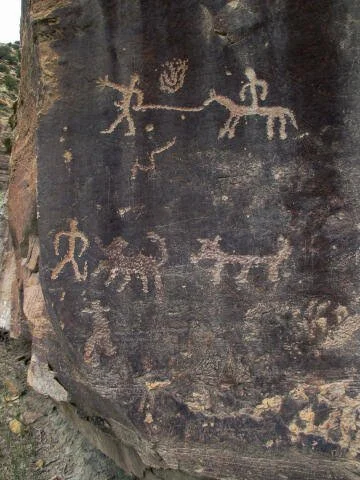
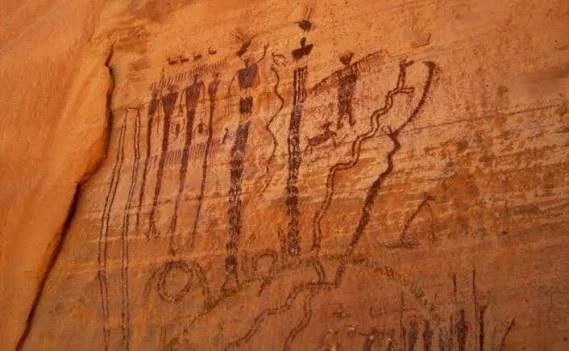
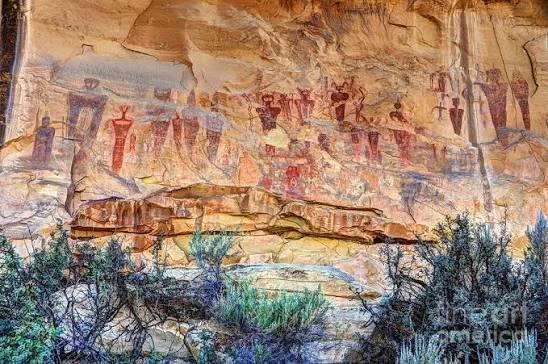
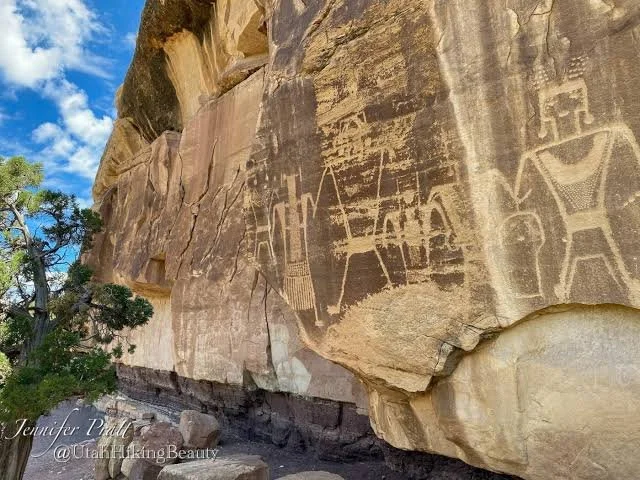
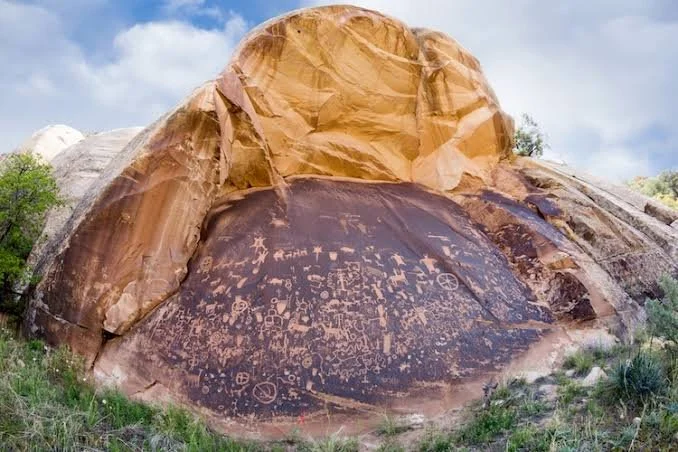
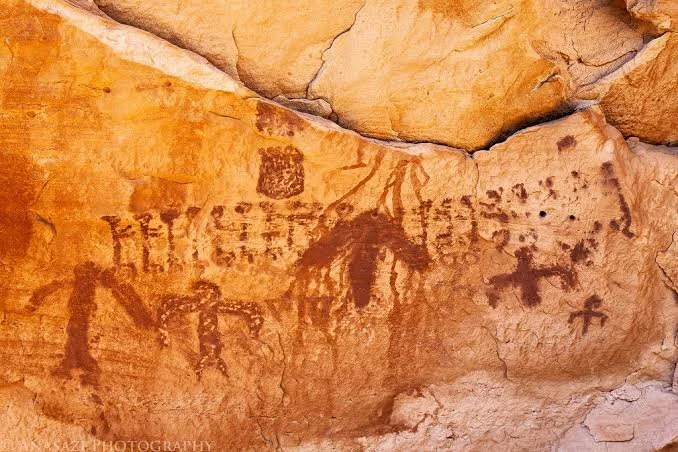
They created petroglyphs and pictographs.
These images belong to an entirely different period of history.
The presence of both dinosaur traces and human rock art demonstrates how one landscape can preserve vastly different timescales.
Fremont and Other Indigenous Traditions
Southern Utah was occupied by different Indigenous communities over thousands of years.
The Fremont tradition is particularly important in central and eastern Utah.
Other rock-art traditions are also present throughout the Colorado Plateau.
Each tradition must be interpreted in its own cultural and chronological context.
The Importance of Landscape
Why would humans create rock art here?
The answer may involve multiple factors.
The region provided:
water
travel corridors
hunting grounds
shelter
elevated viewpoints
dramatic rock surfaces
The cliffs themselves may have carried symbolic significance.
Archaeology and Geology Together
Paria demonstrates the value of interdisciplinary research.
Geologists investigate:
sedimentary formations
erosion
stratigraphy
fossil traces
Archaeologists investigate:
rock art
camps
tools
ceramics
settlement
Paleontologists study dinosaur evidence.
Together, these disciplines reconstruct a much longer history than any one field could provide.
Preservation
Both dinosaur tracks and rock art are fragile.
Visitors walking directly across fossil surfaces can gradually damage them.
Rock art can be damaged by touching or scratching.
Modern graffiti can permanently obscure ancient imagery.
The best protection is careful visitation and site management.
The Problem of Misinterpretation
Popular descriptions can sometimes combine different kinds of evidence.
A site might contain dinosaur tracks nearby and rock art elsewhere.
That does not mean Indigenous artists carved images of dinosaurs.
The archaeological evidence must be examined separately.
Some Indigenous traditions may contain stories involving ancient animals, but connecting a specific petroglyph to dinosaurs requires evidence.
The Geological Timescale
The most striking feature of the landscape is its timescale.
Dinosaurs lived tens or hundreds of millions of years ago.
Human occupation occurred vastly later.
The two records are separated by an enormous span of geological time.
Yet erosion places them in the same modern landscape.
Conclusion
The Paria Rimrocks illustrate how southern Utah preserves multiple chapters of natural and human history.
Dinosaur tracks provide evidence of ancient animal behavior.
Rock art records much later Indigenous cultural activity.
The geology connects them by exposing the surfaces where both forms of evidence survive.
The result is a landscape that functions as a natural archive.
Its sandstone records movement by animals millions of years ago and human activity thousands of years later.
That extraordinary overlap of geological and archaeological history is what makes the Paria region so compelling.