The Cave That Proved the Sahara Was Once Full of Water—and the Ancient Figures Still Swimming on Its Walls
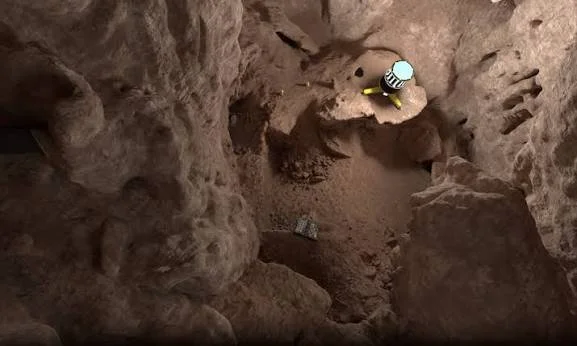
Deep within the remote Gilf Kebir plateau, near the borderlands of southwestern Egypt and southeastern Libya, lies one of the most haunting archaeological sites in the Sahara: the Cave of Swimmers.
Despite its popular name, the Cave of Swimmers is not located in a landscape that resembles a place where anyone could swim today. The surrounding environment is among the driest and most isolated regions on Earth. Vast expanses of desert stretch for hundreds of kilometers, rainfall is extremely limited, and permanent surface water is virtually absent.
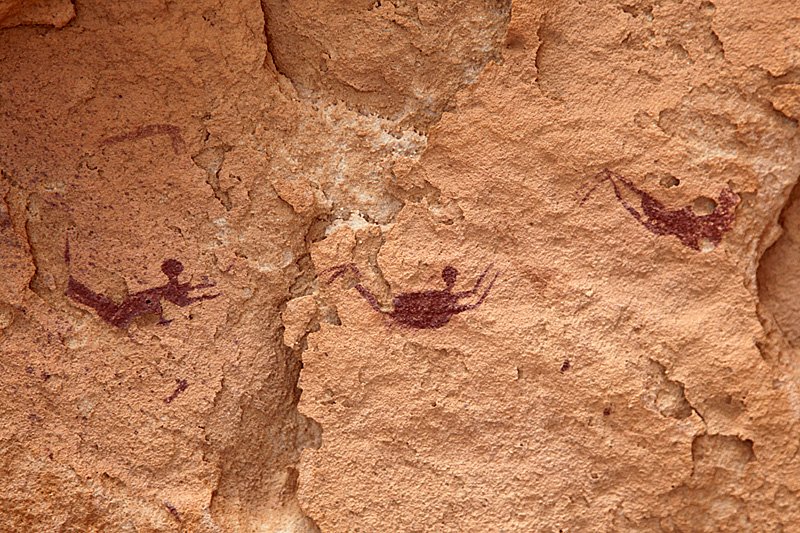
Yet on the walls of a prehistoric rock shelter, ancient artists created images that appear to show human figures moving through water.
Some figures seem to float horizontally.
Others appear to have bent limbs resembling swimming motions.
These enigmatic paintings have made the site one of the most famous pieces of prehistoric Saharan art. They have also become powerful visual evidence for a remarkable scientific reality:
The Sahara was not always a desert.
The paintings preserve memories—or perhaps symbolic representations—of a radically different prehistoric world, one in which water, vegetation, wildlife, and human communities occupied landscapes that are now almost completely barren.
Discovery in the Gilf Kebir
The Cave of Swimmers became internationally known after its documentation by Hungarian explorer László Almásy during expeditions into the Gilf Kebir region in the 1930s.
Almásy later described the paintings in a way that emphasized their apparent resemblance to swimmers. The name became permanently attached to the site.
However, the interpretation should be approached carefully.
The figures are prehistoric images, not photographs.
Archaeologists cannot ask their creators what they intended to represent.
The figures may depict swimming, but alternative interpretations have also been proposed. Their position, however, is unusual enough that the connection with movement through water remains one of the most widely discussed explanations.
The mystery is therefore genuine.
But the art should not be treated as simple documentary evidence of a prehistoric swimming competition.
Instead, it belongs to a much larger cultural and environmental context.
Gilf Kebir: A Desert That Was Once Different
The modern landscape of the Gilf Kebir gives little indication of the environments that existed there thousands of years ago.
During wetter prehistoric phases, particularly during periods associated with the African Humid Period, rainfall patterns across North Africa were significantly different.
The Sahara experienced environmental transformations that included:
Increased rainfall.
Expanded vegetation.
Lakes and wetlands.
More active drainage systems.
Greater availability of animal resources.
Human settlement in regions now considered hyper-arid.
These conditions did not remain constant.
Climate fluctuated over thousands of years.
But the archaeological evidence demonstrates that prehistoric Sahara was far more environmentally diverse than its modern appearance suggests.
The Cave of Swimmers belongs to this lost world.
Who Painted the Figures?
The exact identity of the artists remains unknown.
They lived before the development of writing in the region.
No inscriptions provide names.
No surviving texts explain the images.
Archaeologists must reconstruct their lives through:
Rock art.
Stone tools.
Campsites.
Animal remains.
Environmental evidence.
Comparisons with other Saharan sites.
The paintings therefore represent one of the few surviving forms of direct communication from these prehistoric communities.
Although we cannot hear their language, we can still see what they chose to place on stone.
Are They Really Swimming?
This is the question that made the cave famous.
The human figures appear in horizontal positions that differ from ordinary standing or walking depictions.
Their limbs are arranged in ways that have led many observers to interpret them as swimmers.
If the interpretation is correct, the images provide extraordinary evidence for human interaction with water in a region that is now one of the driest places on Earth.
However, archaeological interpretation must remain cautious.
Ancient art can be symbolic.
A horizontal human figure could represent:
Swimming.
Floating.
Death.
Ritual movement.
A supernatural state.
A mythological narrative.
The title “Cave of Swimmers” is therefore an interpretation, not a proven translation of prehistoric meaning.
Yet the environmental evidence for a wetter Sahara makes the idea of ancient swimming entirely plausible.
The Other Figures of the Cave
The site contains more than the famous “swimmers.”
Other paintings include human figures and scenes whose meanings remain difficult to reconstruct.
Some appear elongated.
Others are arranged in groups.
The artistic tradition demonstrates that prehistoric communities were capable of creating complex visual compositions.
These were not random marks.
They required:
Preparation.
Pigment production.
Knowledge of suitable rock surfaces.
Artistic technique.
Shared cultural meaning.
The cave may have served a social or symbolic function beyond ordinary shelter.
How Did Prehistoric Artists Make the Paintings?
Creating rock paintings required materials.
Pigments could be obtained from mineral sources such as iron oxides, which can produce red and yellow tones.
Black pigments could be produced from charcoal or manganese-rich minerals.
The material then had to be processed and applied.
Possible binders may have included organic substances, although identifying them after thousands of years is difficult.
The artists may have used:
Fingers.
Brushes made from plant fibers.
Animal hair.
Simple applicators.
Every surviving image represents a technological process as well as an artistic act.
The Cave and the “Green Sahara”
The Cave of Swimmers has become an icon of prehistoric climate change.
It reminds us that landscapes are not permanent.
A desert can become grassland.
Lakes can disappear.
Animal populations can migrate or vanish.
Human societies must adapt.
The ancient artists may never have imagined that the world surrounding their shelter would eventually become one of the most inhospitable environments on Earth.
Yet their paintings survived.
Thousands of years later, they became evidence of an environment their descendants would no longer recognize.
Popular Culture and Misinterpretation
The Cave of Swimmers gained additional fame through popular culture, particularly because of its association with the story that inspired elements of The English Patient.
This attention brought global recognition.
But fame can also produce misinformation.
The cave is sometimes presented as if it offers definitive proof of a specific prehistoric event.
Others have promoted speculative theories unrelated to archaeological evidence.
The reality is already extraordinary enough.
There is no need to invent lost advanced civilizations or supernatural explanations.
The true story is that prehistoric people lived in a Sahara very different from today—and they created images whose meaning still challenges modern researchers.
Why the Cave of Swimmers Matters
The site represents several important fields of study at once.
It is valuable for:
Prehistoric archaeology.
Rock-art research.
Saharan environmental history.
Human adaptation.
Paleoclimate studies.
The study of symbolic behavior.
Its greatest importance may lie in the way it forces us to rethink the Sahara.
Today, the region appears ancient and unchanging.
The paintings prove otherwise.
The desert has a history.
And on the wall of a remote rock shelter, a group of prehistoric figures may still be doing the one thing that seems impossible in the modern Sahara:
swimming.