Before Libya Became Desert: The Ancient Cattle Herders Who Painted an Entire Lost Civilization
At the meeting zone of modern Libya, Egypt, and Sudan rises a remote mountain massif known as Jebel Uweinat or Gebel Uweinat.
Today, reaching the area requires crossing some of the most isolated parts of the Sahara.
But thousands of years ago, this region supported human communities whose presence survives in an extraordinary collection of prehistoric rock paintings and engravings.
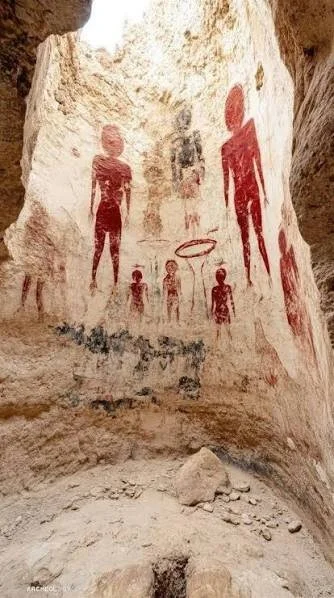
The art of Uweinat depicts people, animals, and scenes associated with changing prehistoric lifeways.
Among its most important themes is the development of pastoralism—the economic system based on the management and movement of domesticated animals, particularly cattle.
These images provide evidence for a period when the Sahara supported communities that hunted, gathered, moved through seasonal landscapes, and eventually developed increasingly complex relationships with livestock.
A Mountain in the Middle of the Sahara
Jebel Uweinat rises dramatically above the surrounding desert.
Its geology created features particularly important to prehistoric people.
The massif contains:
Rock shelters.
Valleys.
Protected surfaces.
Seasonal water systems.
Areas capable of preserving archaeological evidence.
In a changing environment, such locations could become focal points for human movement.
Communities traveling through the wider landscape may have returned repeatedly to the same valleys and shelters.
Over generations, these places accumulated archaeological traces.
The Sahara Around 8,000 Years Ago
The phrase “8,000-year-old” should not imply that every artwork at Uweinat was created in the same year or even during the same century.
The rock-art traditions of the region span long periods.
Nevertheless, many belong to prehistoric phases associated with a significantly wetter Sahara.
During these periods, monsoon systems and rainfall patterns created environmental conditions that allowed vegetation and animal populations to expand.
The landscape supported:
Wild game.
Grazing animals.
Human communities.
Seasonal water sources.
This was the environmental foundation upon which pastoral societies developed.
The Rise of Cattle Pastoralism
One of the most significant transformations in North African prehistory was the increasing importance of cattle.
The domestication and management of animals changed human relationships with the environment.
Pastoral communities could organize their lives around herds.
This required knowledge of:
Seasonal grazing.
Water sources.
Animal reproduction.
Migration routes.
Herd protection.
Rock art from Uweinat and the wider Sahara preserves visual evidence of cattle becoming increasingly important.
Cattle Were More Than Food
In pastoral societies, livestock can have multiple roles.
Cattle may represent:
Meat.
Milk.
Wealth.
Social status.
Marriage exchanges.
Ritual importance.
Family identity.
Therefore, images of cattle cannot automatically be interpreted as simple agricultural illustrations.
A carefully depicted animal may have carried symbolic significance.
The art may reflect the social world created around herding.
Human Figures and Social Life
Uweinat's rock art also depicts human beings.
Some figures appear individually.
Others appear in groups.
Their gestures and body positions may suggest movement, ritual, work, or social interaction.
However, interpretation remains difficult.
A prehistoric artist may have understood the meaning of a scene immediately, while modern observers must reconstruct that meaning thousands of years later.
The paintings preserve the image but not the accompanying explanation.
The Transition From Hunting to Herding
Prehistoric societies did not all abandon hunting when livestock became important.
For long periods, hunting, gathering, and pastoralism could coexist.
The archaeological record often reveals gradual transitions rather than sudden revolutions.
A community might:
Hunt wild animals.
Gather plants.
Begin managing domestic animals.
Move seasonally with herds.
Develop stronger pastoral identities.
The art of Uweinat helps researchers visualize these changing relationships.
Artistic Style and Cultural Exchange
The rock art of Uweinat belongs to a wider Saharan artistic world.
Similar themes appear across regions now separated by vast distances of desert.
This suggests prehistoric movement, interaction, or shared cultural traditions.
The Sahara was not necessarily an empty barrier.
During wetter periods, it may have contained corridors connecting communities.
People could travel.
Ideas could spread.
Artistic traditions could influence neighboring regions.
The Mystery of Meaning
Why were the paintings created?
There is no single answer.
Possible functions include:
Ritual.
Storytelling.
Group identity.
Education.
Territorial association.
Memory.
Religious belief.
It is possible that different images served different purposes.
A cattle scene may have had a different meaning from a human figure.
A painting created for ritual may have been placed beside another created for storytelling.
Environmental Collapse
The conditions that supported prehistoric occupation eventually changed.
The African Humid Period ended gradually.
Rainfall patterns shifted.
Vegetation declined.
The Sahara became increasingly arid.
Communities had to adapt.
Some populations migrated toward regions where water remained available.
Others developed new strategies for survival.
The pastoral landscapes represented in the art slowly disappeared.
Why Uweinat Is Archaeologically Extraordinary
The art of Uweinat preserves evidence of a human world that cannot be understood through written history.
The communities left no surviving books.
Yet they created visual archives.
Through their paintings, researchers can study:
Ancient environments.
Animal-human relationships.
Pastoralism.
Human migration.
Symbolic culture.
Today, Uweinat stands in one of the most remote parts of the Sahara.
But thousands of years ago, it was not at the edge of the world.
For the people who painted its shelters, it was part of their world.
And their art still preserves the memory of that lost landscape.