The Last Village Before Tibet: Inside Chitkul's Incredible Life at the Edge of the Himalayas
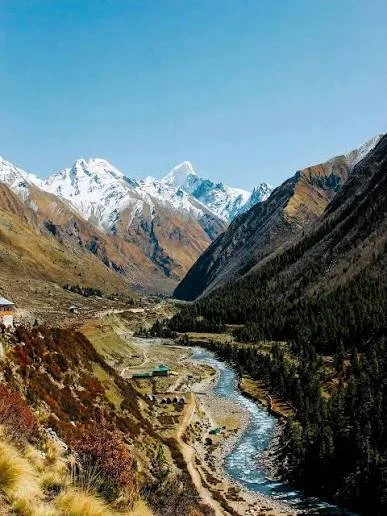
At the far end of the Baspa Valley lies Chitkul, one of the best-known high-altitude villages in Kinnaur.
Popular descriptions often call it the “last inhabited village of India” toward the Tibetan frontier. While the phrase is geographically simplified, it captures something important about the village's cultural identity: Chitkul occupies a dramatic borderland landscape where mountains, rivers, seasonal isolation, and historical trade routes have shaped daily life.
The story of Chitkul is not primarily one of ancient ruins.
It is the story of a living Himalayan settlement.
The Baspa Valley
The Baspa River flows through one of the most dramatic valleys in Kinnaur.
The landscape contains:
High mountains.
Alpine and subalpine environments.
Agricultural terraces.
Forests.
Glacial systems.
Seasonal watercourses.
For centuries, communities had to adapt agricultural and settlement practices to these conditions.
Land was valuable.
Growing seasons were limited.
Winter could isolate villages.
Traditional Architecture
Historic Himalayan villages often developed architecture suited to local environments.
In Kinnaur, traditional structures could combine:
Stone.
Timber.
Mud or earth.
Multi-level construction.
Wood and stone could be arranged in ways that provided structural strength and insulation.
Traditional building techniques represent generations of accumulated engineering knowledge.
Agriculture at High Altitude
Life in Chitkul depended on careful use of the short agricultural season.
Communities cultivated crops adapted to local conditions and relied on livestock and other resources.
Agriculture in the Himalayas is rarely a simple matter of planting and harvesting.
It requires:
Water management.
Terrace construction.
Soil preservation.
Seasonal planning.
Collective labor.
Historical Connections Beyond the Valley
Despite its remote appearance, Chitkul was historically connected to wider networks.
The Himalayan frontier was not an empty barrier.
Mountain passes enabled trade and communication between communities.
Goods, animals, ideas, and cultural practices moved through these routes.
Modern political borders later changed how these landscapes were understood and used.
Religion and Village Identity
Religious traditions remain deeply connected to community life.
Temples, sacred objects, and local rituals provide continuity.
In Himalayan villages, religion is often embedded in the calendar.
Festivals correspond with agricultural cycles.
Rituals can involve local deities.
Community participation reinforces social relationships.
Seasonal Isolation
Winter historically created one of the greatest challenges.
Heavy snow and difficult roads could isolate communities.
This meant that villages had to plan carefully.
Food storage became essential.
Fuel was required.
Buildings had to provide protection.
Seasonality shaped culture.
Tourism and the Modern Transformation
Chitkul's dramatic scenery has increasingly attracted visitors.
Tourism can bring economic opportunities.
But rapid popularity can also create challenges:
Waste management.
Water pressure.
Road development.
Changes in traditional architecture.
Seasonal overcrowding.
The future of Chitkul therefore depends partly on sustainable development.
Why Chitkul Matters
Chitkul is a reminder that heritage does not exist only in monuments.
A living village can be a historical archive.
Its architecture reflects environmental adaptation.
Its agricultural practices preserve traditional knowledge.
Its location reflects centuries of interaction with the Himalayan landscape.
Chitkul's greatest mystery is not hidden underground.
It is visible every day.
People continue to live in a landscape that has shaped human communities for generations.