The 1,000-Year-Old Monastery Hidden Above the Clouds: Inside Nako's Sacred Himalayan Village
Nako is not simply a monastery.
It is a cultural landscape.
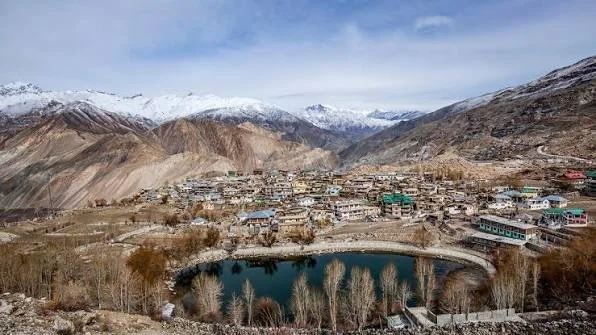
Located in the high-altitude Kinnaur region of Himachal Pradesh, the village combines traditional Himalayan settlement, Buddhist religious architecture, mountain geography, and centuries of cultural exchange.
Its monastery complex represents the deep historical connections between the Indian Himalayas and the Tibetan cultural world.
For travelers approaching the settlement, the environment itself is striking. Dry mountains rise above the village, while traditional buildings and religious structures occupy a landscape shaped by altitude, limited resources, and generations of adaptation.
Kinnaur: A Borderland of Cultures
Kinnaur has historically occupied a transitional cultural zone.
Different valleys experienced influences from:
Hindu traditions.
Tibetan Buddhism.
Local Himalayan beliefs.
Trade networks.
Political powers from neighboring regions.
This diversity is reflected in architecture, language, religious practice, and art.
Nako's Buddhist heritage must therefore be understood within this broader cultural environment.
A Monastic Complex Rather Than a Single Building
The historic religious structures of Nako include multiple temples and sacred spaces.
This is important because a monastery is often a complex rather than a single architectural unit.
Different rooms and buildings may serve different purposes:
Prayer halls.
Shrines.
Meditation spaces.
Storage rooms.
Residential areas.
Smaller chapels.
Over centuries, these spaces may be repaired or rebuilt.
The visible complex therefore represents accumulated history.
The Art of the Himalayan Interior
Like other Himalayan monasteries, Nako's greatest artistic treasures are often located inside rather than outside.
Murals and sculptures can preserve religious traditions extending across centuries.
The interior spaces may contain representations of:
Buddhas.
Bodhisattvas.
Buddhist teachers.
Guardians.
Celestial figures.
These images transformed the temple into a sacred environment.
The Influence of the Second Diffusion of Buddhism
The development of Buddhist institutions in western Tibet and the Himalayan regions was strongly influenced by a period often described as the “Second Diffusion” of Buddhism.
Following earlier political changes in Tibet, Buddhist institutions underwent processes of revival and reorganization.
New translations were produced.
Monasteries developed.
Teachers traveled across regions.
Nako belongs to this larger historical world.
Village Life and Religious Life
One of the most important aspects of Nako is the close relationship between the monastery and the surrounding community.
A rural Himalayan monastery was not isolated from everyday life.
It could provide:
Religious services.
Ritual leadership.
Festival organization.
Education.
Cultural continuity.
The monastery was part of the village's social structure.
Building in a Harsh Climate
High-altitude architecture requires adaptation.
Builders had to consider:
Cold winters.
Limited timber.
Snow.
Strong sunlight.
Earthquake risks.
Limited agricultural land.
Traditional construction therefore relied heavily on local materials and accumulated environmental knowledge.
Stone and earth walls provided insulation.
Flat roofs could reflect local climatic conditions.
Buildings were arranged according to available land.
Murals as Historical Documents
A mural can reveal far more than artistic taste.
It may preserve information about:
Religious affiliation.
Artistic influence.
Patronage.
Trade connections.
Costume.
Iconography.
By comparing murals from Nako with those from other Himalayan and Tibetan sites, scholars can trace artistic relationships.
Conservation in a Living Village
Preserving Nako requires balancing several priorities.
The buildings must remain structurally stable.
The artwork must be protected.
But the site must also continue to serve the local community.
This is a common challenge in heritage conservation.
A living monument cannot simply be turned into a museum.
Why Nako Is Historically Important
Nako represents the endurance of Himalayan cultural traditions.
For approximately a millennium, religious practices have remained connected to this high-altitude landscape.
The village demonstrates how communities can preserve cultural identity even under conditions of geographical isolation.
Its monastery is not merely an old building.
It is evidence of continuity.
Generation after generation, people maintained sacred spaces in a landscape where survival itself required cooperation and adaptation.
That combination of environmental resilience and cultural memory makes Nako one of the most fascinating historic landscapes of the Indian Himalayas.