The Village Beneath a Sacred Mountain: Inside Kalpa's Ancient Temples and Himalayan Apple Kingdom
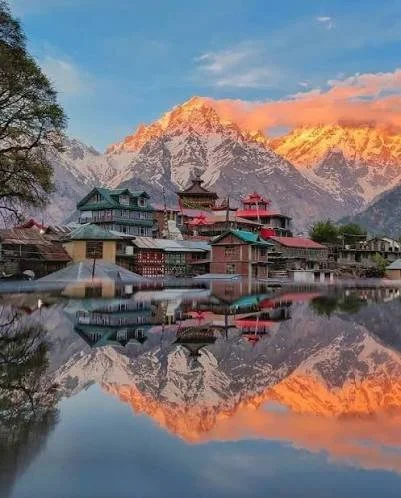
Kalpa occupies one of the most spectacular settings in Kinnaur.
The village is famous for its views toward the Kinner Kailash range, its apple orchards, and its mixture of Himalayan architectural and religious traditions.
Yet the landscape's beauty can overshadow its historical importance.
Kalpa represents a cultural environment where agriculture, Hinduism, Buddhism, local traditions, and mountain geography developed together.
Kinner Kailash and Sacred Geography
Mountains occupy powerful positions in Himalayan religious thought.
Kinner Kailash is associated with Shiva and forms part of the sacred geography of the region.
The mountain is not simply scenery.
For religious communities, sacred geography creates a relationship between physical landscape and cosmology.
A temple facing a sacred mountain becomes part of a larger religious environment.
Kalpa's Religious Architecture
Traditional temples in Kinnaur often display a mixture of artistic influences.
Wood carving can be especially important.
Architectural forms may reflect local building traditions while incorporating religious symbolism from Hindu and Buddhist worlds.
This blending demonstrates the cultural complexity of Kinnaur.
The Rise of Apple Agriculture
Kalpa is now strongly associated with apple cultivation.
The development of commercial horticulture transformed many Himalayan communities.
Apple orchards created new economic opportunities.
But this transformation also changed landscapes.
Traditional agriculture increasingly interacted with market systems.
Road construction and transport became economically important.
Traditional Farming Before the Apple Economy
Before commercial horticulture dominated many parts of Kinnaur, communities relied on diversified agriculture.
Crops adapted to altitude and climate were cultivated alongside livestock.
This system reduced dependence on a single product.
The growth of apple farming brought prosperity but also increased exposure to market changes and environmental risks.
Architecture and Environmental Adaptation
Kalpa's traditional buildings were designed for mountain conditions.
Stone and timber provided structural and thermal advantages.
Sloping or specialized roof designs responded to local weather.
Buildings reflected both practical engineering and artistic identity.
A Cultural Meeting Point
Kalpa demonstrates that the Himalayas cannot be divided neatly into “Indian” and “Tibetan” cultural zones.
The region contains layers.
Religious traditions overlap.
Languages and artistic styles reveal historical contact.
Trade routes connected communities.
Tourism and Heritage
Kalpa's scenery has made it increasingly important as a tourist destination.
However, tourism creates a conservation challenge.
The very qualities that attract visitors—traditional architecture, orchards, sacred landscapes—can be threatened by uncontrolled development.
Preserving cultural character requires planning.
Why Kalpa Matters
Kalpa represents a Himalayan landscape where economic and spiritual history are inseparable.
The apple orchard is part of modern history.
The temple represents older traditions.
The mountain represents sacred geography.
Together, they create a cultural landscape rather than a collection of separate attractions.
Kalpa shows that heritage is not always hidden in museums.
Sometimes it grows in orchards, survives in wooden temples, and rises above the village in the form of a sacred mountain.