Introduction
Olive cultivation has shaped Mediterranean landscapes for thousands of years. Olive trees provided oil, food, fuel, and products used in trade, while their long lifespans made them important features of agricultural environments.
On islands with steep terrain and limited flat land, farmers developed specialized methods to make cultivation possible. One approach involved constructing small terraces along hillsides and cliffs.
These terraces transformed difficult slopes into agricultural plots by creating relatively level surfaces supported by stone walls or other retaining structures.
The study of cliffside olive terraces reveals how island communities adapted farming to limited land, variable rainfall, soil erosion, and difficult transportation routes.
The Importance of Olive Cultivation
Olive trees are well adapted to many Mediterranean environments.
They can tolerate dry conditions once established and grow in soils that may be unsuitable for more demanding crops.
Olive oil was used in cooking, lighting, personal care, and other activities.
The economic value of olives encouraged communities to maintain trees across generations.
An olive grove could therefore become a long-term investment, with trees inherited and managed by successive households.
Why Terraces Were Necessary
Island landscapes often contain steep slopes and limited agricultural plains.
Without protective structures, soil can be washed downhill by heavy rain.
Terracing reduces the effective slope of cultivated ground and helps retain soil and moisture.
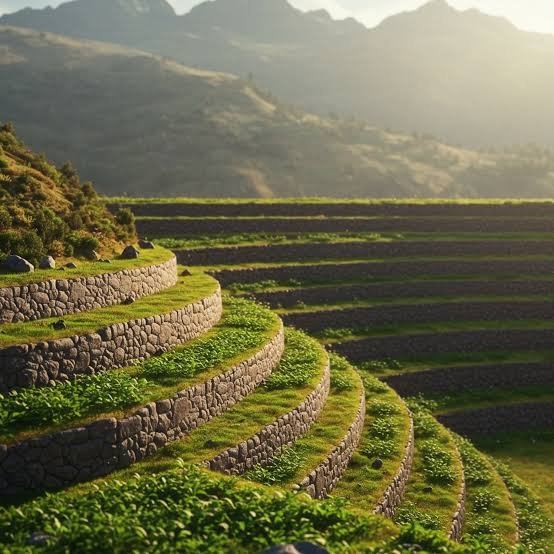
A terrace is typically created by cutting into a hillside and constructing a retaining wall along the lower edge. The resulting platform provides a more manageable area for cultivation.
In cliffside environments, these structures may be narrow and irregular because they must follow the natural shape of the terrain.
Construction Techniques
Terrace walls were commonly built using locally available stone.
Dry-stone construction involves placing stones together without mortar, relying on their shape and arrangement for stability.
Some walls may include larger foundation stones and smaller material packed into gaps.
The design allows limited movement of water through the structure, reducing pressure that could otherwise build up behind a solid wall.
The terrace surface may contain soil collected from nearby areas, organic matter, and smaller stones.
Construction requires considerable labor, especially on steep terrain where transporting materials is difficult.
Micro-Agriculture on Small Plots
The term micro-agriculture describes cultivation on relatively small plots.
On islands, narrow terraces may support only a limited number of olive trees.
Although each plot is small, many terraces together can create a substantial agricultural landscape.
Families may cultivate different crops on separate levels, combining olives with vines, vegetables, or other plants where conditions allow.
The arrangement of terraces can reflect household ownership, inherited property divisions, and local agricultural traditions.
Water Management
Water availability is a major challenge in Mediterranean island environments.
Rainfall may be concentrated in particular seasons, while summers can be hot and dry.
Terraces can help slow the movement of rainwater and reduce soil loss. Their walls may also influence how water is distributed across the slope.
Some agricultural systems incorporate channels, cisterns, or small collection structures.
These features allow communities to store water or direct it toward cultivated areas.
However, terraces do not automatically function as irrigation systems. Their primary purpose may be soil retention, with water management occurring as a secondary benefit.
Olive Trees and Soil Conservation
Olive trees have root systems that help stabilize soil.
Their canopy can reduce the direct impact of rainfall on the ground, although vegetation management and soil conditions influence the extent of this protection.
Maintaining terraces and trees together can help reduce erosion.
Abandoned terraces may deteriorate as walls collapse and soil moves downhill.
The resulting changes can gradually transform the agricultural landscape.
Archaeological Dating of Terraces
Dating terrace systems is difficult because they are often repaired and rebuilt over long periods.
A retaining wall may contain stones from an older structure, while the cultivated soil behind it may have accumulated gradually.
Archaeologists can investigate construction sequences through excavation and stratigraphic relationships.
Artifacts incorporated into wall foundations may provide chronological clues, although they can be older than the construction itself.
Soil analysis, radiocarbon dating of suitable organic materials, and comparison with historical maps can help establish the development of a terrace system.
Researchers must distinguish the date of the earliest terrace from later repairs and expansions.
The Social Organization of Terrace Farming
Terrace construction requires cooperation.
A single household might build and maintain a small plot, but larger systems could involve shared labor and coordinated water management.
Property boundaries may be marked by walls, paths, or changes in terrace construction.
The division of land can reflect inheritance practices and changing household structures.
Because olive trees can remain productive for many decades, ownership and maintenance responsibilities may extend across generations.
Transport and Market Access
Harvesting olives is only one part of production.
The fruit must be collected and transported to a place where it can be processed.
On steep islands, narrow paths and difficult terrain can make transportation challenging.
Farmers may carry olives in baskets or use animals where paths permit.
Pressing facilities might be located within villages or near agricultural areas, depending on the scale of production.
The relationship between terraces and processing facilities can reveal how agricultural landscapes were connected to local economies.
Abandonment and Landscape Change
Terraces may be abandoned when rural populations decline, agricultural markets change, or transportation becomes difficult.
Once maintenance stops, walls can collapse and cultivated soil may erode.
Trees may survive for years after the terraces become overgrown.
Modern remote sensing and landscape surveys can identify abandoned terrace systems even when they are partly concealed by vegetation.
These remains preserve evidence of former agricultural organization and can help reconstruct changes in rural population and land use.
Conclusion
Cliffside olive terraces demonstrate how island communities adapted agriculture to steep terrain and limited land resources.
Through stone retaining walls, careful soil management, and long-term cultivation, farmers transformed difficult slopes into productive landscapes.
These systems were not simply agricultural structures. They reflected household organization, cooperation, inheritance, water management, and connections with local markets.
Although many terraces have been abandoned or altered, their remains provide valuable evidence of how communities made productive use of challenging environments.
The history of island olive cultivation shows that agricultural innovation does not always require large fields or advanced machinery. Sometimes it begins with a narrow strip of land, a carefully placed stone wall, and generations of work to preserve the soil.