Introduction
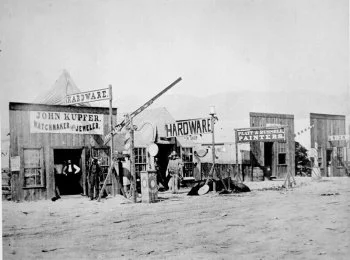
Corinne occupies a distinctive place in Utah's nineteenth-century history because its development was closely connected to the arrival of the railroad and to the growth of a non-Mormon commercial community in a territory where Latter-day Saint settlers dominated many established settlements.
Founded in 1868 near the Bear River and shortly before the completion of the transcontinental railroad, Corinne rapidly became a center of commerce, transportation, warehousing, and freight distribution. Its population included merchants, railroad workers, freight operators, entrepreneurs, migrants, and others who were attracted by the opportunities created by the new transportation network.
The term "Gentile" was widely used in nineteenth-century Utah to refer to non-Latter-day Saints. It was a historical social category rather than a neutral modern demographic description. Corinne's reputation as a "Gentile boomtown" therefore reflects the city's role as an important non-Mormon commercial center during the territorial period.
The Railroad and the Birth of Corinne
Corinne's development was inseparable from the transcontinental railroad.
When the Union Pacific and Central Pacific railroads approached their meeting point in Utah, communities located along transportation corridors suddenly acquired new economic opportunities.
Corinne was strategically positioned near the Bear River and railroad lines.
Its founders recognized that the settlement could serve as a distribution point for goods moving into Utah's interior.
The timing was crucial.
The city was established in 1868, only months before the ceremonial completion of the transcontinental railroad in 1869.
That coincidence allowed Corinne to benefit from the dramatic expansion of transportation across the Great Basin.
A Commercial Alternative
Most established settlements in northern Utah were strongly associated with the Latter-day Saint community.
Corinne developed differently.
Merchants who were not members of the Church of Jesus Christ of Latter-day Saints established businesses there.
The city became associated with an economy based on trade rather than primarily on agricultural colonization.
Warehouses stored goods arriving by rail.
Freighters transported merchandise into surrounding communities.
Hotels accommodated travelers.
Saloons, restaurants, stores, and other businesses served workers and visitors.
Corinne thus became a commercial gateway.
Freight and the Interior
Railroads dramatically reduced the cost and time of moving goods across long distances, but rail access did not eliminate the need for local freight transportation.
Goods unloaded at railroad facilities still had to reach communities beyond the tracks.
Wagon freight therefore remained important.
Teams of horses and oxen transported supplies into Utah's interior.
This created a transitional economy in which railroads and traditional overland freight systems operated together.
Competition with Salt Lake City
Corinne's commercial ambitions brought it into competition with Salt Lake City.
The new railroad created possibilities for merchants to bypass established distribution networks.
Corinne's boosters envisioned the settlement becoming a major commercial city.
Its location made this vision plausible.
Yet transportation routes, business networks, and political relationships ultimately favored other centers.
The city's rapid rise was therefore followed by a gradual decline in its regional economic dominance.
Social Diversity
Corinne's population was more diverse than many rural Mormon settlements of the period.
Railroad workers, merchants, immigrants, freight operators, and travelers created a cosmopolitan environment.
The city contained people from different religious and cultural backgrounds.
This diversity also produced social tensions.
The community was part of a larger territorial environment characterized by religious divisions and competing economic interests.
The End of the Boom
Corinne's decline demonstrates a central principle of transportation geography.
A town can prosper because of a particular route, but transportation systems are constantly changing.
As rail connections expanded and other communities developed better commercial relationships with the railroad, Corinne's strategic advantage diminished.
The city never became the enormous metropolis imagined by its boosters.
Nevertheless, it survived.
Archaeological and Architectural Evidence
Historic buildings, streets, commercial structures, transportation corridors, and archaeological deposits provide evidence of Corinne's boom period.
Domestic artifacts can reveal household consumption.
Commercial buildings demonstrate the organization of trade.
Transportation-related remains reveal how goods were moved between railroad and wagon networks.
The archaeological record therefore complements written accounts of the city's ambitions.
Corinne's Historical Significance
Corinne is important because it reveals that Utah's settlement history was not politically or culturally uniform.
The territory contained communities with different religious affiliations, economic strategies, and visions for the future.
Its emergence as a railroad-centered commercial town illustrates how transportation could challenge established economic systems.
Conclusion
Corinne's history is the story of a frontier boomtown created by the railroad.
Its identity as a "Gentile" community reflects its nineteenth-century position outside the dominant Latter-day Saint settlement network.
Its warehouses, freight operations, commercial institutions, and railroad connections reveal how the transcontinental railroad transformed Utah.
Although its commercial ambitions eventually diminished, Corinne remains an important historical example of the intersection of transportation, religion, migration, and western economic development.