Introduction
Kelton was one of the important settlements associated with transportation across western Utah during the era when railroads and wagon freight worked together to move people and goods through the Great Basin.
Located in a remote region near the Great Salt Lake Desert, Kelton developed as a railroad and freight community. Its history demonstrates that the completion of the transcontinental railroad did not immediately eliminate overland transportation.
Instead, railroads created new freight-transfer points where goods could be moved from trains to wagons and then transported into surrounding regions.
The Great Basin Transportation Problem
Western Utah presented enormous transportation challenges.
Distances were long.
Water was scarce.
Mountain ranges interrupted travel.
The Great Salt Lake Desert created a particularly difficult environment for travelers and livestock.
Before railroads, overland freight routes depended upon carefully spaced water sources.
The railroad dramatically changed this system but did not eliminate the importance of local freight.
The Railroad Station
Kelton became significant because of its position along the railroad.
Railroad stations in remote regions served multiple purposes.
They provided water, fuel, maintenance, communication, freight handling, and passenger services.
A station could become the nucleus of a settlement.
Kelton developed within this transportation environment.
Freight Transfer
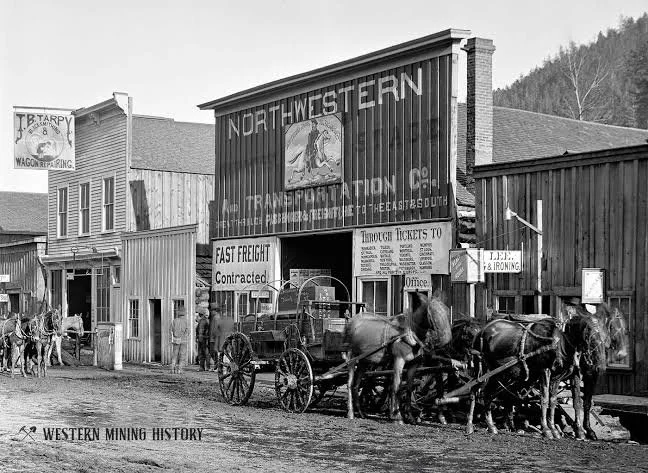
One of Kelton's most important functions was associated with wagon freight.
Goods arriving by railroad could be loaded onto wagons and transported to destinations beyond the immediate railroad corridor.
This created a hybrid transportation economy.
Railroads handled long-distance movement.
Wagons handled regional distribution.
The two systems depended upon one another.
Teamsters
Freight transportation required experienced teamsters.
Driving a wagon across the Great Basin required knowledge of terrain, water sources, weather, livestock management, and route conditions.
Teamsters also faced economic pressures.
They had to maintain animals, equipment, and supplies while transporting heavy cargo over difficult terrain.
Community Life
Kelton developed the institutions typical of a transportation town.
Businesses served railroad employees and travelers.
Hotels and boardinghouses provided accommodation.
Restaurants and saloons served workers.
Warehouses stored goods.
Blacksmiths and mechanics maintained transportation equipment.
The settlement therefore had an economy larger than the railroad station itself.
The Desert Environment
Kelton's location made water especially important.
Water determined where animals could travel and where freight routes could operate.
Railroads solved some of the logistical problems by developing water infrastructure, but the broader desert environment remained demanding.
This relationship between infrastructure and natural resources is central to understanding western transportation history.
Decline
Transportation towns were vulnerable to changes in railroad logistics.
When railroads altered routes or developed alternative freight systems, communities dependent on transfer operations could decline quickly.
The automobile and improved highways later transformed freight transportation again.
As motor vehicles became more capable of crossing long distances, traditional wagon-based distribution declined.
Kelton gradually lost its earlier economic importance.
Archaeological Evidence
The remains of transportation towns can include foundations, roads, loading areas, wells, commercial structures, and discarded objects.
Such evidence can reveal how people interacted with transportation infrastructure.
A bottle discarded near a hotel may provide evidence of commercial life.
A building foundation can reveal the scale of a business.
A loading area can demonstrate how freight moved between transportation systems.
Historical Importance
Kelton illustrates the transitional character of western transportation.
It belongs to a period when railroads were transforming long-distance movement but wagons remained essential for local distribution.
This hybrid economy existed for decades.
Conclusion
Kelton's significance lies in its role as a freight and transportation community in the Great Basin.
Its history demonstrates that the railroad did not simply replace older transportation systems. Instead, rail and wagon freight initially worked together.
The eventual disappearance of the town reflects another transportation transformation: the replacement of wagon freight by more flexible highway and motor-vehicle systems.