Could Homo sapiens and an archaic, now-extinct human species have lived side by side on the Indonesian island of Sulawesi more than 65,000 years ago?
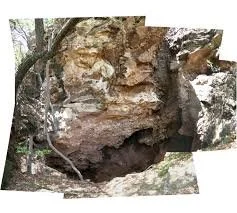
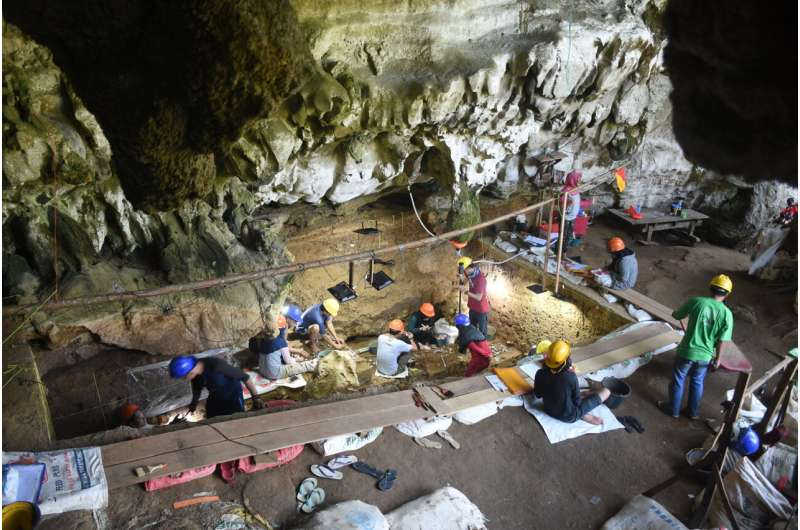
This question has been raised by an international team of archaeologists following multiple excavation seasons at Leang Bulu Bettue, a limestone cave in the Maros–Pangkep karst region of southern Sulawesi.
If evidence confirms that modern humans and another human species occupied the island at the same time, it also raises the possibility that the two groups may have encountered and interacted with one another.
Findings from a new study led by Griffith University and published in PLOS ONE reveal, for the first time, a deeply layered archaeological sequence extending at least eight metres below the present ground surface. These layers contain evidence of human activity that predates the arrival of modern humans on Sulawesi. The study is titled “A near-continuous archaeological record of Pleistocene human occupation at Leang Bulu Bettue, Sulawesi, Indonesia.”
The discoveries build on earlier research by the same team indicating that archaic hominins were present on Sulawesi as early as 1.04 million years ago.
By comparison, Homo sapiens are believed to have reached the island sometime before the first settlement of Australia, around 65,000 years ago.
“The depth and continuity of the cultural sequence at Leang Bulu Bettue now make this cave a key site for exploring whether these two human lineages overlapped in time,” said Griffith University PhD candidate Basran Burhan, an archaeologist from South Sulawesi who led the research under the supervision of Professor Adam Brumm of Griffith University’s Australian Research Centre for Human Evolution.
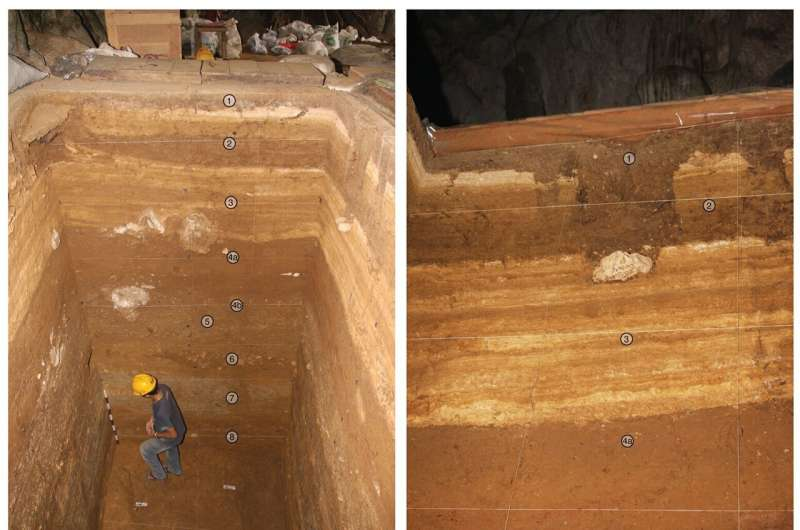
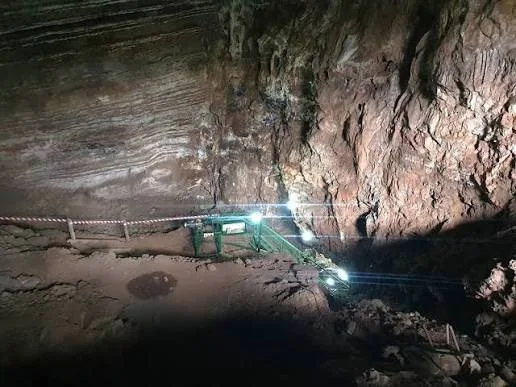
Stratigraphy at Leang Bulu Bettue.
Excavations carried out since 2013 have uncovered an exceptionally long and well-preserved sequence of human occupation at the site, with the deepest and oldest evidence dating to more than 132,300–208,400 years ago.
Some of the most remarkable discoveries from this early phase include clear signs of animal butchery and stone tool production, including large, heavy-duty tools known as “picks.” These activities took place long before Homo sapiens had left Africa.
“These behaviours appear to represent an archaic hominin cultural tradition that continued on Sulawesi well into the Late Pleistocene,” said Professor Adam Brumm.
However, the archaeological record shows a dramatic change by around 40,000 years ago. An earlier occupation phase—characterised by cobble-based core and flake technologies and animal remains dominated by dwarf bovids (anoas, small wild cattle native to Sulawesi) alongside now-extinct Asian straight-tusked elephants—was replaced by a distinctly different cultural phase.
“This later phase is marked by a new technological toolkit and the earliest known evidence of artistic expression and symbolic behaviour on the island—traits typically associated with modern humans,” said Basran Burhan.
“The clear behavioural break between these two phases may indicate a major demographic and cultural shift on Sulawesi, most likely linked to the arrival of our species and the replacement of the earlier hominin population.”
The researchers suggest that Leang Bulu Bettue could provide the first direct archaeological evidence of a chronological overlap—and possibly interaction—between archaic humans and Homo sapiens in Wallacea.
These findings underscore Sulawesi’s importance for understanding human evolution in Island Southeast Asia and open new pathways for investigating how different human species coexisted, adapted, and ultimately disappeared.
“That’s what makes archaeological research in Sulawesi so exciting,” Professor Brumm said. “At Australian sites, no matter how deep you dig, you will never find evidence of humans before Homo sapiens arrived, because Australia was only ever inhabited by our species.
“But Sulawesi was occupied by hominins for a million years before we arrived. If you dig deep enough, you may reach the point where two human species came face-to-face.”
Adding to the intrigue, the team has not yet reached the bottom of the site’s cultural deposits.
“There may be several more metres of archaeological layers beneath the deepest levels we have excavated so far at Leang Bulu Bettue,” Basran said.
“Future work at this site could uncover discoveries that significantly reshape our understanding of early human history on Sulawesi—and possibly beyond.”