Situated just a short drive north of Mérida, the modern capital of Yucatán, lies Dzibilchaltún, an archaeological site whose name translates poetically from the Yucatec Maya language as "Place of the Writing on Flat Stones." This ancient metropolis stands as one of the oldest and longest-inhabited urban centers in the northern Maya lowlands, with a continuous occupational history spanning from the Middle Preclassic period around 500 BCE until the arrival of Spanish conquistadors in the sixteenth century. While the site features an extensive network of plazas and administrative buildings, its unique geographic layout and spiritual life are profoundly tied to a singular geological feature: Cenote Xlacah, an open-air natural sinkhole that served as both a life-giving water source and a sacred ritual platform.
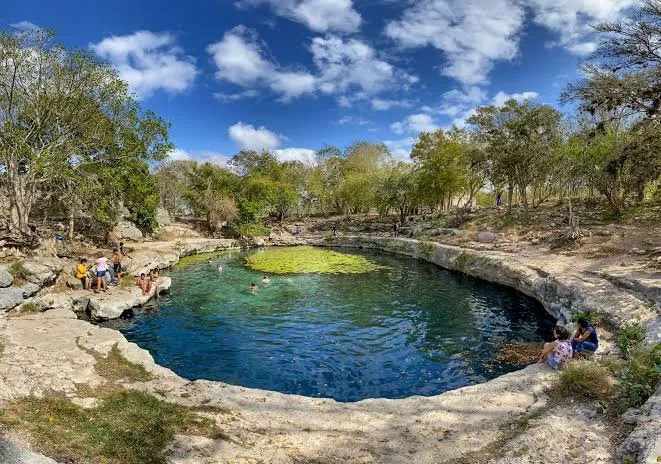
Cenote Xlacah is the literal and spiritual heart of Dzibilchaltún. Reaching depths of over forty meters, this expansive, crystal-clear body of water provided the necessary hydration for an urban population that at its peak surpassed twenty thousand residents. In the arid landscape of the northern Yucatán Peninsula, where surface rivers are entirely absent due to the porous limestone bedrock, cenotes were critical for physical survival. However, to the ancient Maya, Xlacah was far more than an ecological resource; it was a physical portal to Xibalba, the watery underworld inhabited by the rain god Chaac and the spirits of the ancestors.
The relationship between the natural world and Maya architecture is manifest in the immediate vicinity of the cenote. Specialized ritual platforms and stone causeways, known as sacbeob, were constructed to directly connect the water’s edge with the city’s major administrative and religious complexes. During archaeological underwater excavations conducted in the mid-twentieth century by National Geographic and the Middle American Research Institute, divers recovered thousands of artifacts from the dark depths of Cenote Xlacah. These findings included thousands of utilitarian pottery shards, alongside highly prized ritual offerings such as carved bone ornaments, jade beads, human skeletal remains, and delicate wooden objects that had been deliberately cast into the abyss to appease the underworld deities during times of drought and political crisis.
Directly connected to this sacred aquatic landscape by a grand limestone causeway is Dzibilchaltún’s architectural masterpiece: the Temple of the Seven Dolls (Templo de las Siete Muñecas). This unique, square-shaped structure is the only known Maya temple to feature windows, a deliberate architectural adaptation designed for sophisticated astronomical observation. The building receives its modern name from a collection of seven small, crude clay figurines discovered buried beneath the temple’s floor during excavations. Each of these figurines displays distinct physical deformities, leading archaeologists to hypothesize that they were used in late post-classic shamanic healing rituals aimed at curing ailments before being ritually interred within the ancient, sacred space.
The Temple of the Seven Dolls is a profound testament to the Maya mastery of archaeoastronomy. The building was engineered with such mathematical precision that during the spring and autumn equinoxes, the rising sun aligns perfectly with the eastern and western portals of the temple. For a few spectacular minutes, the sun bursts directly through the center of the stone doorway, casting a brilliant beam of light along the grand causeway toward the ceremonial core of the site. This solar phenomenon served as an indispensable cosmic calendar, signaling to the ruling elites and farmers the exact moment to prepare the land for planting or to harvest their crops, tying human agricultural cycles directly to the movements of the cosmos.
Dzibilchaltún also presents a striking layer of historical syncretism. Standing directly in the center of the site's primary pre-Columbian plaza are the roofless stone ruins of an early Spanish Franciscan chapel, constructed in the late sixteenth century using the carved stones dismantled from the surrounding Maya temples. This deliberate spatial placement represents the aggressive spiritual conquest of the region. Yet, despite centuries of colonial intervention and environmental change, Dzibilchaltún endures. The sacred platform of Cenote Xlacah and the solar alignments of its temples remain as monuments to a civilization that harmonized urban design, cosmological mathematics, and natural geography into an enduring sacred landscape.