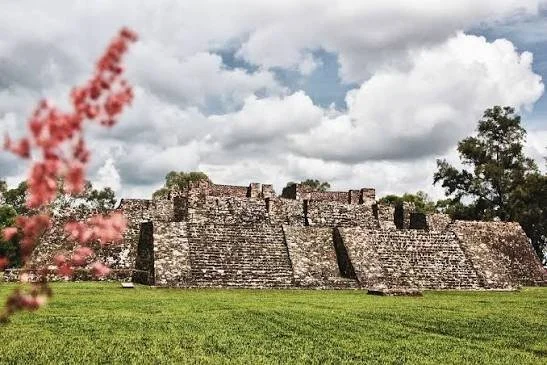
Nestled directly within the modern, bustling urban neighborhoods of Cuernavaca, the capital of Morelos, lies Teopanzolco, a remarkable archaeological site that offers an invaluable tangible link to the complex history of the Aztec Empire. The site’s name is derived from the Nahuatl language, translating roughly to "In the Old Temple Place." Built and inhabited primarily during the Late Postclassic period between 1300 and 1521 CE, Teopanzolco was founded by the Tlahuica people, a Nahuatl-speaking ethnic group closely related to the Mexica of Tenochtitlan. This site stands as a profound architectural prototype, showcasing the classic dual-pyramid design that would later reach its monstrous, ultimate expression at the Huey Teocalli (Templo Mayor) in the Aztec capital.
The defining feature of Teopanzolco is its Grand Basal Platform, which supports the unique Dual Pyramid. This architectural style represents a profound Mesoamerican ideological concept: the balance of opposing cosmic forces. The pyramid base rises in a series of stepped, sloping terraces constructed from local volcanic stone and river boulders, coated in a thick layer of smooth lime plaster. At the broad summit of this single platform sat two independent, side-by-side temples, accessed by a massive, divided central staircase. The northern temple was dedicated entirely to Tlaloc, the ancient god of rain, water, and agricultural fertility, while the southern temple was consecrated to Huitzilopochtli, the fierce Mexica patron deity of war, fire, and the sun.
This architectural duality reflected the delicate balance required to sustain human life and empire. The Tlaloc side was symbolized by the cool, life-giving rains necessary to cultivate maize in the fertile valleys of Morelos, while the Huitzilopochtli side represented the burning heat of the sun and the raw military force required to capture sacrificial victims to feed that sun. On the Huitzilopochtli side, the remains of a sacrificial stone (techcatl) can still be traced, where high priests performed cardiotomy—the ritual extraction of the human heart—before rolling the bodies down the steep steps of the pyramid to re-enact celestial myths.
A major archaeological discovery occurred at Teopanzolco following the catastrophic 7.1 magnitude earthquake that struck Central Mexico on September 19, 2017. The violent seismic activity caused severe structural shifting within the core of the Grand Pyramid. When archaeologists from the National Institute of Anthropology and History (INAH) used advanced radar and exploratory shafts to assess the damage, they discovered a hidden, older temple structure buried deep inside the pyramid’s core. This interior temple, dating back to roughly 1150 CE, contained a wealth of offerings, including ceramic vessels, charcoal remains, and a primary burial, proving that the Tlahuica practiced the traditional Mesoamerican custom of building new, larger pyramids directly over older structures to encapsulate their sacred power.
Surrounding the dual pyramid are several smaller, specialized structures that complete the ceremonial precinct. Among these is a unique circular temple dedicated to Ehecatl-Quetzalcoatl, the Aztec god of the wind. Mesoamerican architects engineered these wind temples with round, sweeping walls to offer no resistance to the blowing gales, allowing the deity to sweep through the valley unimpeded, bringing the rain clouds in his wake. Nearby are several rectangular platforms used for elite residences and administrative functions, where the Tlahuica lords collected tribute—such as cotton textiles, a major agricultural product of Morelos—to send to their Aztec overlords in Tenochtitlan.
Teopanzolco is a monument to the resilience of cultural heritage. Despite being completely surrounded by contemporary urban infrastructure, roads, and modern residential homes, the ancient volcanic stone pyramids continue to command a powerful presence. They stand as a physical testament to the sophisticated engineering, deeply rooted religious cosmos, and dramatic historical shifts that shaped the Tlahuica people before the cataclysm of the Spanish conquest transformed the sacred valley of Morelos forever.