In the semi-arid valley of northern Campeche, rising above the surrounding savannas like an artificial mountain, stands Edzná, an ancient Maya capital of staggering engineering complexity and architectural grandeur. Inhabited as early as 400 BCE and reaching its cultural and political zenith during the Late Classic period between 600 and 900 CE, Edzná—likely derived from Itzá, meaning "House of the Itzás"—developed an exceptionally unique urban layout. The city is celebrated across Mesoamerica for its pioneering hydraulic engineering and its distinct architectural style, which seamlessly blends the regional Puuc and Chenes traditions into a monumental complex centered around the Great Acropolis and its crowning jewel: the Building of the Five Stories (Edificio de los Cinco Pisos).
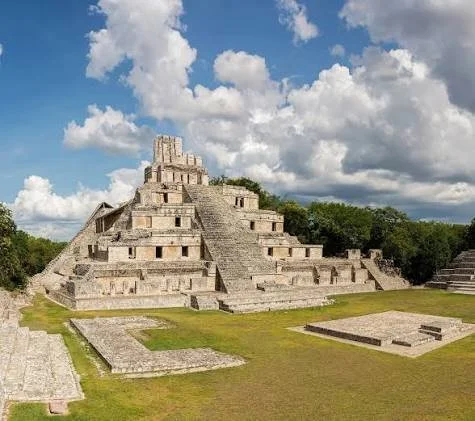
The Building of the Five Stories at Edzná, featuring tiered palace rooms and a central staircase.. Source: Matt Champlin / Getty Images
The Great Acropolis of Edzná is a massive raised platform that hosts an array of elite residential, administrative, and religious structures. Unlike typical Mesoamerican pyramids, which were solid, layered masses built purely to support a small shrine at the summit, the Building of the Five Stories is a highly functional hybrid of a public temple and an elite palace residential complex. Rising over thirty-one meters above the grand plaza, this five-tiered structure features dozens of vaulted rooms built directly into each level, complete with interior chambers, exterior porticoes, and elegant stone pillars. It represents a vertical neighborhood for the divine and the ruling elite, where the supreme lord of Edzná could live, govern, and conduct sacred rituals in full view of the populace below.
A grand, sweeping central staircase cuts directly through the five tiers of the palace, ascending toward a classic cross-shaped shrine at the very top. This summit temple was once adorned with a soaring roof comb, a decorative stone lattice that made the building appear even taller and more imposing against the Campeche sky. The architecture of the building exhibits the hallmark characteristics of the Chenes style, featuring heavy limestone masonry, recessed doorways, and intricate geometric friezes. Walking through the lower levels, one can still see the stone benches used by Maya nobles, and the small holes drilled into the door jambs where woven curtains were once hung to provide privacy for the royal inhabitants.
Equally spectacular, yet hidden beneath the earth and the surrounding landscape, is Edzná’s revolutionary hydraulic network. The valley in which Edzná sat suffered from a volatile climate: it was plagued by intense tropical torrential downpours during the summer months, followed by severe, life-threatening droughts during the winter. To overcome this environmental hostility, the engineers of Edzná designed a massive, centralized system of canals and reservoirs that was entirely unprecedented in the Maya world. They excavated a network of twelve main canals radiating outward from the city center, covering a distance of over twenty-two kilometers.
These canals served a brilliant dual purpose. During the rainy season, they acted as an urban drainage system, channeling catastrophic floodwaters away from the plazas and agricultural fields into vast, man-made reservoirs (aguadas) lined with impermeable clay and stone blocks to prevent seepage. During the long dry season, this stored water was redirected through a series of smaller distribution channels to irrigate thousands of hectares of intensive maize and vegetable farms, ensuring a stable food supply that allowed the city to survive regional famines. Furthermore, the main canals were wide and deep enough to be used as aquatic highways, allowing merchants to transport heavy goods by canoe directly into the central marketplace of the city.
Near the Great Acropolis, visitors can explore the Temple of the Masks (Templo de los Mascarones), another architectural wonder that emphasizes Edzná's artistic sophistication. This structure features two remarkably preserved stucco masks located at its base, depicting the Maya Sun God, Kinich Ahau. Modeled in high-relief stucco and painted in rich shades of red and blue, these masks represent the sun at sunrise and sunset, complete with cross-eyed pupils—a trait of elite Maya beauty—and ornate nose rings. Through its mastery of hydraulic engineering and its architectural innovations, Edzná stands as a supreme monument to Maya ingenuity, proving that human civilization could flourish within a challenging environment by transforming an arid valley into an engineered oasis of monumental power.