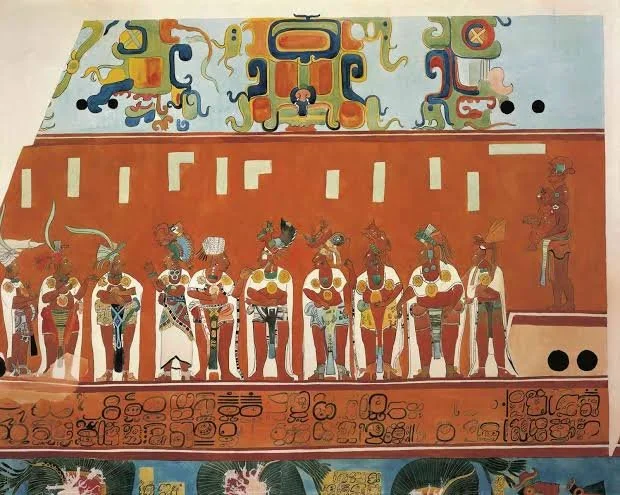
Hidden away in the dense, emerald canopy of the Lacandon jungle, the small Classic Maya site of Bonampak holds an artistic legacy that forever altered our understanding of Mesoamerican civilization. Discovered by American explorer Giles Healey in 1946 with the guidance of the local Lacandon Maya, Bonampak—meaning "Painted Walls" in ancient Yucatec—is home to Structure 1, a modest three-room building constructed around 790 CE. Within this unassuming exterior lies the "Sistine Chapel of the Americas," a breathtaking series of narrative frescoes that wrap entirely around the walls and vaulted ceilings of three distinct rooms, offering an explosive, technicolor account of courtly life, warfare, and human sacrifice.
A view of the vibrant, preserved frescoes inside Structure 1 at Bonampak.. Source: nathan kelly / Getty Images
Before the discovery of these murals, mainstream archaeology largely viewed the ancient Maya as an isolated, peaceful race of priests and astronomers who engaged in quiet philosophical contemplation. The Bonampak frescoes shattered this historical illusion with vivid, unapologetic realism. Executed using a sophisticated wet-fresco technique where natural mineral pigments were applied directly to damp lime plaster, the paintings have survived over twelve centuries due to a protective layer of calcium carbonate that naturally sealed the walls over time. The narrative unfolded across the three rooms details a singular, high-stakes historical sequence under the reign of King Yajaw Chan Muwaan.
Room 1 introduces the viewer to the opulent world of the royal court and the celebration of a young heir's presentation. Here, the walls are filled with images of aristocrats dressed in elaborate, floor-length white capes, heavy jade pectorals, and towering headdresses fashioned from the iridescent green feathers of the quetzal bird. Below the royal dais, a lively procession of musicians beats upon turtle shells with deer antlers, blows into elongated wooden trumpets, and shakes gourds, creating a visual rhythm that leaps off the walls. The atmosphere is one of immense wealth, stability, and cultural refinement, highlighting the complex social hierarchy and theatricality of the Late Classic Maya elite.
The narrative takes a violent and dramatic turn in Room 2, which contains the most famous and harrowing battle scene in Pre-Columbian art. The walls depict a chaotic, hand-to-hand raid launched against a rival city to capture high-ranking prisoners. Warriors are shown locked in ferocious combat, clad in jaguar pelts and brandishing flint-tipped spears. The climax of this room is the iconic "Judgment of the Captives," set upon the steep steps of a ceremonial pyramid. King Chan Muwaan stands triumphantly at the apex, holding a lance, while bound, bleeding prisoners cower at his feet. One captive lies dead on the steps below, while others look in horror at their own fingers, from which streams of bright red blood drip down onto the stone, a prelude to their ultimate sacrifice.
Room 3 shifts the narrative to the grand celebration of victory and the culmination of the sacrificial rites. The murals show noblewomen, including the king's mother and wife, performing ritual bloodletting by piercing their tongues to offer thanks to the gods. Outside, on the exterior terraces, massive public dances are underway. Dancers wearing enormous, stylized backpacks shaped like aquatic monsters and celestial deities spin in ecstatic motion, their movements captured with an astonishing sense of fluid realism by the ancient painters. The use of a rich palette of blues, greens, yellows, and deep iron reds creates a sensory overload that underscores the symbiotic relationship between political victory and religious devotion.
The Bonampak murals are a monument to the narrative capability of indigenous American art. They reveal a world where the preservation of cosmic order demanded immense human cost, where warfare was a highly ritualized tool of statecraft, and where royal courts were centers of dazzling aesthetic sophistication.