Introduction
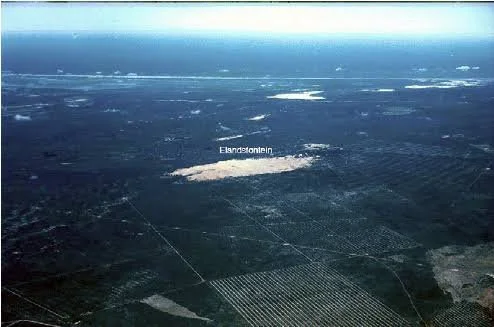
Elandsfontein, near the western coast of South Africa, is one of the most important open-air Acheulean archaeological sites in the country.
Unlike cave sites such as Sterkfontein or Blombos, Elandsfontein preserves archaeological evidence in an open landscape.
This is especially valuable because open-air sites reveal how hominins interacted with broader landscapes rather than concentrating activity inside shelters.
The Acheulean
The Acheulean is an archaeological tradition famous for large cutting tools such as handaxes and cleavers.
These tools required more complex production than simple flakes.
A toolmaker had to select an appropriate stone.
The core then had to be shaped through controlled removals.
The resulting object could have a sharp cutting edge and carefully shaped form.
Elandsfontein's Fauna
Elandsfontein is particularly important because stone artifacts occur alongside large mammal remains.
A Cambridge study describes the Cutting 10 locality as one of the rare southern African sites where Acheulean artifacts and animal bones occur together in primary or near-primary context.
The fauna includes numerous mammal species.
Butchery
Some evidence suggests that people processed animals at the site.
Cut marks and the distribution of skeletal elements can help archaeologists reconstruct carcass processing.
However, not every bone at an archaeological site was necessarily killed or butchered by humans.
Carnivores and natural processes can also accumulate bones.
This is why taphonomic analysis is essential.
Landscape
The environment around Elandsfontein was different from the modern landscape.
The fauna suggests a setting in which grasses played a substantial role.
Large herbivores were abundant.
Water sources supported animal populations.
These conditions created opportunities for hominin hunters and scavengers.
Acheulean Technology
Handaxes are among the most recognizable archaeological objects in human history.
Their repeated forms demonstrate learned technological traditions.
However, their function was probably not limited to one task.
They could have been used for cutting, butchering, woodworking, digging, and other activities.
Skill
Producing a symmetrical handaxe requires considerable motor control.
The maker must predict how a blow will travel through stone.
Too much force can fracture the wrong portion.
Too little force may fail to remove the desired flake.
The final form therefore reflects planning.
Hominin Identity
As with many early Stone Age sites, it is difficult to identify the exact species responsible for the artifacts.
Middle Pleistocene Africa contained multiple hominin populations.
Stone tools are cultural evidence rather than biological fossils.
Unless directly associated with human remains, they should not automatically be assigned to one species.
Open-Air Archaeology
Elandsfontein's open-air context is important because it provides a different perspective from cave archaeology.
Caves can preserve materials unusually well.
Open landscapes are more vulnerable to erosion.
However, open-air sites may preserve activity areas, butchery locations, raw-material sources, and landscape-use patterns that caves cannot.
Research History
Elandsfontein has been studied for decades.
Early collections were sometimes made before modern archaeological recording methods were available.
Later controlled excavations improved understanding of stratigraphy and spatial relationships.
This illustrates how archaeological interpretations can change as methods improve.
Conclusion
Elandsfontein is an important Acheulean landscape because it combines stone technology, large-mammal remains, and open-air archaeological context.
The site provides evidence for hominin interaction with animals and landscapes during the Pleistocene.
Its greatest value lies in demonstrating that early human technological behavior was not confined to caves but occurred across extensive African environments.