Introduction
In southern Utah, the Escalante Petrified Forest preserves the remains of ancient trees transformed into stone.
The forest is a geological record rather than a conventional archaeological site.
Its importance lies in the preservation of wood from ecosystems that existed millions of years ago.
The landscape therefore provides an extraordinary connection to deep geological time.
Visitors walk among what appear to be logs scattered across the desert floor.
But these are not recently fallen trees.
They are fossils.
What Is Petrified Wood?
Petrified wood forms when organic material is gradually replaced or preserved by minerals.
A fallen tree becomes buried in sediment.
Groundwater carrying dissolved minerals moves through the wood.
Silica and other minerals can enter the cellular structures.
Over long periods, the original organic material may be replaced while retaining the microscopic structure of the wood.
The result is stone that preserves the appearance of wood.
The Chinle Formation
Much of the petrified wood in southern Utah is associated with the Chinle Formation.
The Chinle records ancient environments from the Late Triassic period.
At that time, the region was not the modern desert.
It included river systems, floodplains, wetlands, and other environments.
Trees grew along waterways.
When they died or were uprooted, some became buried rapidly enough to fossilize.
Geological Time
The Triassic period ended more than 200 million years ago.
This means that the trees represented at Escalante are vastly older than human history.
Humans have occupied the Colorado Plateau for thousands of years.
The petrified trees predate human occupation by an enormous margin.
The Fossilization Process
Petrification requires specific conditions.
The tree must be buried before it decomposes completely.
Water must carry minerals into the wood.
The chemical environment must allow mineral replacement or preservation.
Over geological time, pressure and mineralization transform the material.
The final fossil may preserve growth rings and cellular structures.
Color
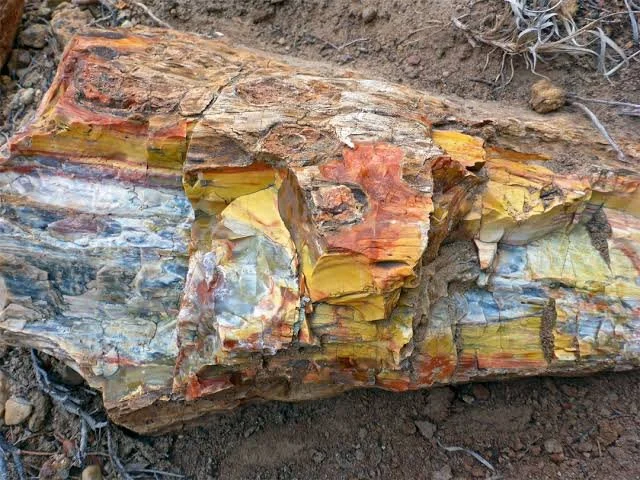
Petrified wood can be remarkably colorful.
Different minerals create different colors.
Iron can produce red or orange tones.
Manganese and other minerals can create darker shades.
Silica can contribute to translucent or pale sections.
The result is sometimes spectacular.
Scientific Value
Petrified wood provides information about ancient environments.
Scientists can study:
tree anatomy
growth patterns
fossil wood types
sedimentary context
paleoclimate
ancient ecosystems
It therefore contributes to paleobotany.
The Ancient Ecosystem
The trees were part of a larger ecosystem.
Other organisms lived alongside them.
Reptiles, amphibians, insects, and early dinosaurs occupied Triassic environments.
The fossil record provides fragments of these communities.
Petrified wood is therefore not an isolated object.
It belongs to an ecosystem preserved in geological strata.
Human History Around the Forest
Although the petrified wood itself is geological rather than archaeological, people later interacted with the landscape.
Indigenous communities traveled through the region.
Later Euro-American explorers and settlers mapped the area.
Modern tourism eventually transformed the forest into a public attraction.
This creates a layered landscape in which geological and human histories overlap.
Scientific Collection
Fossils are valuable scientific resources.
Removing specimens without authorization can destroy information.
The exact location of a fossil can matter.
A piece of petrified wood found in geological context tells scientists something about the layer in which it was deposited.
Unauthorized collection can therefore reduce scientific value.
Preservation
Petrified wood may appear indestructible because it is stone.
But the landscape surrounding it is fragile.
Erosion can expose new material.
Vehicle traffic can damage surfaces.
Unauthorized collecting can remove specimens permanently.
Petrified Wood and Archaeology
It is important to distinguish fossil material from archaeological artifacts.
A petrified log is not a human-made object.
However, ancient people sometimes used fossil wood as raw material.
If worked pieces of petrified wood are found in archaeological contexts, they can become evidence of human activity.
This illustrates how geology can intersect with archaeology.
Conclusion
The Escalante Petrified Forest is a geological archive of an ancient world.
Its stone logs preserve trees that lived more than 200 million years ago.
The wood became mineralized through burial, groundwater, and geological processes.
Today, these fossils provide evidence about ancient ecosystems long before human beings occupied the region.
The forest therefore expands our understanding of Utah's history beyond archaeology.
The landscape contains not only traces of people but traces of life from an unimaginably distant geological past.