Introduction
Frisco, located in Utah's remote Beaver County, is one of the most evocative surviving landscapes of the American West's nineteenth-century mining era. Today, the settlement is largely remembered through its weathered buildings, cemetery, mine workings, and especially the remains of its historic smelter complex. Yet the importance of Frisco extends beyond its appearance as a ghost town. It represents a major phase in Utah's transition from an isolated frontier territory into an industrial mining economy connected to national and international markets.
The community developed around the Horn Silver Mine, one of the most productive silver deposits in Utah during the late nineteenth century. Frisco became a center for extracting, processing, transporting, and commercializing mineral wealth. Its history demonstrates that mining communities were not simply collections of prospectors living beside holes in the ground. They were industrial settlements containing mills, smelters, warehouses, transportation infrastructure, businesses, housing, schools, churches, saloons, and administrative institutions.
The ruins visible today are therefore archaeological evidence of an integrated industrial system.
The Geological Foundation
Frisco's history begins with the geology of the San Francisco Mining District. Mineralization occurred in a complex geological environment containing silver and lead-bearing ores. Nineteenth-century miners were particularly interested in deposits in which valuable silver occurred alongside lead minerals.
This association was economically significant because lead could serve as both a valuable commodity and an important metallurgical component during ore processing. The challenge was not merely finding ore but developing methods to extract valuable metals economically from rock containing numerous unwanted minerals.
The discovery of rich deposits transformed the area rapidly.
The Rise of Frisco
The mining district expanded dramatically during the 1870s. As ore production increased, Frisco developed as the principal settlement associated with the mining operation.
Mining communities often grew extraordinarily quickly. Population depended on the profitability of the ore body, and investment followed expectations of continued production. Merchants arrived because miners needed supplies. Hotels and boardinghouses appeared because workers required accommodation. Freight operators developed businesses transporting equipment and ore.
Frisco thus became part of a regional economic network.
The settlement also depended upon transportation routes connecting the mines with outside markets. Mining could not function independently of transportation because heavy machinery, timber, fuel, food, and other supplies had to be imported, while processed or semi-processed mineral products had to leave the district.
The Horn Silver Connection
The prosperity of Frisco was closely associated with the Horn Silver Mine. Exceptionally productive silver deposits generated enormous excitement among investors and mining companies.
The scale of the operation required increasingly sophisticated industrial infrastructure. Mining companies had to excavate underground workings, construct hoisting systems, provide ventilation, remove water, transport ore, and establish facilities capable of treating mineral-bearing material.
The deeper the mine became, the more engineering challenges increased.
Mining therefore required specialized workers, capital, machinery, and technical knowledge.
Smelting in the Mining Economy
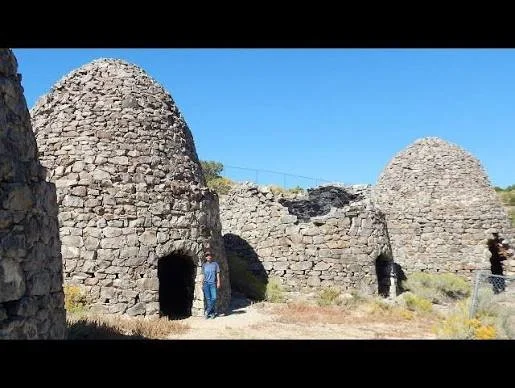
The most important archaeological feature of Frisco's industrial landscape is the remains associated with ore processing and smelting.
Mining and metallurgy are distinct stages of production. Extracting ore from underground does not automatically produce usable metal. Ore must be crushed, concentrated, roasted, smelted, or otherwise processed depending on its mineral composition.
A smelter uses high temperatures and chemical reactions to separate metals from unwanted components of the ore.
Lead smelting was particularly important in nineteenth-century western mining districts because lead-bearing ores could contain economically significant quantities of silver.
Industrial smelting required furnaces, fuel, fluxes, chimneys, storage areas, and transportation systems. The ruins therefore reveal the physical complexity of nineteenth-century metallurgy.
Industrial Archaeology at Frisco
The Frisco landscape can be understood as an industrial archaeological site. Archaeologists examining such places do not study only buildings. They investigate relationships among structures, machinery, roads, dumps, foundations, mine entrances, slag deposits, water systems, and residential areas.
Slag is particularly important.
Slag consists of waste material produced during metallurgical processing. Although it was considered waste by nineteenth-century operators, archaeologists can use it to reconstruct production techniques.
Its composition may provide evidence about:
the types of ore processed;
furnace temperatures;
flux materials;
metallurgical techniques;
production intensity;
changing industrial processes.
In this sense, industrial waste can become an archaeological archive.
Labor and Community
Behind the industrial infrastructure were thousands of hours of human labor.
Mining was physically demanding and dangerous. Workers operated underground in environments characterized by darkness, unstable rock, dust, confined spaces, and machinery. Surface workers faced equally demanding conditions in mills, smelters, transportation yards, and construction sites.
Mining towns also developed complex social structures.
Workers came from different ethnic, national, and regional backgrounds. Western mining communities could contain immigrants from Europe, migrants from other American regions, Indigenous people, Mexican and Mexican American workers, and members of established local communities.
The workforce was therefore culturally diverse, even though economic and social inequalities were significant.
Environmental Consequences
The same industrial processes that generated wealth transformed the surrounding environment.
Mining required enormous quantities of timber for underground supports and fuel. Smelting released smoke and particulate pollutants. Ore processing created tailings and slag. Roads and transportation systems altered the landscape.
Lead and other heavy metals could persist in soils long after industrial operations ceased.
Modern preservation of Frisco therefore involves more than stabilizing historic buildings. Industrial archaeology increasingly considers environmental contamination and ecological recovery as part of the site's history.
Decline
Mining towns were vulnerable to the exhaustion of profitable ore deposits.
When production declined, businesses lost customers. Population fell. Buildings were abandoned, dismantled, or reused elsewhere. Transportation infrastructure deteriorated.
This process created the characteristic ghost-town landscape associated with Frisco.
Yet the abandonment itself is historically meaningful. It illustrates the boom-and-bust structure of extractive economies.
Frisco as a Historical Landscape
Frisco's ruins should not be interpreted simply as picturesque remnants of a vanished frontier. They represent the remains of an industrial system that connected remote Utah to national capitalism.
The smelter ruins, mine workings, foundations, roads, and cemetery together preserve evidence of a community organized around mineral production.
Conclusion
Frisco is one of Utah's most significant surviving mining landscapes because it preserves the physical relationship between underground extraction and surface metallurgy. Its lead-smelting ruins demonstrate the technological complexity of nineteenth-century mining and provide archaeological evidence for the industrial transformation of the American West.
The site ultimately tells a broader story: mineral wealth could create communities almost overnight, but those communities remained dependent upon geology, transportation, capital, labor, and technological innovation. When those conditions changed, entire settlements could disappear.