Introduction
The Horn Silver Mine is central to understanding the rise and decline of Frisco and the San Francisco Mining District in western Utah. During the nineteenth century, discoveries of exceptionally rich silver ore generated enormous expectations among miners, investors, merchants, and entrepreneurs.
The resulting boom created a classic western mining town: rapid population growth, industrial expansion, speculative investment, and the construction of infrastructure designed around mineral extraction.
The eventual decline demonstrates the vulnerability of mining economies.
Discovery and Development
The Horn Silver deposit became prominent during Utah's great nineteenth-century mining expansion. Rich silver-lead ores attracted capital because their metal content offered the possibility of extraordinary profits.
Mining companies rapidly expanded underground operations.
Such expansion required more than miners. Engineers, timber suppliers, blacksmiths, teamsters, merchants, machinists, and laborers all became part of the economic system.
The mine therefore acted as the economic engine of an entire community.
The Meaning of a "Rich" Ore Deposit
A mine's profitability depends on more than the presence of valuable minerals.
Operators must consider:
grade;
depth;
extraction costs;
transportation costs;
processing technology;
labor;
market prices;
financing.
A deposit containing enormous quantities of silver might still become unprofitable if the ore becomes too difficult to extract or transport.
Conversely, relatively moderate grades could remain economically viable if extraction and processing were inexpensive.
The Horn Silver story illustrates this economic reality.
Mining Engineering
As underground workings expanded, engineers confronted problems involving ventilation, drainage, structural stability, and ore transportation.
Mining shafts became essential for accessing deeper deposits. Hoisting equipment allowed workers and ore to move vertically.
Timber supports helped stabilize underground workings.
Water could become a major obstacle, requiring pumping systems.
The increasing depth of mines therefore encouraged technological development.
Frisco's Urban Expansion
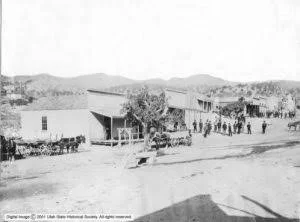
The success of Horn Silver contributed to the rapid growth of Frisco.
Businesses appeared to serve the mining population. Housing expanded. Freight networks developed. Industrial facilities were constructed.
This growth produced an urban environment whose existence depended fundamentally on mineral extraction.
The town's economic structure was therefore highly specialized.
Boomtown Psychology
Mining booms produced powerful expectations.
News of rich discoveries could attract people from hundreds of miles away. Newspapers and mining publications frequently celebrated discoveries and promoted investment.
Speculation became part of the economic culture.
Mining shares could rise rapidly when new ore was discovered and collapse when production failed to meet expectations.
This speculative environment created opportunities for entrepreneurs but also significant financial risk.
Industrial Expansion
The Horn Silver operation required increasingly sophisticated processing facilities.
Ore had to be transported from underground workings to surface facilities and then processed into forms suitable for shipment.
The presence of smelters and other processing infrastructure indicates that Frisco was not simply a mining camp. It had become an industrial center.
Why Boomtowns Collapsed
Mining towns commonly declined for several interconnected reasons.
One was geological uncertainty.
Ore bodies are finite and irregular. Rich zones can suddenly narrow or disappear.
Another was market volatility.
Changes in metal prices could transform profitable operations into marginal ones.
Technology also mattered. A mine might become less competitive compared with deposits using newer extraction or processing methods.
Transportation costs were another important factor.
The collapse of a mining town was therefore rarely caused by one event.
The Human Consequences
Economic decline affected every part of the community.
When mines reduced operations, workers left to find employment elsewhere. Merchants lost customers. Hotels emptied. Property values fell.
Buildings that had been essential during the boom became unnecessary.
Some were dismantled for construction materials. Others deteriorated.
The physical ruins visible today therefore represent the final stage of a much larger economic transformation.
Archaeological Evidence
Archaeologists can reconstruct the economic history of the district through material remains.
Mining tools reveal work practices.
Bottle fragments reveal commercial activity.
Ceramics provide evidence of household consumption.
Foundations reveal the organization of industrial and residential spaces.
Ore-processing waste demonstrates metallurgical activity.
Cemeteries provide information about mortality, demographics, and community structure.
Taken together, these materials create a more complicated picture than written accounts alone.
Conclusion
The Horn Silver Mine illustrates the extraordinary speed with which mineral discoveries could transform the Utah desert into an industrial settlement. Its subsequent decline demonstrates an equally important truth: mining communities were economically dependent upon geological deposits and global markets.
The ruins of Frisco preserve this cycle in physical form, making the Horn Silver story an important case study in western industrial archaeology.