Introduction
Few archaeological landscapes in Scandinavia possess the symbolic power of Gamla Uppsala.
Located in central Sweden, Gamla Uppsala became one of the most important political and religious centers of pre-Christian Scandinavia. Its enormous burial mounds, ceremonial landscape, royal associations, and later Christian history combine to create one of the richest archaeological environments for understanding early Swedish society.
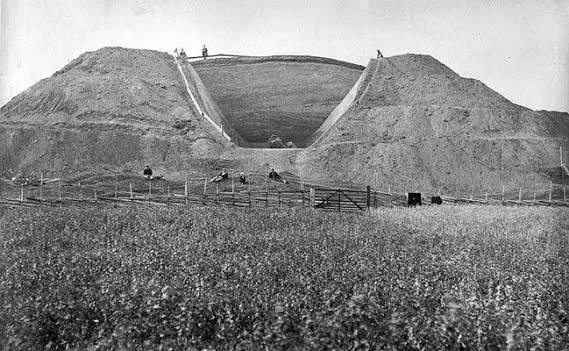
The most famous monuments are the monumental burial mounds traditionally known as the Royal Mounds.
Rising dramatically from the surrounding landscape, they demonstrate the ability of Iron Age communities to organize enormous amounts of labor for commemorative and political purposes.
Gamla Uppsala was not simply a cemetery.
It was a center of power.
The Royal Mounds
The three largest mounds dominate the archaeological landscape.
They are generally associated with the Migration Period and Vendel Period, although their precise dates and identities remain subjects of scholarly investigation.
The construction of such monuments required enormous labor.
Earth and other materials had to be collected and transported.
The mound had to be carefully constructed around the burial.
Its impressive size ensured that the deceased remained physically and visually connected with the surrounding landscape.
Monumental burial therefore served both religious and political purposes.
Royal Burial and Social Power
Burial mounds were expressions of status.
A modest burial could communicate one social position, while a monumental mound communicated another.
At Gamla Uppsala, the scale of the monuments indicates access to substantial resources.
The individuals buried beneath them were probably members of an elite with significant political influence.
However, archaeologists cannot simply assume that every mound contained a king.
The exact identities of the people buried within the largest mounds remain uncertain.
This uncertainty is important because archaeology distinguishes between evidence and later tradition.
Gamla Uppsala as a Political Center
The site appears to have been more than a burial ground.
Archaeological investigations have identified evidence of substantial settlement and large halls.
Such buildings could accommodate feasting, political gatherings, ceremonies, and elite activities.
Feasting was an important mechanism of political authority.
A powerful leader could demonstrate generosity by distributing food and drink.
Guests could establish alliances through shared meals.
Political loyalty could therefore be strengthened through hospitality.
Religious Significance
Gamla Uppsala became closely associated with pre-Christian Scandinavian religion.
Medieval written sources describe a major pagan sanctuary in the region.
One famous account describes a temple containing images of gods such as Thor, Odin, and Freyr.
However, these descriptions were written after Scandinavia had become Christian and must therefore be interpreted cautiously.
Archaeology cannot independently confirm every detail described in medieval texts.
Nevertheless, the combination of monumental burial, elite settlement, ceremonial structures, and landscape organization strongly suggests that religious activities were important at Gamla Uppsala.
Sacrifice and Ritual
Animal remains from the broader archaeological environment have provided evidence relevant to ritual activity.
Animals were important in Scandinavian religious practices.
Sacrificial ceremonies could involve cattle, horses, pigs, sheep, and other animals.
Their remains may appear in unusual archaeological contexts.
Such discoveries help archaeologists investigate whether certain areas were used for ritual rather than ordinary food consumption.
Religion was therefore deeply integrated with political and economic life.
The Landscape as a Monument
One of Gamla Uppsala's greatest characteristics is its landscape.
The mounds were not isolated monuments.
They existed within a broader ceremonial environment.
Roads, buildings, open spaces, burial areas, and natural features interacted with one another.
The placement of monuments influenced how people moved through the landscape.
A visitor approaching the site would have encountered the mounds as enormous visual statements.
The landscape communicated permanence, ancestry, and authority.
Feasting Halls
Large halls were central to elite Scandinavian society.
A hall could serve as a political headquarters, ceremonial space, dining area, and residence.
The architecture itself could communicate status.
Large wooden structures required substantial resources and skilled construction.
Within the hall, social hierarchy could be physically represented through seating arrangements.
The ruler or leading figure occupied a prominent position.
Feasting therefore combined architecture, food, gift exchange, storytelling, and political negotiation.
Connections With the Wider Scandinavian World
Gamla Uppsala was part of extensive networks.
Goods, ideas, artistic styles, and people moved across Scandinavia and the Baltic region.
Objects discovered at elite sites can sometimes be linked to distant manufacturing traditions.
This demonstrates that early Swedish elites were not isolated.
They participated in international networks that connected Scandinavia with continental Europe and the eastern Baltic.
Christianity and Transformation
The history of Gamla Uppsala continued after the conversion of Sweden.
Christian institutions were established at the site.
The medieval church became an important symbol of the transformation of Swedish society.
The old religious landscape was not simply erased.
Instead, Christian institutions emerged within a landscape already loaded with political and cultural significance.
This process illustrates how Christianization could involve both replacement and adaptation.
The Archaeological Importance of Gamla Uppsala
Modern archaeology has transformed our understanding of the site.
Excavations have revealed settlement remains, craft activity, animal bones, burial evidence, and architectural structures.
Geophysical surveys have also helped identify buried features without excavating everything.
These techniques allow researchers to reconstruct the settlement on a much larger scale.
The result is a picture of a complex center rather than a simple cemetery.
Myth, Memory, and History
Gamla Uppsala occupies an unusual position between archaeology and mythology.
Later traditions associated the site with legendary Swedish kings and gods.
Such traditions cannot automatically be treated as literal historical records.
However, they remain historically significant because they demonstrate how later generations remembered the landscape.
Places of political importance often accumulate stories.
The landscape becomes a repository of collective memory.
Conclusion
Gamla Uppsala represents one of the most important archaeological landscapes of Iron Age Scandinavia.
Its monumental mounds demonstrate elite power.
Its halls reveal political and social organization.
Its ritual evidence illustrates the importance of religion.
Its later Christian history shows how dramatically Scandinavian society changed.
Above all, Gamla Uppsala demonstrates that landscapes themselves could become instruments of power.
The great mounds were visible declarations that important ancestors had lived, ruled, and been remembered.
For centuries, their presence helped preserve the memory of an earlier Scandinavian world.