For over a century, the origins of the Bronze Age Minoan civilization (c. 2600–1100 BCE) on the island of Crete were shrouded in intense archaeological controversy. Sir Arthur Evans, the British archaeologist who unearthed the magnificent Palace of Knossos, famously hypothesized that the Minoans were a displaced, elite elite population from North Africa or the Middle East, arguing that their highly sophisticated architecture, vibrant frescoes, and advanced maritime trade networks were too complex to have developed from the local Aegean population.
However, modern paleogenomics has decisively corrected this assumption, uncovering a profound genetic continuity that links the ancient builders of the Labyrinth directly to the modern inhabitants of Greece.
                         [ THE AEGEAN GENETIC PIPELINE ]
                                       │
         ┌─────────────────────────────┴─────────────────────────────┐
         ▼                                                           ▼
 [ ANCIENT NEOLITHIC BASELINE ]                            [ LATER BRONZE AGE INPUTS ]
 * Western Anatolian Farmers (~75% Core)                  * Caucasus / Iranian Admixture
 * Aegean Indigenous Foragers                             * Northern Steppe (Mycenaean Only)
         │                                                           │
         └─────────────────────────────┬─────────────────────────────┘
                                      ▼
             [ GENETIC ENDPOINT: High Continuity in Modern Greeks ]
The Archaeogenetic Extraction
To solve this historical enigma, an international coalition of geneticists and archaeologists harvested and mapped genome-wide data from ancient skeletons recovered from Minoan tombs across Crete, Mycenaean burials on the Greek mainland, and Bronze Age remains from southwestern Anatolia.
Despite the notoriously poor preservation of ancient DNA (aDNA) in the warm, humid climate of the Mediterranean, researchers successfully isolated high-quality nuclear DNA from the petrous bone of the inner ear, providing an uncompromised genetic snapshot of the Bronze Age Aegean.
The Ancestral Blueprint
The paleogenomic results revealed a highly localized, distinct ancestry profile that rewrote Aegean prehistory:
The Neolithic Core: The data proved that the Minoans were not foreign invaders. They derived at least three-quarters ($75\%$) of their genetic ancestry directly from the first Neolithic farmers who had migrated from Western Anatolia and the Aegean islands thousands of years prior. They were, genetically speaking, indigenous locals who evolved in place.
The Eastern Admixture: The remaining quarter of Minoan ancestry showed a distinct genetic signature linked to ancient populations from the Caucasus and Iran. This indicates a previously unrecorded, prehistoric migration event across the Mediterranean corridor during the 4th-2nd millennium BCE, bringing new cultural and genetic layers to Crete without erasing the native population.
The Mycenaean Divide and Modern Continuity
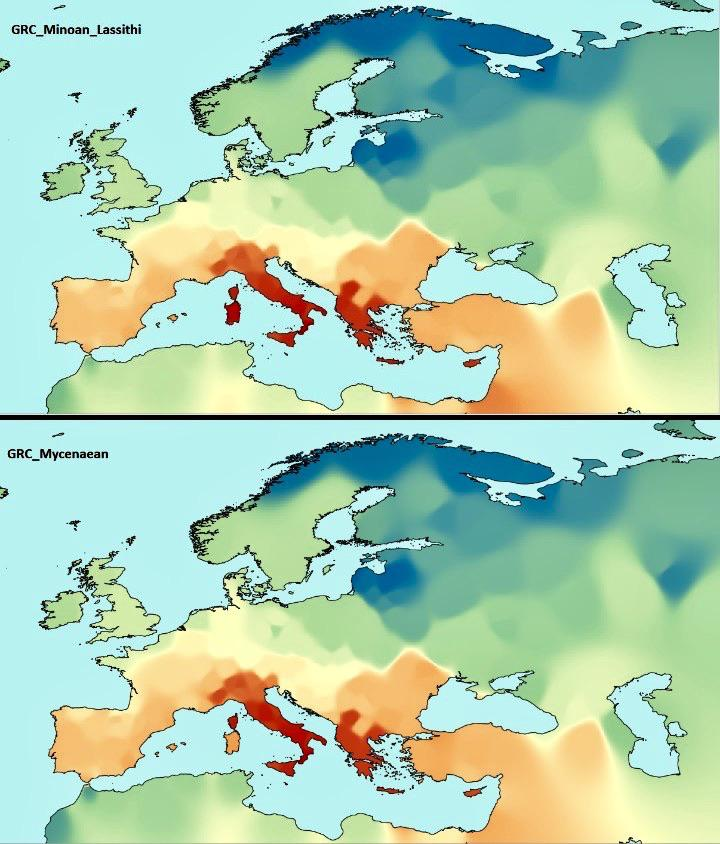
The study also analyzed the Mycenaeans of mainland Greece—the militaristic society celebrated in Homer’s Iliad. The genetic data revealed that while Mycenaeans and Minoans were incredibly close cousins sharing the same basic Anatolian-Caucasus genetic foundation, the Mycenaeans possessed a critical genetic difference: they carried an additional $4\% \text{ to } 16\%$ of ancestry derived from Eastern European and Siberian hunter-gatherers, introduced via pastoralists from the Eurasian steppe.
When geneticists compared these ancient Bronze Age profiles to modern populations, the results were striking. Modern Greeks are genetically bound directly to these Bronze Age civilizations. While the modern Greek genome shows subtle dilution and subsequent admixture with later historical migrations through the Balkans and the Mediterranean, the foundational core remains heavily anchored to the Mycenaean and Minoan baselines. The Greeks, as paleogenomicists note, have been a genetic "work in progress" for millennia, adding new layers of cultural and biological migration without ever erasing the genetic ghosts of Europe's first literate societies.