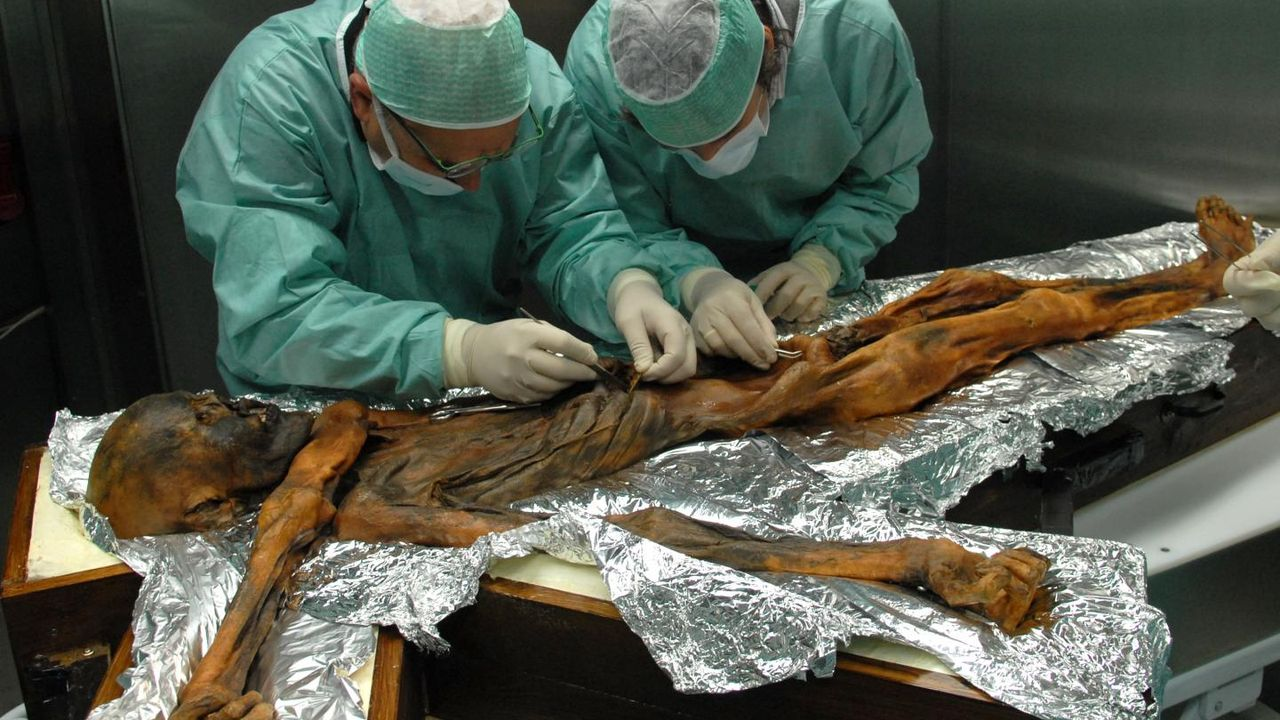
When Ötzi the Iceman—a beautifully preserved 5,300-year-old glacier mummy—was discovered sticking out of the alpine ice on the Austro-Italian border in 1991, he became an instant scientific sensation. For decades, researchers subjected his hair, clothes, and bones to exhaustive analysis. However, a major anatomical mystery remained: his actual stomach appeared to be missing on early CT scans.
It wasn't until a comprehensive re-examination of his internal thoracic cavity that radiologists discovered his stomach had migrated upward into his chest cavity as his body naturally mummified under the crushing weight of the glacier.
The subsequent extraction and meticulous molecular analysis of his true stomach contents delivered an absolute dietary shock to paleonutritionists.
[ PRE-ANALYSIS ASSUMPTION ] ──► Lean, Spartan, Neolithically Cleansed Forager Diet
                                            │
                                (High-Definition Biomarker Scan)
                                            │
                                            ▼
[ MOLECULAR TRUTH ] ──────────► 46% Pure Adipose Fat: High-Velocity Glacier Fuel
The Molecular Reconstruction of the Last Meal
Using a cutting-edge combination of shot-gun metagenomics, microscopic macroremain analysis, and stable isotope tracking, scientists successfully reconstructed the final hours of Ötzi's life through his digestive tract.
The analysis proved that approximately 30 to 120 minutes before his violent murder on the high mountain pass, Ötzi sat down to a highly deliberate, exceptionally energy-dense meal:
The High-Fat Bomb: To the shock of researchers, up to 46% of the total stomach content was composed of pure animal fat. This was not lean meat; it was highly concentrated, greasy adipose fat derived from the Alpine ibex (Capra ibex) and red deer (Cervus elaphus).
The Ancient Grain Base: This massive dose of wild animal fat was paired with finely ground einkorn wheat (Triticum monococcum), one of the oldest domesticated grains of the European Neolithic. The presence of charred bran fragments suggests the grain was consumed not as a wet porridge, but as a dense, hard-baked unleavened flatbread.
The Toxic Medicinal Accompaniment: Most bizarrely, the analysis detected significant quantities of spores and tissue from the bracken fern (Pteridium aquilinum), an incredibly toxic, carcinogenic plant. Scientists hypothesize that Ötzi was intentionally consuming this poison as a form of primitive medicine to treat the severe human whipworm (Trichuris trichiura) infestation actively documented in his colon, using the toxic plant to paralyze the intestinal parasites.
Reworking the Neolithic Diet Paradigm
The extreme fat content of Ötzi's stomach fundamentally disrupted our understanding of prehistoric human survival mechanics. For decades, archaeologists envisioned the European Chalcolithic diet as a spartan, lean, and highly unstable agricultural existence.
Ötzi's last meal proved that high-altitude copper-age hunters possessed a sophisticated, intuitive mastery of human thermodynamics.
They understood that to survive, travel, and hunt in a freezing, sub-zero alpine environment at 3,200 meters above sea level, a human cannot rely on lean protein or simple carbohydrates. They required a high-velocity, slow-burning caloric engine fueled by pure, unrendered wild fat, transforming our view of prehistoric nutrition from accidental foraging to deliberate, high-performance survival engineering.