Introduction
Pottery is among the most informative forms of archaeological evidence for understanding past communities. Unlike many organic materials that decay over time, fired clay can survive for centuries or even millennia under suitable conditions. Fragments of pots may reveal how people prepared food, stored grain, transported liquids, exchanged goods, and expressed cultural identity through decoration.
The title Ha Thetsane: Lesotho's Iron Age Pottery places this important material evidence within the archaeological history of Lesotho. The Iron Age is generally associated with communities that practiced farming and livestock keeping and made use of iron technology, although the timing and character of these developments varied across Southern Africa. The presence of pottery at a site does not, by itself, prove that every associated activity belongs to a single Iron Age occupation.
Understanding the Iron Age in Southern Africa
The term Iron Age is an archaeological classification rather than a claim that iron was the only important material used by a society. Communities classified within the Iron Age could also use stone tools, wooden implements, bone, clay, and other materials.
In Southern Africa, the development and spread of farming, livestock keeping, ironworking, and pottery production occurred through complex processes involving migration, interaction, local innovation, and the exchange of knowledge. These processes did not happen everywhere at the same time.
Archaeologists therefore study individual regions carefully rather than assuming that a single timeline applies to the entire subcontinent. In the highlands of present-day Lesotho, settlement patterns were influenced by elevation, climate, water availability, grazing opportunities, and access to agricultural land.
Pottery provides one way to investigate how communities living in this environment organized their domestic activities and maintained connections with neighboring groups.
How Ancient Pottery Was Made
Traditional pottery production involved several stages. First, potters collected clay from suitable deposits. They might process it to remove stones and other unwanted material, then mix it with temper, such as crushed rock or other substances, to alter its working properties and reduce cracking during drying and firing.
Vessels could be formed by pinching, coiling, or combining techniques. Coiling involved adding successive rolls of clay and smoothing them together to create the desired shape. The potter then refined the vessel's walls, rim, base, and surface.
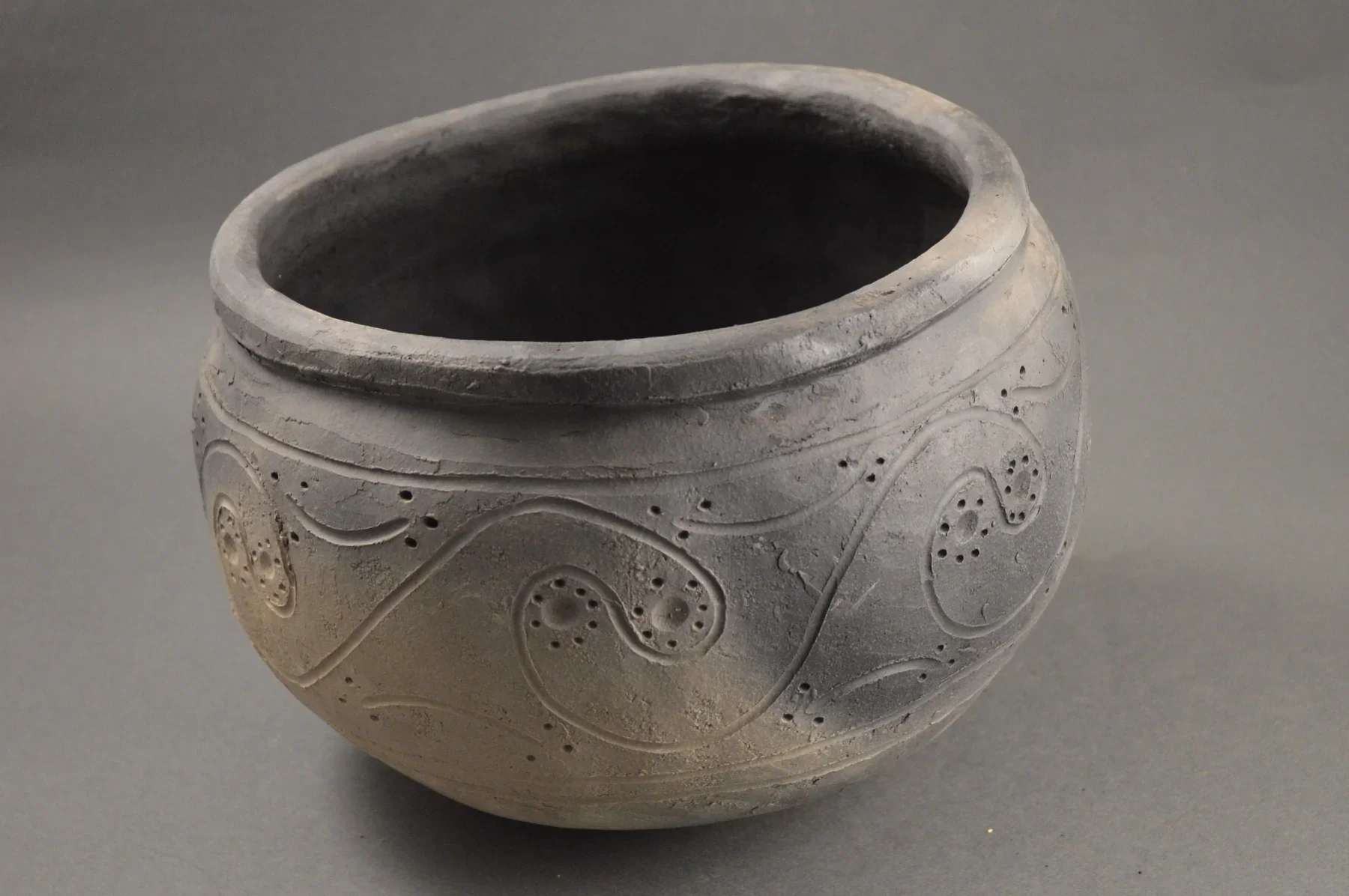
Decoration could be applied using impressions, incisions, grooves, ridges, or other techniques. These patterns were not merely aesthetic. They may reflect learned traditions, individual choices, practical requirements, or the influence of neighboring communities.
The vessel was dried before firing. In many traditional production systems, firing took place in an open fire or a relatively simple firing arrangement rather than a large permanent kiln. Differences in temperature, oxygen supply, fuel, and the vessel's position could influence its final color and strength.
What Pottery Can Reveal
Pottery fragments are valuable because they preserve evidence of both technology and behavior. The thickness of a vessel's walls, its rim shape, and the composition of its clay can help researchers infer how it was made and used.
Large, sturdy vessels may have been suitable for storage or cooking, while smaller vessels could have served other domestic or ceremonial purposes. However, function should not be assigned from size alone. Residue analysis, wear patterns, vessel shape, and comparison with ethnographic evidence can strengthen an interpretation.
Decoration can also help researchers identify similarities between assemblages from different sites. If vessels from Ha Thetsane resemble pottery from other parts of Lesotho or neighboring regions, this may indicate shared manufacturing traditions or interaction between communities.
Such similarities do not necessarily prove direct migration. Ideas and styles can spread through exchange, intermarriage, visits, imitation, and the movement of individual craftspeople.
Pottery and Everyday Life
The manufacture and use of pottery were closely connected to household routines. Cooking vessels helped transform cultivated crops and animal products into meals. Storage containers could protect food from moisture, insects, and other sources of spoilage, depending on their design and the conditions in which they were kept.
Pottery also provides a window into labor and knowledge. Producing a durable vessel requires familiarity with clay, moisture, shaping, drying, and firing. Such expertise may have been passed between generations through observation and practice.
A pottery assemblage can therefore reveal aspects of daily life that written records rarely describe. Even a small fragment may preserve a rim profile, decorative pattern, or manufacturing mark that helps researchers reconstruct a broader technological tradition.
Dating and Archaeological Context
The archaeological context of pottery is essential. A fragment found on the surface may have been moved from its original location by erosion, farming, construction, or later occupation. A fragment recovered from a carefully excavated layer provides stronger contextual information.
Pottery itself is not always directly datable. Researchers often establish its age through associated charcoal, seeds, bones, or other materials that can be dated using appropriate scientific methods. The reliability of the date depends on whether the dated material genuinely belongs to the same occupation.
Archaeologists must also consider that a settlement may have been occupied repeatedly. Pottery from different periods can become mixed, especially where later people dug into earlier deposits.
Conservation and Research
Pottery fragments are vulnerable to careless handling, weathering, and the loss of their archaeological context. Collecting objects without recording where they were found can destroy information that may be more valuable than the object itself.
Systematic recording, photography, specialist analysis, and collaboration with local heritage institutions can preserve this evidence for future study.
Conclusion
Ha Thetsane's pottery offers a valuable subject through which to explore technology, food preparation, household organization, and cultural interaction in Lesotho's past. The significance of the material lies in the combination of its physical characteristics and the archaeological context in which it is found.
When carefully studied, pottery can help researchers reconstruct how communities adapted to their environment, maintained craft traditions, and interacted with others. It reminds us that ordinary objects used in daily life often provide some of the clearest evidence for understanding the complexity of the past.