Deep within the Ach Valley of southwestern Germany lies Hohle Fels, one of the world's most important archaeological sites for understanding the emergence of Upper Paleolithic art, music, symbolic behavior, and modern human culture.
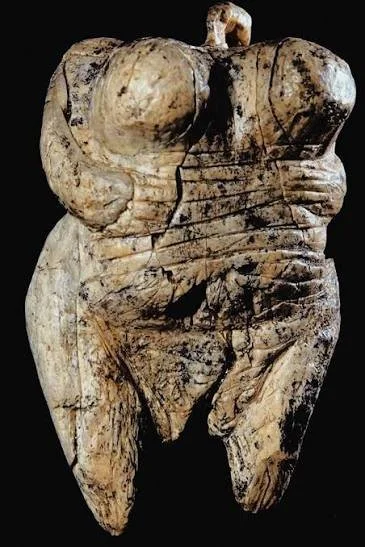
The cave is particularly famous for the Venus of Hohle Fels, a small female figurine carved from mammoth ivory and dated to approximately 40,000 years ago.
Discovered in 2008, the figurine is one of the earliest known examples of figurative human representation and is generally dated to the Aurignacian period. The University of Tübingen describes it as approximately 40,000 years old and among the most important early representations of a human figure.
The figurine is only a few centimeters high.
Yet its significance is enormous.
The Hohle Fels Cave
Hohle Fels is located near Schelklingen in the Ach Valley of Baden-Württemberg.
The cave formed in Jurassic limestone and contains archaeological layers spanning both the Middle and Upper Paleolithic.
Researchers from the University of Tübingen have conducted excavations at the site since 1977.
The cave is therefore important not because of one object alone.
It contains a long archaeological record.
The Aurignacian
The Venus belongs to the Aurignacian, an Upper Paleolithic archaeological tradition associated with early Homo sapiens in Europe.
The Aurignacian is famous for technological and symbolic innovations including:
blade production,
bone and antler tools,
ornaments,
ivory carving,
figurative art,
and musical instruments.
Hohle Fels contains several of these categories.
It is therefore an exceptional site for examining the emergence of early modern human culture in Europe.
Discovery of the Venus
In 2008, archaeologists recovered six fragments of mammoth ivory.
At first, the pieces appeared incomplete.
When researchers carefully reconstructed them, they formed a small female figurine.
The sculpture measures approximately 5.97 centimeters in height.
Its discovery transformed the archaeological significance of Hohle Fels.
What Does the Figurine Depict?
The figurine clearly represents a human female body.
It has exaggerated:
breasts,
abdomen,
hips,
and genital region.
The head is absent.
Instead, the upper portion of the figure includes a small perforation or loop-like feature.
This unusual design has led to speculation that the figurine may have been suspended or worn.
However, the precise function remains unknown.
The Missing Head
The absence of a head is particularly interesting.
The figure does not appear to be unfinished simply because of damage.
Its design incorporates the upper body and leaves the head absent.
The perforated area could have allowed the object to be suspended.
This raises the possibility that the figurine was worn as a pendant.
But this remains an interpretation.
Why "Venus"?
The term Venus is a modern archaeological convention.
It does not mean that Paleolithic people worshipped the Roman goddess Venus.
The name was adopted because of the figurine's female form and the later tradition of calling prehistoric female figurines "Venuses."
The actual cultural meaning of the Hohle Fels figurine is unknown.
Possible Interpretations
Researchers have proposed numerous possibilities.
The figurine could have represented:
fertility,
sexuality,
motherhood,
an ancestor,
an individual woman,
an idealized body,
social identity,
or a symbolic figure.
Some interpretations are more speculative than others.
There is currently no written evidence telling us what the artist intended.
The Body as a Cultural Symbol
The figurine demonstrates that the human body had become an important subject of visual representation.
This is significant.
Animals had already appeared in prehistoric art.
But the creation of a three-dimensional human figure demonstrates another dimension of symbolic behavior.
The artist was not merely recording an animal.
The artist was representing members of the same species.
Mammoth Ivory
The choice of mammoth ivory is itself technologically significant.
Ivory is hard.
It requires specialized tools.
The artist had to understand:
the structure of the material,
how it fractures,
how it can be carved,
and how to achieve a desired shape.
The process likely required considerable time.
The Figurine and Skilled Craftsmanship
The finished sculpture is small but carefully executed.
The artist had to create anatomical forms at miniature scale.
The exaggerated proportions appear deliberate.
The craftsmanship demonstrates that early Aurignacian people possessed sophisticated carving skills.
Hohle Fels and Early Music
The Venus was not the only extraordinary discovery.
The same cave produced fragments of an early musical instrument.
The University of Tübingen reports that a flute made from a griffon-vulture wing bone was found approximately 70 centimeters from the Venus in the same broad archaeological context. It retained a mouthpiece, five finger holes, and a length of approximately 21.8 centimeters.
This association is remarkable.
The cave preserves evidence for both:
visual representation
and
music.
The Bird Figurines
Hohle Fels also contains animal figurines.
These include representations of:
horses,
birds,
and other animals.
The cave therefore reveals a broader artistic repertoire rather than a single isolated human sculpture.
The Lion Man Connection
The region around the Swabian Jura has produced several famous ivory sculptures.
The Lion Man from nearby Hohlenstein-Stadel is another extraordinary Aurignacian figure.
Together with Hohle Fels, these discoveries demonstrate that southwestern Germany was a major center of early figurative art.
The Swabian Jura
The caves of the Swabian Jura have produced some of the world's earliest known figurative artworks and musical instruments.
The region includes:
Hohle Fels,
Geißenklösterle,
Hohlenstein-Stadel,
and other important Paleolithic sites.
These sites collectively demonstrate a remarkable concentration of symbolic culture.
Human Expansion and Symbolic Culture
The emergence of figurative art in Europe is often discussed in connection with the arrival and expansion of Homo sapiens.
The Hohle Fels figurine contributes to this broader debate.
It demonstrates that early modern humans in Europe were capable of producing sophisticated symbolic objects very early in the archaeological record.
This does not mean that symbolic cognition suddenly appeared at one precise moment.
The evolution of symbolic behavior was likely much older and more complex.
The Meaning of the Figurine
The safest conclusion is that the figurine had symbolic significance.
Its deliberate carving, unusual proportions, and placement within an Aurignacian archaeological context distinguish it from an ordinary utilitarian tool.
But exactly what it symbolized remains unknown.
That uncertainty should be preserved rather than replaced with a confident but unsupported story.
A Portable Object
Unlike cave paintings, the Venus was portable.
Someone could carry it.
The perforation reinforces the possibility that it may have been suspended.
If it was worn, the object could have functioned as a personal symbol.
This raises fascinating questions about identity.
Perhaps people used such objects to communicate:
belonging,
social roles,
age,
status,
ancestry,
or personal beliefs.
The Figurine and Human Imagination
Regardless of its exact meaning, the Venus demonstrates something fundamental.
The artist was capable of taking a physical human body and transforming it into an abstract cultural object.
The sculpture is not a natural body.
It is an interpretation.
The artist selected particular features and exaggerated them.
This demonstrates intentional representation.
The Importance of Hohle Fels
The cave's importance extends far beyond the Venus.
Its archaeological layers preserve evidence of:
Neanderthal occupation,
early modern human occupation,
stone tools,
bone and ivory technology,
ornaments,
figurative art,
musical instruments,
and subsistence practices.
This makes Hohle Fels an exceptional laboratory for studying the transition from Middle to Upper Paleolithic lifeways.
Recent Discoveries
The cave continues to produce important finds.
In 2025, archaeologists recovered two tiny mammoth-ivory bird figurines from Aurignacian layers, adding to an earlier bird figurine discovered in 2001. The new pieces were reported in 2026 and demonstrate continued artistic production at the site approximately 40,000 years ago.
These discoveries further strengthen Hohle Fels' reputation as one of Europe's most important centers of early figurative art.
Conclusion
Hohle Fels is one of the most extraordinary prehistoric sites in Europe.
Its approximately 40,000-year-old ivory Venus represents one of the earliest known human figurative sculptures and provides compelling evidence of sophisticated symbolic expression during the Aurignacian.
Yet the figurine becomes even more significant when viewed within its archaeological context.
The same cave produced musical instruments, animal figurines, ornaments, tools, and evidence of repeated human occupation.
The Venus therefore should not be understood as an isolated masterpiece.
It is part of a larger cultural transformation in which early modern humans were creating new forms of visual representation, music, personal ornamentation, and technological expression.
The tiny ivory figure ultimately tells us something enormous about human history:
tens of thousands of years ago, people were already using art to transform the human body, natural materials, and the surrounding world into expressions of ideas that could outlive the individuals who created them.