Neumark-Nord is one of the most important Middle Paleolithic archaeological landscapes in Germany for understanding Neanderthal subsistence, landscape use, animal hunting, and resource management.
Located in Saxony-Anhalt, the site complex preserves evidence from the Last Interglacial, approximately 125,000 years ago.
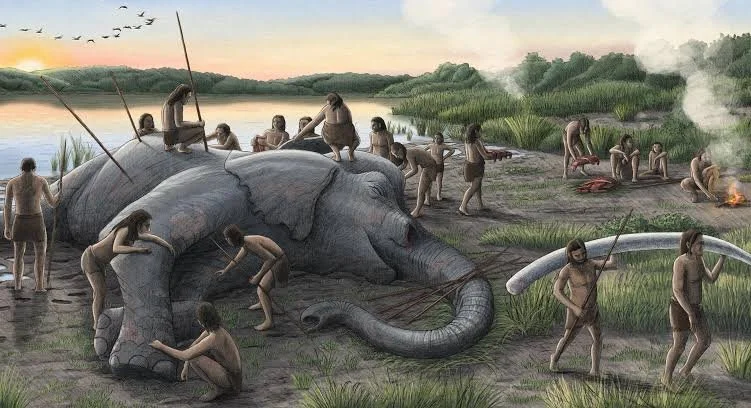
The site is particularly famous for evidence that Neanderthals hunted and butchered enormous straight-tusked elephants (Palaeoloxodon antiquus).
These animals were among the largest terrestrial mammals of the Pleistocene.
The archaeological evidence therefore provides an extraordinary picture of Neanderthal hunters confronting animals weighing many tons.
The Last Interglacial
Approximately 125,000 years ago, Europe experienced the Eemian or Last Interglacial.
The climate was considerably warmer than during the glacial periods that followed.
Large portions of northern Europe contained forests, lakes, wetlands, and productive ecosystems.
Neanderthals occupied this landscape.
Neumark-Nord preserves evidence of their interaction with it.
The Straight-Tusked Elephant
The main elephant species was Palaeoloxodon antiquus, commonly called the straight-tusked elephant.
These animals were enormous.
Some individuals could weigh many tonnes.
They possessed massive tusks and powerful bodies.
Successfully killing one would have been an extraordinary achievement.
But the archaeological evidence indicates that Neanderthals repeatedly exploited them.
Evidence for Hunting
The 2023 archaeozoological study of the Neumark-Nord elephant assemblage concluded that elephant hunting formed part of the cultural repertoire of Last Interglacial Neanderthals over more than 2,000 years, representing many generations.
This is a major conclusion.
The evidence does not represent a single lucky encounter.
It indicates repeated behavior.
Butchery Marks
The elephant bones preserve traces of human processing.
Cut marks indicate that Neanderthals removed tissues from the carcasses.
The location of the marks can provide information about butchery strategy.
Neanderthals were not simply encountering dead elephants.
They were systematically processing them.
Why Hunt an Elephant?
Large animals provide enormous quantities of food.
A successful elephant hunt could provide:
meat,
fat,
marrow,
hides,
tendons,
bones,
and other materials.
However, large animals also present significant logistical challenges.
A single group could not necessarily consume an entire elephant immediately.
The carcass therefore had to be processed and managed.
Nutritional Efficiency
Recent research has emphasized the importance of fat.
Fat provides a high caloric return.
In environments where meat is abundant but carbohydrates are limited, access to fat can be especially valuable.
Neumark-Nord demonstrates that Neanderthals understood how to exploit within-bone nutrients.
The "Fat Factory"
A 2025 Science Advances study identified evidence of large-scale processing of animal bones at Neumark-Nord.
Researchers found evidence that Neanderthals processed at least 172 large mammals at a lakeside location to extract bone grease and other within-bone nutrients.
This has been described as a prehistoric "fat factory."
The term is modern, but it captures the organized nature of the activity.
How Was Bone Grease Extracted?
The process was labor-intensive.
Large bones were broken into fragments.
The fragments were then processed to release fat.
Evidence suggests that the material was heated in water.
This allowed grease to separate and be collected.
The process required:
obtaining carcasses;
transporting selected body parts;
breaking bones;
heating fragments;
extracting fat;
collecting and storing the resulting resource.
This is an elaborate sequence.
Resource Intensification
The behavior represents what archaeologists call resource intensification.
Instead of simply consuming the easiest-to-access food, people invest more labor to obtain additional nutritional value.
Bone grease is an excellent example.
It requires substantial effort.
But the caloric return can be significant.
The strategy therefore makes sense when groups have predictable access to large quantities of animal remains.
A Lakeside Processing Area
The location of the processing activity is significant.
Neanderthals apparently used particular parts of the landscape for particular tasks.
This suggests spatial organization.
A location near water could be advantageous for:
processing,
cleaning,
cooking,
extracting fat,
and disposing of waste.
Hunting and Planning
Large-scale elephant hunting requires planning.
Hunters need to know where animals travel.
They need to identify opportunities.
They need to coordinate.
They must decide how to process and transport the carcass.
This indicates that Neanderthal hunting was not simply spontaneous opportunism.
It could involve long-term knowledge of the landscape.
Social Group Size
The quantity of meat and fat produced by large-animal hunting has implications for social organization.
A single elephant can produce far more food than a small group can consume quickly.
This may indicate that larger social groups gathered around major resources or that carcass products were transported or preserved.
The researchers behind the elephant study argued that the evidence is consistent with Neanderthal social units being larger and less mobile than older models often assumed.
Neanderthals and Landscape Management
Neumark-Nord is valuable because it is not merely an isolated kill site.
The broader archaeological landscape preserves evidence of repeated human activity.
Researchers have investigated:
vegetation,
animal populations,
lakes,
hunting,
butchery,
fire,
and resource processing.
This allows archaeologists to reconstruct Neanderthal interaction with an entire environment.
Beyond the Mammoth Image
The title refers to a "mammoth hunt," but the primary species at Neumark-Nord was the straight-tusked elephant, not the woolly mammoth.
This distinction is scientifically important.
The woolly mammoth is associated primarily with colder Ice Age environments.
Straight-tusked elephants occupied warmer interglacial landscapes.
Neumark-Nord therefore represents a very different ecological world.
Why the Site Changed Perceptions
Older stereotypes portrayed Neanderthals as opportunistic scavengers.
Neumark-Nord provides strong evidence against such a simplistic model.
Repeated elephant hunting requires:
knowledge,
courage,
cooperation,
planning,
butchery skill,
and resource management.
The behavior is sophisticated.
The Scale of the Achievement
Imagine confronting an elephant several times larger than any modern terrestrial animal found in most of Europe.
Now imagine doing so using wooden weapons, stone tools, fire, and group coordination.
The archaeological record indicates that Neanderthals repeatedly accomplished this.
Their success required more than physical strength.
It required accumulated ecological knowledge.