Introduction
Ophir, located in Utah's Oquirrh Mountains, developed within the larger mining history of the Tooele Valley and surrounding Wasatch Front. Although Utah is particularly associated with silver, lead, copper, and later large-scale mining operations, gold also played a role in the territory's nineteenth-century mineral economy.
Ophir's history demonstrates that western mining districts rarely depended on one metal alone. Deposits could contain combinations of gold, silver, lead, copper, and other minerals, while the economic importance of each changed according to technology and market conditions.
Mining in the Oquirrh Mountains
The Oquirrh Mountains contain extensive mineral deposits created through complex geological processes.
These deposits attracted prospectors during Utah's nineteenth-century mineral expansion.
The mountains eventually became among the most important mining regions in the American West.
Ophir emerged within this broader mineral landscape.
From Prospecting to Permanent Settlement
Early prospecting was often temporary.
A prospector might locate mineralization, establish a small claim, and move elsewhere if the deposit failed to justify further investment.
Permanent communities required something different: enough ore and infrastructure to support sustained operations.
Once mining companies invested in tunnels, roads, mills, and other facilities, settlements became more stable.
Ophir's development reflects this transition.
Gold and Polymetallic Ores
Gold rarely occurs in isolation in many western ore districts.
It can occur alongside silver and base metals, meaning the profitability of mining depends on recovering multiple commodities.
Nineteenth-century metallurgical technology was often less effective than modern processing techniques. Some ores that contained valuable metals could therefore be difficult to exploit economically.
Advances in milling, concentration, roasting, and smelting changed what could be considered a profitable deposit.
The Mining Community
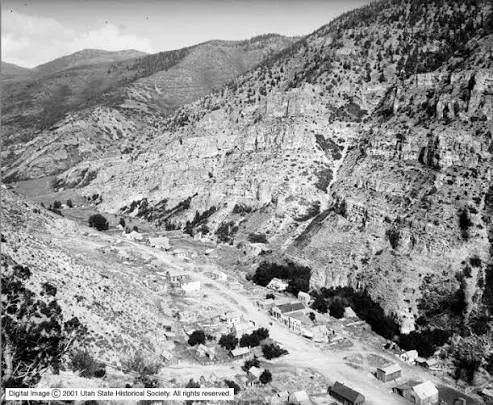
Ophir developed the institutions characteristic of western mining towns.
Businesses supplied miners with food, clothing, tools, and equipment.
Blacksmiths repaired tools and machinery.
Transportation workers moved ore and supplies.
Hotels and boardinghouses served workers and travelers.
Community institutions emerged as populations became more permanent.
These structures demonstrate that mining towns were functioning communities rather than temporary collections of miners.
Transportation
Transportation was one of the greatest challenges facing Utah's mining industry.
Mining machinery was heavy.
Ore was heavier.
Moving low-grade ore over long distances could destroy profitability.
Consequently, roads, wagon routes, railroads, and local processing facilities were essential.
The economic geography of Ophir was therefore shaped by transportation as much as geology.
Labor
Mining depended on specialized knowledge.
Workers learned to identify ore, operate drills, construct supports, use explosives, and operate machinery.
As mines became more industrialized, occupational specialization increased.
Miners also faced serious dangers.
Cave-ins, explosions, falls, machinery accidents, and respiratory hazards were common features of underground work.
Gold Rush Culture
The phrase "gold rush" evokes sudden migration and instant wealth, but mining historians increasingly emphasize that most prospectors did not become wealthy.
Mining booms redistributed wealth unevenly.
Mine owners and investors could profit enormously when production was successful, while wage workers generally received more predictable but limited compensation.
Merchants sometimes benefited from supplying mining communities regardless of which individual miners succeeded.
This distinction is essential to understanding western mining economies.
Archaeological Landscape
Historic Ophir can be studied through its remaining buildings, roads, mining features, foundations, dumps, and other material evidence.
Archaeologists can investigate where different economic activities occurred and how the settlement changed over time.
Domestic artifacts can reveal everyday life.
Industrial remains demonstrate technological practices.
Together, they show how ordinary people experienced the gold and mineral economy.
Long-Term Significance
Ophir belongs to a larger history of Utah's transformation during the nineteenth century.
Mining contributed to transportation development, population growth, technological change, and commercial integration.
It also contributed to environmental transformation and social conflict.
The landscape therefore contains both evidence of economic development and reminders of the costs of extraction.
Conclusion
Ophir's mining history demonstrates the complexity of Utah's nineteenth-century mineral economy. Gold was part of a broader system involving multiple metals, transportation networks, industrial technology, labor, investment, and settlement.
Its significance lies not simply in the amount of gold recovered but in the way mining transformed the landscape and created communities that connected Utah's mountain districts to wider markets.