Introduction
Kromdraai is one of the most important fossil-bearing sites in South Africa's Cradle of Humankind.
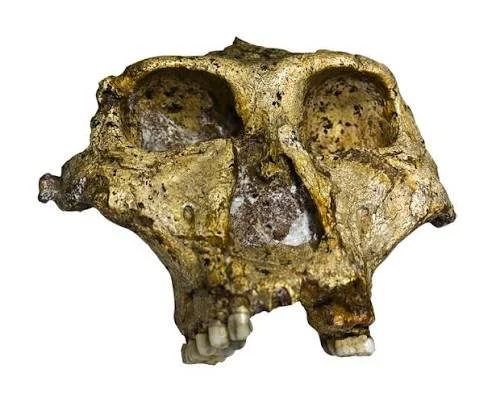
The site is historically significant because it produced the type specimen of Paranthropus robustus, a heavily built hominin characterized by powerful chewing anatomy.
Kromdraai is also important because its archaeological deposits contain stone tools and evidence of other hominins.
This makes it a particularly valuable site for understanding the diversity of early hominins in southern Africa.
Discovery of Paranthropus robustus
The first major discovery of Paranthropus robustus at Kromdraai occurred in the 1930s.
The specimen became the type specimen for the species.
A type specimen is especially important in biological classification because it establishes the reference point for identifying members of the species.
Robust Anatomy
Paranthropus robustus had powerful chewing adaptations.
Its skull was heavily built.
The teeth were relatively large.
The jaws were strong.
The anatomy has traditionally been interpreted as reflecting adaptation to demanding foods.
Diet
The exact diet of Paranthropus robustus has been debated.
For many years, researchers emphasized hard or tough foods.
Later dental microwear and isotopic studies complicated the picture.
The species may have consumed a broader range of foods than the classic "nut-crushing" model suggested.
This is an important example of scientific revision.
Brain
Despite its robust chewing apparatus, Paranthropus robustus had a relatively small brain compared with later Homo.
This demonstrates that brain expansion was not a universal feature of every hominin lineage.
Different evolutionary strategies existed simultaneously.
Kromdraai A and B
Kromdraai includes two major localities, commonly designated Kromdraai A and Kromdraai B.
Kromdraai B is especially associated with hominin fossils.
Kromdraai A has produced important faunal and archaeological material.
Modern research recognizes that these localities belong to the same broader cave complex.
A recent Cambridge synthesis notes that Kromdraai B produced the type specimen of Paranthropus robustus, while stone tools occur at both Kromdraai A and B.
Stone Tools
Kromdraai has produced Oldowan and early Acheulean-related artifacts.
This raises an important question:
Who made the tools?
The presence of Paranthropus robustus fossils and stone tools in the same broad archaeological landscape does not automatically prove that Paranthropus made them.
Early Homo has also been identified or proposed in the Kromdraai assemblage.
Multiple Hominins
This is one of Kromdraai's greatest scientific values.
The site demonstrates that multiple hominin populations could inhabit the same region.
Human evolution was therefore not a simple sequence in which one species replaced another instantly.
Different hominins overlapped.
They may have exploited different foods or habitats.
The Cradle of Humankind
Kromdraai belongs to the Cradle of Humankind World Heritage landscape.
UNESCO identifies the region as one of the world's most important concentrations of fossil evidence concerning human evolution.
The site's value is therefore both local and global.
Paleoenvironment
The landscape around Kromdraai changed through time.
Cave deposits preserve animal remains that help reconstruct ancient environments.
Predators, herbivores, and smaller mammals provide evidence of ecological conditions.
The hominins lived within these ecosystems rather than outside them.
Evolutionary Side Branch
Paranthropus robustus is generally understood as part of a robust australopithecine lineage rather than a direct ancestor of modern humans.
Its extinction illustrates that evolutionary success is not guaranteed by specialized adaptations.
A lineage can survive for hundreds of thousands of years and eventually disappear.
Scientific Importance
Kromdraai demonstrates why fossils must be interpreted together with geology and archaeology.
A skull reveals anatomy.
Animal fossils reveal ecology.
Stone tools reveal technology.
Sediments reveal geological history.
Only by combining these forms of evidence can researchers reconstruct the past.
Conclusion
Kromdraai is one of the defining sites in the study of Paranthropus robustus.
Its fossils reveal a distinctive hominin adapted to powerful chewing, while associated archaeological evidence demonstrates that the surrounding landscape was occupied by technologically capable hominins.
The site ultimately reinforces one of the central lessons of paleoanthropology: human evolution was a branching process involving multiple species, overlapping populations, experimentation, and extinction.