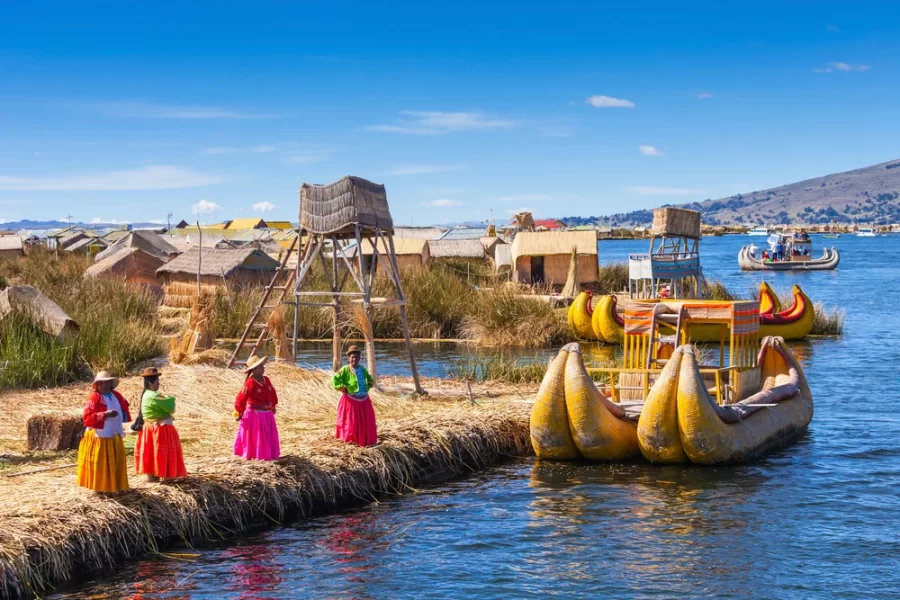
Perched high in the Andes mountains on the border of Peru and Bolivia, sitting at an altitude of 12,500 feet above sea level, Lake Titicaca is the highest navigable body of water in the world. To the ancient civilizations of the Andes—most notably the Tiwanaku empire (c. 500–1000 CE) and the later Inca Empire—Lake Titicaca was the absolute center of the cosmos. According to Andean creation myths, it was from the icy depths of this lake that the god Viracocha emerged to create the Sun, the Moon, and the first human beings.
                         [ TITICACA SACRED GEOGRAPHY ]
                                       │
         ┌─────────────────────────────┴─────────────────────────────┐
         ▼                                                           ▼
 [ INDIGENOUS UROS BIOSPHERE ]                             [ RECENT SUB-SURFACE DISCOVERIES ]
 Floating *totora* reed island ecosystems                   Sacrificial gold/silver llama statuettes
         │                                                           │
         └─────────────────────────────┬─────────────────────────────┘
                                      ▼
               [ RITUAL CORE: Submerged Santiago de Ojje Reef ]
The lake operates a fascinating dual architectural ecosystem: above the waves, the indigenous Uros people have maintained a continuous, millennia-old tradition of constructing entire living cities out of woven totora reeds, building floating artificial islands that can support houses, schools, and watchtowers. Meanwhile, deep beneath the surface sits a sprawling archive of stone structures and elite religious offerings that are rewriting the history of pre-Inca state power.
The Submerged Temples of the Khoa Reef
In the early 2000s, international underwater archaeological expeditions led by the Akakor Geographical Exploring team and Oxford University began systematic scuba and sonar surveys around the isolated Khoa and Santiago de Ojje reefs within the lake. Submerged beneath 20 to 30 feet of water, teams discovered massive, man-made stone walls, paved paths, and terrace structures that had been inundated over centuries due to shifting high-altitude precipitation patterns.
More important than the architecture were the breathtaking ritual artifacts preserved in the ultra-cold, low-oxygen lake water. For centuries, Tiwanaku and Inca priests sailed out to the center of the lake to drop elite offerings directly into the water:
The Llama Sculptures: Divers recovered dozens of tiny, exquisitely carved ceremonial box containers fashioned from rare Spondylus sea shells and solid silver, containing miniature figurines of llamas and alpacas hammered out of pure gold leaf.
The Ritual Ceramics: Teams extracted hundreds of intact Tiwanaku ceramic incense burners (incensarios) shaped like stylized jaguars, painted with intricate geometric slips and filled with residues of burned psychoactive resins.
Animal Sacrifices: The presence of juvenile llama skeletons alongside elite gold jewelry suggests that the lake floor was a permanent, sacred repository for complex propitiation rituals designed to stabilize the volatile Andean climate.
These underwater discoveries prove that long before the Inca established their empire, the Tiwanaku state was deploying highly advanced maritime technology to transform Lake Titicaca into a centralized, watery cathedral, binding the elite wealth of the Andes directly to the sacred memory of the water.