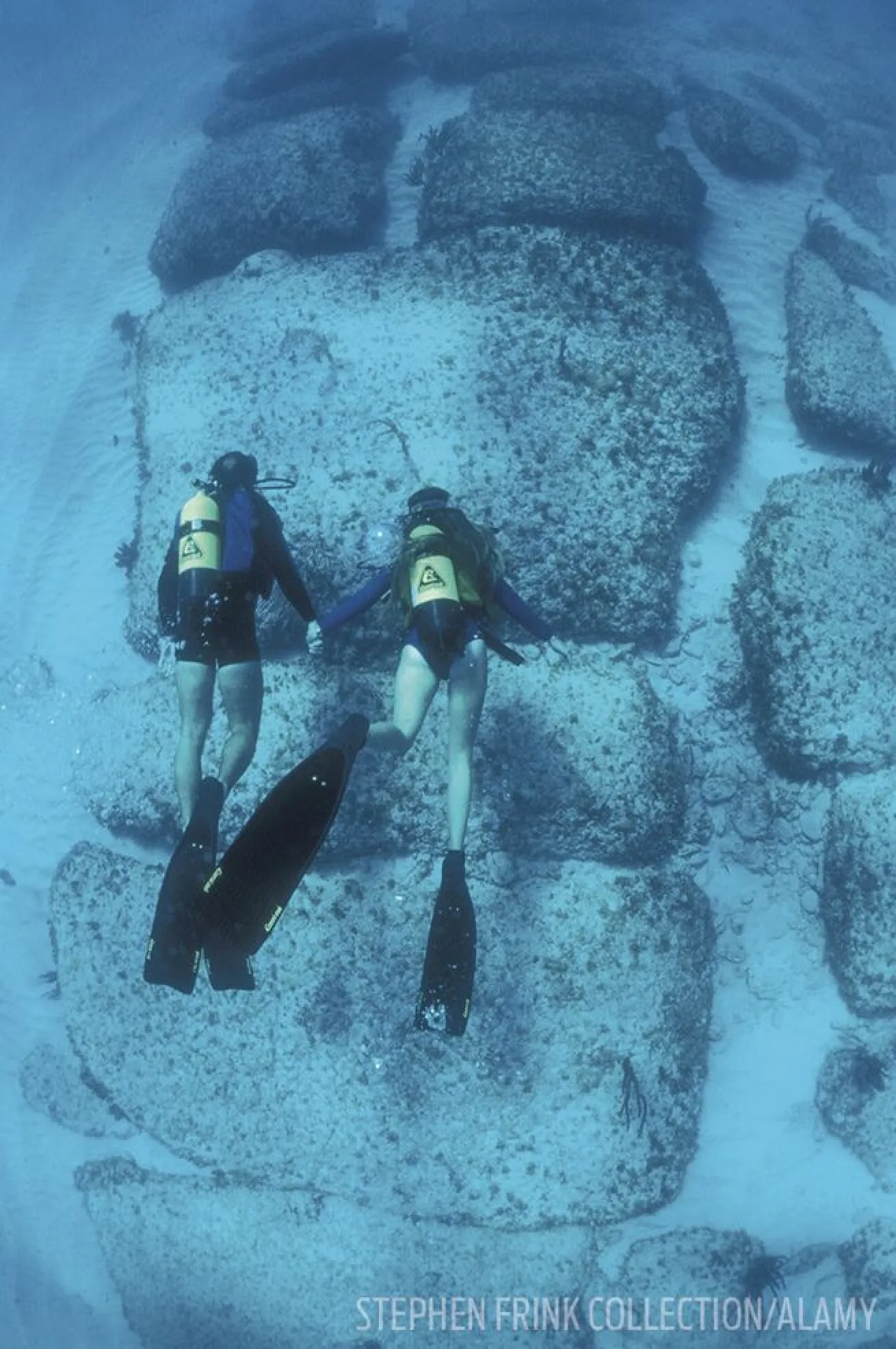
Located just off the coast of North Bimini Island in the Bahamas, resting in approximately 15 feet of crystal-clear Atlantic water, lies the Bimini Road (sometimes called the Bimini Wall). This striking underwater feature consists of a 0.8-kilometer-long, J-shaped linear track composed of massive, flat, roughly rectangular limestone blocks that appear to be neatly arranged like a paved highway or a defensive harbor wall on the ocean floor.
   [ MYTHOLOGICAL CATALYST ] ──► Edgar Cayce's 1938 Atlantis Prophecy
                                            │
                                (The 1968 Discovery)
                                            │
                                            ▼
   [ GEOLOGICAL ANALYSIS ] ◄──── Beachrock Tessellation via Natural Jointing
The site sparked an international sensation when it was discovered in 1968 by marine scientists. To many, it appeared to be the definitive confirmation of a famous prophecy made by American mystic Edgar Cayce in 1938. Cayce had explicitly predicted that the ruins of the lost continent of Atlantis would be rediscovered in the waters around Bimini between 1968 and 1969.
The apparent alignment of this prophecy with the discovery of a seemingly engineered stone road triggered decades of fringe archaeological speculation, attracting alternative historians who argued that the stones were part of a prehistoric temple complex or an ancient Phoenician harbor installation.
The Scientific Deconstruction
Because the site represents a significant case study in pseudo-archaeology, professional geologists and marine scientists have subjected the Bimini Road to intense physical and chemical testing. The results have gently but decisively corrected the myth, proving that the Bimini Road is an entirely natural geological formation:
Beachrock Tessellation: The road is composed of a specific type of limestone known as beachrock, which forms rapidly beneath the sand along coastal shorelines due to the precipitation of calcium carbonate cements.
Natural Jointing: As the shoreline recedes or undergoes tectonic flexing, the brittle beachrock fractures along highly uniform, straight lines known as joints. Over centuries, internal currents and wave action erode these cracks, smoothing the edges of the individual slabs and making them look like hand-cut, rectangular paving blocks.
The Stratigraphic Proof: Core drilling samples through the Bimini stones revealed that the internal bedding planes of the rock run continuously from one block to the next. If humans had cut and laid these stones, the internal geological layers would be completely randomized.
Furthermore, micro-fossils and radiocarbon dating within the stone matrix confirm that the rock formed naturally on the Bahamian shelf roughly 2,000 to 3,500 years ago—long after any theoretical date for Atlantis. The Bimini Road remains a stunning underwater destination, not as a monument to a lost empire, but as a masterclass in nature's ability to mimic the precision of human engineering.