• MAIN PAGE
  • LATEST NEWS
    • Lost Cities
    • Archaeology's Greatest Finds
    • Underwater Discoveries
    • Greatest Inventions
    • Studies
    • Blog
  • PHILOSOPHY
  • HISTORY
  • RELIGIONS
    • Africa
    • Anatolia
    • Arabian Peninsula
    • Balkan Region
    • China - East Asia
    • Europe
    • Eurasian Steppe
    • Levant
    • Mesopotamia
    • Oceania - SE Asia
    • Pre-Columbian Civilizations of America
    • Iranian Plateau - Central Asia
    • Indus Valley - South Asia
    • Japan
    • The Archaeologist Editor Group
    • Scientific Studies
    • Aegean Prehistory
    • Historical Period
    • Byzantine Middle Ages
    • Predynastic Period
    • Dynastic Period
    • Greco-Roman Egypt
  • Rome
  • PALEONTOLOGY
  • About us
Menu

The Archaeologist

  • MAIN PAGE
  • LATEST NEWS
  • DISCOVERIES
    • Lost Cities
    • Archaeology's Greatest Finds
    • Underwater Discoveries
    • Greatest Inventions
    • Studies
    • Blog
  • PHILOSOPHY
  • HISTORY
  • RELIGIONS
  • World Civilizations
    • Africa
    • Anatolia
    • Arabian Peninsula
    • Balkan Region
    • China - East Asia
    • Europe
    • Eurasian Steppe
    • Levant
    • Mesopotamia
    • Oceania - SE Asia
    • Pre-Columbian Civilizations of America
    • Iranian Plateau - Central Asia
    • Indus Valley - South Asia
    • Japan
    • The Archaeologist Editor Group
    • Scientific Studies
  • GREECE
    • Aegean Prehistory
    • Historical Period
    • Byzantine Middle Ages
  • Egypt
    • Predynastic Period
    • Dynastic Period
    • Greco-Roman Egypt
  • Rome
  • PALEONTOLOGY
  • About us
No results found

Leang Burung: Sulawesi's 40,000-Year Cave Art

July 17, 2026

Introduction

For over a century, Eurocentric paradigms dominated the study of prehistoric art, positioning western Europe as the exclusive birthplace of complex human creative expression. This narrative was shattered by deep-time discoveries within the Maros-Pangkep karst networks of South Sulawesi, Indonesia—most notably at the limestone rock shelter of Leang Burung.

Stratigraphic excavations and advanced uranium-series dating of cave art panels at Leang Burung have pushed the antiquity of figurative art back over 40,000 years. This proves that complex visual storytelling emerged just as early, if not earlier, in the tropical settings of Wallacea as it did in the ice-age caves of France and Spain.

Karst Geomorphology and Uranium-Series Chronology

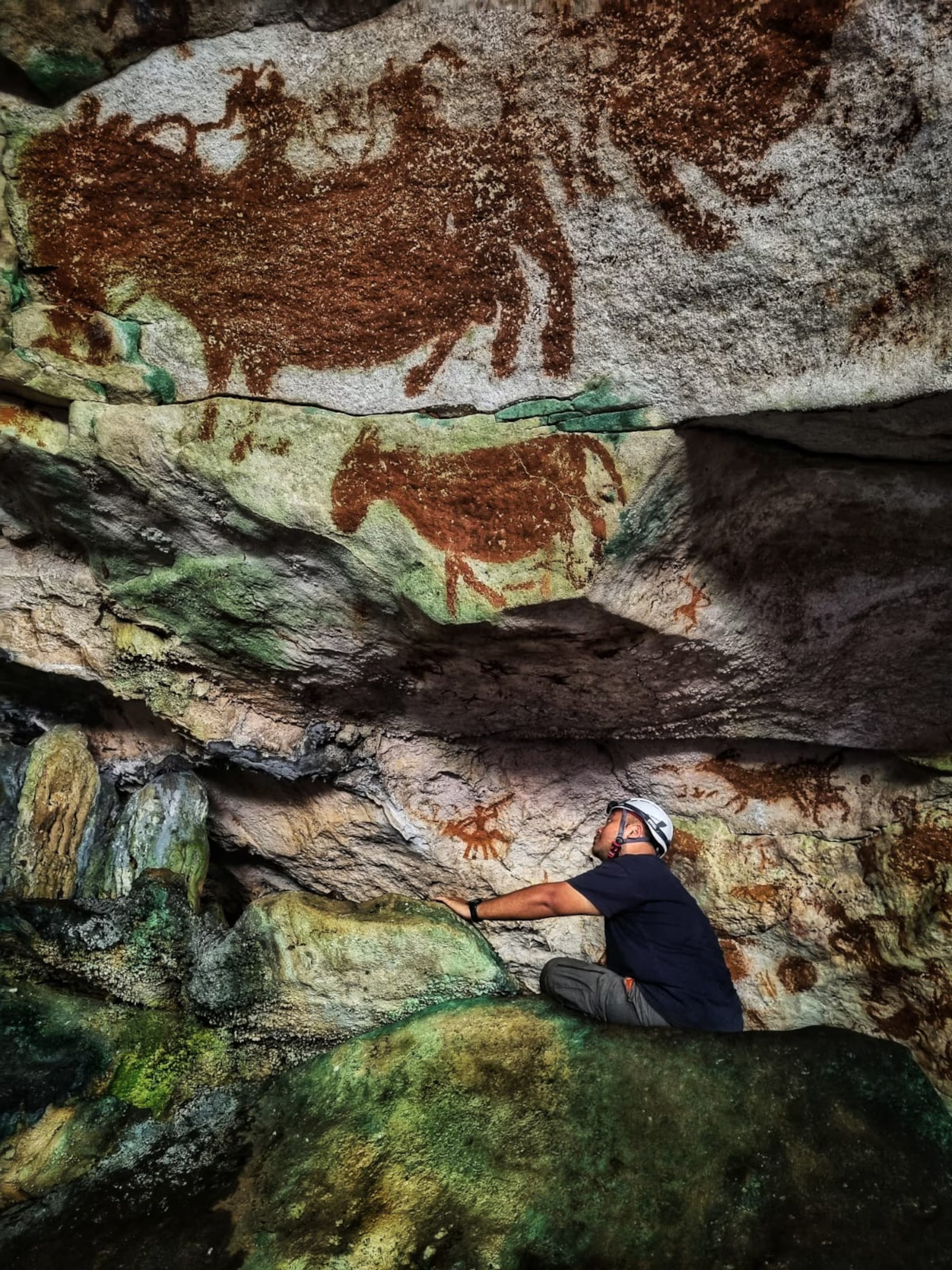
The cave art of Leang Burung is situated within a dramatic landscape of towering tower-karst limestone cliffs. The rock shelters are not deep, pitch-black caverns, but rather well-lit, open-faced rock overhangs where prehistoric communities lived, knapped stone, and painted.

The art features large silhouettes of endemic Wallacean megafauna—primarily the babirusa (pig-deer) and the Sulawesi warty pig (Sus celebris)—alongside negative stencils of human hands created by spraying red ochre pigments over a hand pressed flat against the limestone wall.

To establish the absolute age of these paintings, geochronologists utilized uranium-series dating on tiny, popcorn-like calcium carbonate deposits known as "cave popcorn" (coralloid speleothems) that grew directly on top of the painted pigments.

Because the mineral layer formed after the art was created, dating the speleothems provides a definitive minimum age for the underlying painting. At Leang Burung, these tests yielded dates exceeding 40,000 years ago, demonstrating that the human impulse to externalize complex myths and abstract thoughts onto stone was a universal feature of early modern human behavior, developed long before our ancestors completed their global migrations.

Conclusion

Leang Burung stands as an invaluable monument to the global evolution of human cognition and creative expression. The ancient animal portraits and hand stencils preserved on its weathering limestone walls prove that early Wallacean hunter-gatherers possessed a sophisticated symbolic culture deeply connected to the unique wildlife of their island home. By anchoring the origins of world art firmly in the Indonesian archipelago, Leang Burung continues to reshape our understanding of where, when, and why humanity first began to paint its story onto the world.
← How Ancient Greeks Built Their Harbors and DocksSamoa's Mulifanua: 3,500-Year Lapita Potsherds →
Featured
image_2026-07-13_205514812.png
July 17, 2026
Puna Pau Quarry: Rapa Nui's Red Scoria Pukao Source
July 17, 2026
Read more →
July 17, 2026
image_2026-07-13_205449679.png
July 17, 2026
Anakena Beach: Rapa Nui's First Settlement Site
July 17, 2026
Read more →
July 17, 2026
image_2026-07-13_205627350.png
July 17, 2026
Vinapū Walls: Rapa Nui's Inca-Like Stone Fitting
July 17, 2026
Read more →
July 17, 2026
image_2026-07-13_205353113.png
July 17, 2026
Orongo Village: Rapa Nui's Birdman Cult Houses
July 17, 2026
Read more →
July 17, 2026
image_2026-07-13_205422193.png
July 17, 2026
Ahu Tongariki: Rapa Nui's Restored Moai Platform
July 17, 2026
Read more →
July 17, 2026
image_2026-07-13_204825214.png
July 17, 2026
Marquesas' Hiva Oa Petroglyphs: 1,000-Year Tiki Rocks
July 17, 2026
Read more →
July 17, 2026
read more

Powered by The archaeologist