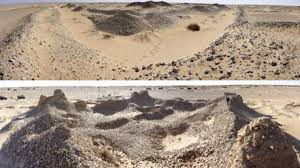
The Sahara Desert is often characterized as a timeless, static wasteland. However, paleoclimatology and satellite archaeology have revealed that for nearly 6,000 years, this region was the "Green Sahara" (the African Humid Period). Between 11,000 and 5,000 years ago, the tilt of the Earth’s axis allowed monsoons to reach much further north, transforming the desert into a lush paradise of mega-lakes, river networks, and savannas. Within this vanished ecosystem, a sophisticated civilization rose that may have been the true cradle of African—and perhaps Western—culture.
The Garamantes: The Empire of the Sands
The most significant evidence of a structured Saharan empire lies with the Garamantes (c. 500 BCE – 700 CE). While the Sahara had already begun its transition back to a desert during their reign, the Garamantes thrived by becoming the world's first masters of desert hydrology. Based in the Fezzan region of modern-day Libya, they built a civilization of "castles" and urban centers that challenged the might of Rome.
Their secret was the foggara system. They excavated hundreds of miles of underground tunnels that tapped into "fossil water"—ancient aquifers trapped beneath the rock from the Green Sahara era. This allowed them to irrigate tens of thousands of acres of desert, growing Mediterranean crops like grapes and figs in a hyper-arid environment. Recent satellite surveys have identified over 100 fortified settlements and sophisticated burial pyramids, proving that the Garamantes were not nomadic "barbarians," but a sedentary, technologically advanced state that controlled the vital trade routes between the Mediterranean and Sub-Saharan Africa.
The Rock Art Archive: The World’s First Map
Deep in the heart of the Sahara, the Tassili n'Ajjer mountain range serves as a stone library of this green era. More than 15,000 individual paintings and engravings depict a world that seems impossible today. We see images of hippos, crocodiles, and elephants—animals that require permanent water sources. More importantly, we see the evolution of human society.
The "Round Head" period (the oldest) depicts shamanistic rituals and mystical figures, while the later "Bovidian" period shows large-scale cattle herding. This art provides evidence of a "Sahara-Sudanic" culture that invented pottery and mastered the domestication of cattle long before these technologies reached many other parts of the world. This culture was a melting pot, where diverse ethnic groups interacted and exchanged ideas on divine kingship and the afterlife.
The Great Migration and the Birth of Egypt
One of the most radical theories in modern archaeology is that Ancient Egypt is a daughter civilization of the Green Sahara. As the monsoons shifted south around 3500 BCE, the Sahara began to dry out with terrifying speed—a process called "desertification." The populations living in the interior were forced to flee toward the only reliable water source left: the Nile Valley.
Archaeologists have noted striking similarities between Saharan rock art and early Egyptian iconography, including the worship of cattle and the concept of the "solar disk." It is likely that the sudden "explosion" of Pharonic culture was actually the result of thousands of years of Saharan social development being compressed into the Nile Valley. The Green Sahara was the laboratory where the foundations of the Western world’s first great empire were tested and refined.