Easter Island, or Rapa Nui, is the most isolated inhabited landmass on Earth. Yet, this tiny speck of volcanic rock is home to nearly 1,000 Moai—colossal stone statues that stand as silent sentinels of a forgotten age. For decades, the Western narrative of Rapa Nui was one of failure: the "Ecocide" theory argued that the inhabitants cut down their entire forest to create wooden rollers for moving the statues, leading to starvation, war, and collapse. Today, this narrative is being dismantled in favor of a story of incredible resilience and engineering genius.
The "Walking" Giants: Physics and Folklore
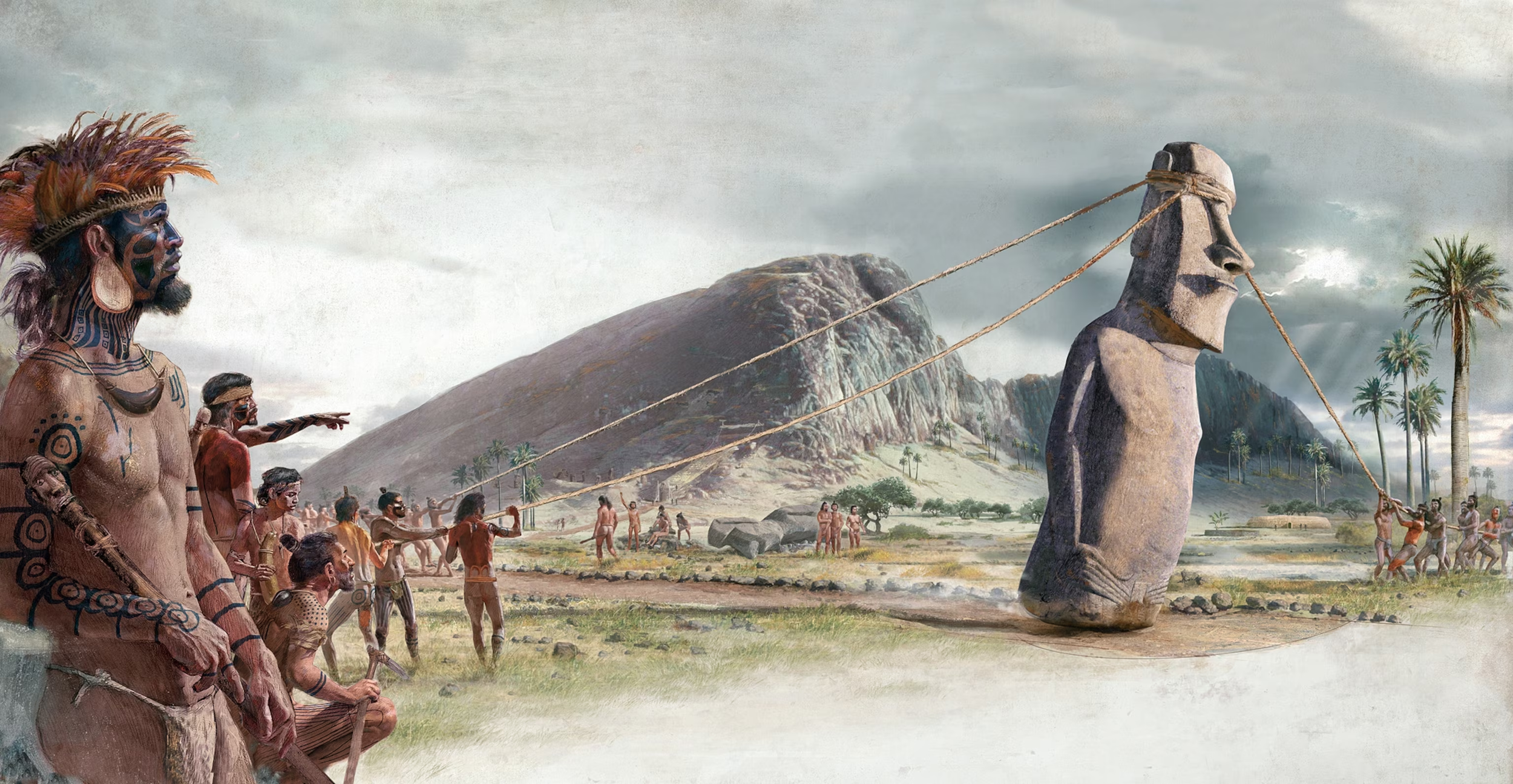
The greatest mystery has always been the transport of the Moai, some of which weigh over 80 tons and were moved miles across rugged terrain. While experimental archaeologists spent years trying to move statues on sledges or rollers, they ignored the Rapa Nui oral tradition, which stated that the statues "walked" to their platforms (ahu).
In 2011, researchers Terry Hunt and Carl Lipo proved that the Moai were engineered for motion. By analyzing the "abandoned" statues along ancient roads, they found that these Moai were not identical to the finished ones on the platforms. The road-statues had a wider, D-shaped base and a forward-leaning center of gravity. This allowed a team of just 18 people using three ropes to rock the statue back and forth in a rhythmic, "walking" motion. This method was not only faster than using rollers but required significantly less wood, proving that the statue-building did not necessitate the destruction of the island's trees.
Deconstructing the "Ecocide" Myth
The idea that the Rapa Nui committed "environmental suicide" is increasingly viewed as a Victorian-era misinterpretation. New soil analysis shows that the Rapa Nui were actually pioneering agriculturalists. When the island's palm forests disappeared (partly due to the arrival of Polynesian rats that ate the seeds), the people didn't starve. Instead, they invented lithic mulching. They broke up volcanic rocks and covered their fields with them to protect the soil from wind erosion and to trap moisture.
This allowed them to maintain a stable population for centuries after the trees were gone. The "collapse" only occurred after European contact, which brought smallpox and the slave trade, devastating the population. The Moai were not a cause of their downfall, but a symbol of the social cohesion that allowed them to survive in a challenging environment.
Mana and the Ancestral Watch
To understand why the Rapa Nui moved these giants, one must understand the concept of Mana (spiritual power). Each Moai was a portrait of a deified ancestor. Once the "eyes" (made of white coral and obsidian) were placed in the statue, it became a living entity.
Crucially, almost all Moai face inward toward the villages, not out to sea. They were designed to cast their protective gaze over the living, ensuring the fertility of the land and the success of the community. They were the anchors of Rapa Nui society—stone bridges between the world of the living and the eternal power of the ancestors. By moving them, the Rapa Nui weren't just moving rocks; they were positioning the very foundations of their spiritual world.