Introduction
The Sterkfontein Caves are among the most famous paleoanthropological sites in the world. Located near Johannesburg within South Africa's Cradle of Humankind World Heritage property, the caves have produced an extraordinary collection of hominin fossils spanning millions of years.
The importance of Sterkfontein is not based on one fossil.
It comes from the accumulation of evidence across generations of excavation.
Australopithecus fossils, animal remains, geological deposits, and archaeological materials together create a record of human evolutionary history extending deep into the Pliocene and Pleistocene.
UNESCO identifies the Sterkfontein, Swartkrans, Kromdraai, and associated sites as an exceptionally important concentration of evidence concerning early human evolution.
The Cradle of Humankind
The term "Cradle of Humankind" refers to a broad fossil-rich landscape rather than a single cave.
The region contains numerous cave systems formed in dolomitic limestone.
Water gradually dissolved underground cavities.
Sediments, animal remains, and other materials subsequently accumulated within these caves.
Some of those deposits eventually preserved hominin fossils.
The result is an extraordinary natural archive.
Early Discoveries
Sterkfontein became famous in the twentieth century through discoveries of early hominin fossils.
Among the most important was the adult female-like Australopithecus specimen known as "Mrs. Ples," although the sex and exact identification of the specimen have been subjects of scientific discussion.
The discovery demonstrated that australopithecines were not merely hypothetical creatures.
They were represented by substantial fossil populations.
Little Foot
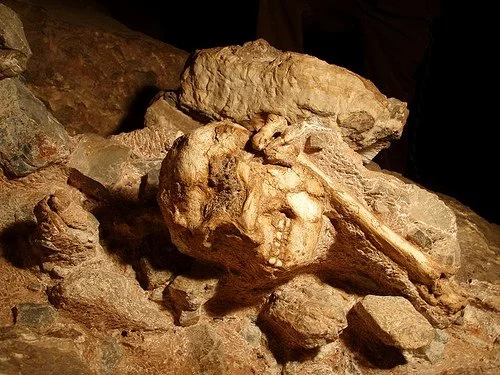
Perhaps the most spectacular discovery associated with Sterkfontein is "Little Foot."
Little Foot is an exceptionally complete Australopithecus skeleton recovered from deep cave deposits.
Its preservation allows researchers to examine the relationship between the skeleton's anatomy and locomotion.
The discovery is important because complete skeletons are exceptionally rare in the fossil record.
Dating the Cave
Dating Sterkfontein is scientifically complicated.
Cave deposits can accumulate in multiple phases.
Different sediments may have entered the cave at different times.
Some fossil-bearing layers have also been affected by geological processes.
Researchers therefore use multiple dating techniques and geological interpretations.
This is why dates associated with Sterkfontein have sometimes changed as methods improved.
Human Evolution
The fossils from Sterkfontein demonstrate that southern Africa was inhabited by multiple hominin populations.
These populations did not necessarily represent a single evolutionary line.
Some may have been ancestors of later groups.
Others may have represented branches that eventually disappeared.
The cave therefore documents diversity rather than a simple chain of descent.
Anatomy
Australopithecine anatomy combines characteristics associated with both ape-like ancestors and later humans.
The pelvis and lower limbs show adaptations for upright walking.
The upper limbs retain characteristics associated with climbing.
The skull and teeth reveal dietary and evolutionary information.
This combination illustrates the mosaic nature of hominin evolution.
The Environment
The landscape surrounding Sterkfontein changed repeatedly over geological time.
Climate shifts altered vegetation.
Grasslands expanded and contracted.
Woodlands changed.
Water availability varied.
Animal communities changed alongside these environmental transformations.
Hominins were therefore living within dynamic ecosystems.
Taphonomy
One of the major challenges at cave sites is determining how fossils entered the caves.
Were animals deliberately carried inside?
Did predators drag carcasses into cavities?
Did individuals fall into shafts?
Were remains transported by water?
These questions belong to the field of taphonomy.
Understanding fossil accumulation is essential because the presence of a fossil in a cave does not automatically mean the animal lived there.
Stone Tools
Some archaeological evidence occurs within the broader Cradle of Humankind landscape.
Stone tools help demonstrate technological development among early hominins.
However, associating a particular tool industry with a particular fossil species is difficult unless both occur in secure archaeological context.
This is one of the central methodological challenges of paleoanthropology.
Why Sterkfontein Matters
UNESCO describes the fossil sites of the region as preserving an exceptionally long record of hominin evolution and notes that the Sterkfontein landscape has played a major role in establishing Africa's importance to human evolutionary research.
The site's importance therefore extends beyond individual discoveries.
Sterkfontein transformed scientific understanding of the antiquity and diversity of human ancestors.
Preservation
Cave environments are fragile.
Excavations can disturb sediments.
Tourism can affect microclimates.
Water movement can damage deposits.
Fossils and archaeological materials must therefore be carefully documented.
Preservation is especially important because excavation is irreversible.
Once a sediment layer is removed, it cannot be replaced in its original archaeological condition.
Conclusion
Sterkfontein Caves represent one of humanity's most important fossil archives.
Its importance lies not simply in the famous specimens found there but in the enormous chronological and biological diversity preserved across the cave system.
The fossils demonstrate that human evolution occurred through a complex branching history involving numerous species and populations.
For that reason, Sterkfontein remains central to understanding humanity's deep African past.