Introduction
Malapa Cave, located within South Africa's Cradle of Humankind region, is one of the most important paleoanthropological discoveries of the twenty-first century. The site became internationally famous after the discovery of remarkably preserved remains of Australopithecus sediba, a hominin species that lived approximately 1.98 million years ago.
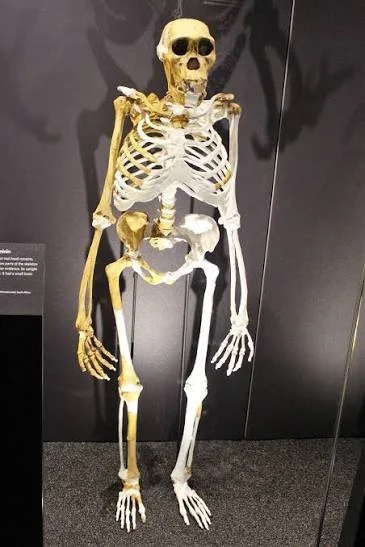
The fossils from Malapa are especially significant because they preserve unusually complete parts of the skeleton. Rather than providing researchers with only isolated teeth or fragments of skull, the Malapa discoveries include substantial portions of the skeleton. This allows scientists to investigate anatomy, locomotion, diet, growth, and evolutionary relationships in unusual detail. The Smithsonian's Human Origins Program dates Australopithecus sediba to approximately 1.977–1.98 million years ago.
Malapa therefore provides something much more valuable than another fossil specimen. It offers a detailed snapshot of a hominin living during a crucial period when several different human relatives occupied Africa.
The Discovery of Malapa
The Malapa fossils were discovered in 2008 during excavations associated with the Cradle of Humankind World Heritage landscape.
One of the most important specimens was a juvenile skeleton designated MH1.
Another major specimen, MH2, represented an adult individual.
The exceptional preservation of these individuals immediately attracted international attention.
The fossils included portions of the skull, teeth, spine, pelvis, hands, arms, legs, and feet.
This level of anatomical representation allowed researchers to reconstruct aspects of the body that are normally impossible to understand from fragmentary fossil material.
Australopithecus sediba
The species name Australopithecus sediba combines the genus Australopithecus with the Sesotho word "sediba," meaning "fountain" or "wellspring."
The name reflected the hope that the fossils would provide new information about human evolutionary origins.
The species displayed a remarkable combination of anatomical characteristics.
Some features resembled earlier australopithecines.
Others appeared more similar to members of the genus Homo.
The mosaic nature of its anatomy became central to the scientific debate surrounding Malapa.
A Mosaic Anatomy
MH1's skeleton demonstrates why human evolution cannot be represented as a simple ladder.
The skull retained several australopithecine characteristics.
The teeth also showed a combination of traits.
The pelvis, however, contained features that researchers considered more derived.
The hand anatomy suggested sophisticated grasping abilities.
The lower limbs indicated a form of bipedal locomotion.
This combination is important because evolution does not necessarily change every part of an organism simultaneously.
Different anatomical systems can evolve at different speeds.
Walking and Locomotion
One of the major questions surrounding Australopithecus sediba concerns how it moved.
The species was clearly adapted to some form of habitual bipedalism.
However, its anatomy does not simply reproduce the modern human pattern.
The pelvis and lower limbs suggest an unusual form of walking.
The foot and ankle anatomy also provides evidence for a locomotor system that combined older and more derived characteristics.
This makes Malapa particularly valuable for studying the evolution of upright walking.
The Hands
The hands of A. sediba are especially interesting.
The fossils suggest a combination of strong grasping capabilities and anatomical features that could have supported precision manipulation.
This raises questions about the relationship between locomotion, climbing, and tool-related behaviors.
However, the presence of an anatomically capable hand does not automatically prove that A. sediba made stone tools.
Stone artifacts and biological fossils must be associated carefully before a behavioral connection can be established.
The Brain
The skull of MH1 also provides information about brain evolution.
Although the brain was relatively small compared with that of later Homo, aspects of its shape have been investigated through endocranial reconstruction.
Researchers have debated whether the cerebral organization of A. sediba provides clues about the evolutionary changes that eventually produced the much larger brains of later humans.
The broader lesson is that brain evolution was gradual and complex.
Diet and Teeth
Dental anatomy provides evidence about diet.
The teeth of A. sediba contain features that distinguish the species from both earlier australopithecines and later hominins.
Researchers have also used microscopic wear and chemical analysis to investigate the foods consumed by the Malapa individuals.
The goal is not merely to identify individual foods but to understand the ecological strategy of the species.
The Malapa Environment
The cave did not exist in isolation.
The surrounding landscape contained woodland, grassland, water sources, and diverse animal life.
Understanding the environment is essential because human evolution is fundamentally connected to ecological change.
Hominins did not evolve in laboratories.
They responded to changing food resources, predators, climate, vegetation, and terrain.
Did Malapa Produce Tools?
The chronological position of Malapa is especially interesting because it overlaps with major changes in hominin technology.
Stone tools are known from Africa by at least several million years ago, although the exact identities of their makers remain uncertain in many cases. The Smithsonian notes that the earliest known stone tools currently extend to approximately 3.3 million years ago, demonstrating that stone technology considerably predates A. sediba.
However, this does not establish that A. sediba made those tools.
The association must remain cautious.
Evolutionary Significance
One of the most important debates concerns where Australopithecus sediba fits within the human family tree.
Some anatomical characteristics appear sufficiently unusual that the species may represent a side branch of hominin evolution.
Other characteristics have been interpreted as potentially relevant to the emergence of Homo.
The fossils therefore do not provide a simple answer to the question of ancestry.
Instead, they demonstrate the diversity of hominins living around two million years ago.
Conclusion
Malapa Cave has transformed the study of human evolution by providing exceptionally complete remains of Australopithecus sediba.
The fossils show that human evolution was not a straightforward march from ape-like ancestors toward modern humans. Different anatomical systems changed at different rates, producing organisms with combinations of primitive and derived characteristics.
Malapa's greatest contribution may therefore be conceptual as much as anatomical: it demonstrates the complexity of evolutionary experimentation within the human lineage.