Introduction
The history of the transcontinental railroad cannot be understood without examining Chinese railroad workers.
Matlin is associated with the broader landscape of Chinese labor camps and railroad construction in Utah and the Great Basin. Such places are important because they preserve evidence of workers whose contributions were essential but whose stories were frequently minimized in older accounts of railroad history.
Chinese Immigration and Railroad Labor
Large numbers of Chinese immigrants came to the United States during the nineteenth century.
Many settled in the American West.
Railroad companies recruited Chinese workers because they had established reputations for disciplined and highly organized labor.
The Central Pacific became particularly dependent upon Chinese workers during construction across the Sierra Nevada and Great Basin.
The Work
Railroad construction was physically demanding.
Workers cleared vegetation.
They graded the ground.
They moved enormous quantities of earth and rock.
They drilled holes for explosives.
They laid ties and rails.
They constructed bridges, culverts, and other infrastructure.
Much of the work was performed manually.
Labor Camps
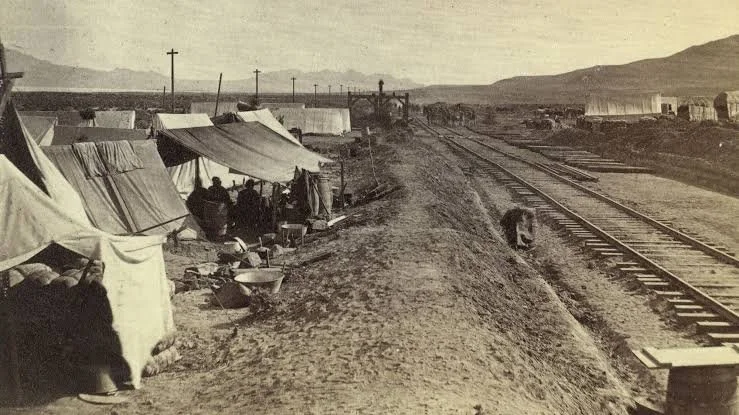
Construction camps were temporary communities.
Workers required sleeping quarters, cooking areas, food storage, water supplies, and work equipment.
Some camps moved as construction advanced.
Others became associated with more permanent railroad infrastructure.
Archaeological remains can include ceramics, bottles, metal objects, food remains, and structural traces.
Chinese Material Culture
Archaeologists have sometimes identified Chinese-associated sites through distinctive ceramic forms, coins, gaming materials, food remains, and other artifacts.
However, interpretation requires caution.
Artifacts do not automatically reveal ethnicity.
Researchers combine multiple forms of evidence, including historical documents, spatial organization, artifact patterns, and oral histories.
Food and Community
Food was particularly important in railroad camps.
Chinese workers maintained culinary practices while adapting to locally available ingredients.
Food remains can therefore provide information about cultural adaptation and community organization.
Chinese workers did not simply abandon their cultural identities when they entered railroad employment.
Working Conditions
Railroad construction was dangerous.
Explosives could cause injuries.
Rockfalls and construction accidents occurred.
Workers endured extreme heat and cold.
The desert environment presented serious logistical challenges.
Chinese workers also faced discrimination and unequal treatment.
Their historical experience must therefore be understood within the broader context of nineteenth-century racial exclusion.
The Chinese Exclusion Act
In 1882, the United States enacted the Chinese Exclusion Act, severely restricting Chinese immigration.
This law reflected widespread anti-Chinese sentiment and had profound effects on Chinese American communities.
Railroad labor history therefore intersects directly with American immigration history.
Archaeological Importance
Chinese railroad camps are important because written records often emphasize company management and construction milestones.
Archaeology can provide evidence of the workers themselves.
Artifacts reveal what they ate, purchased, repaired, discarded, and carried.
This creates a more complete historical record.
Preservation
Many railroad camps were temporary.
Their structures disappeared soon after workers moved.
Weather and later development further damaged archaeological remains.
Consequently, even small artifact concentrations can have major historical value.
Conclusion
Matlin's significance lies in the broader story it represents: the Chinese workers whose labor helped construct and maintain the railroad system across the American West.
Railroad history becomes much richer when the famous golden spike is placed alongside the camps, tools, meals, hardships, and communities of the laborers who made the ceremony possible.