Introduction
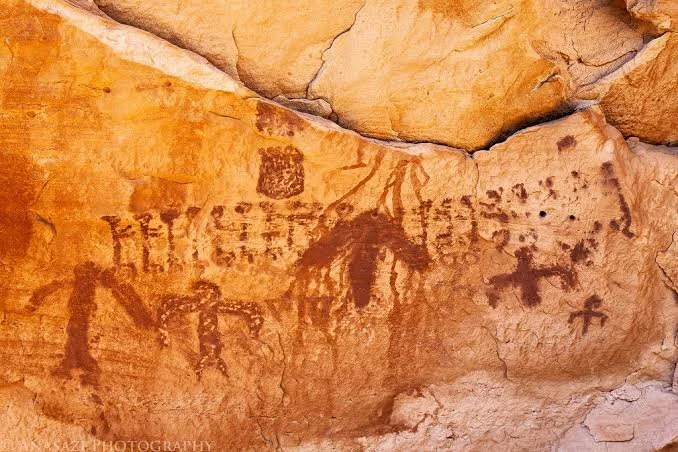
Along the sandstone walls of Nine Mile Canyon in eastern Utah, the McConkie Ranch area contains some of the most recognizable Fremont rock art in the region.
The images are famous for their human figures, animals, hunting scenes, and geometric forms.
At first glance, the panels may appear to tell simple stories.
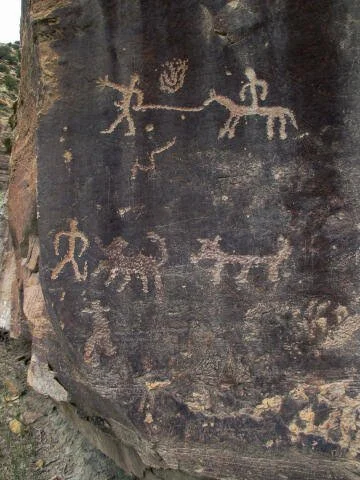
A hunter seems to pursue an animal.
A human figure appears to hold a weapon.
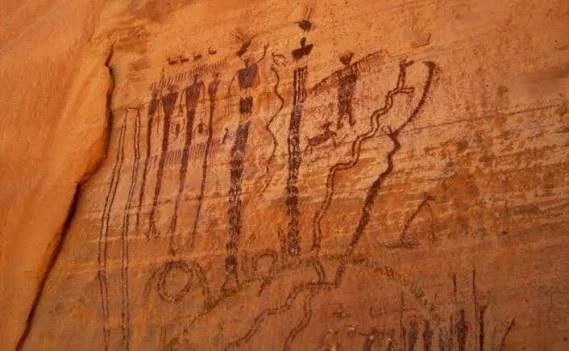
A large anthropomorphic figure appears to stand over the canyon.
But archaeology requires a more careful approach.
Rock art is evidence of symbolic behavior, but the original meanings of many images cannot be recovered with certainty.
The Fremont Tradition
The Fremont tradition developed across much of Utah during the first and second millennia A.D.
Fremont communities practiced agriculture but also relied heavily on hunting and gathering.
Their material culture included distinctive pottery, basketry, moccasins, and rock art.
The McConkie Ranch Panels
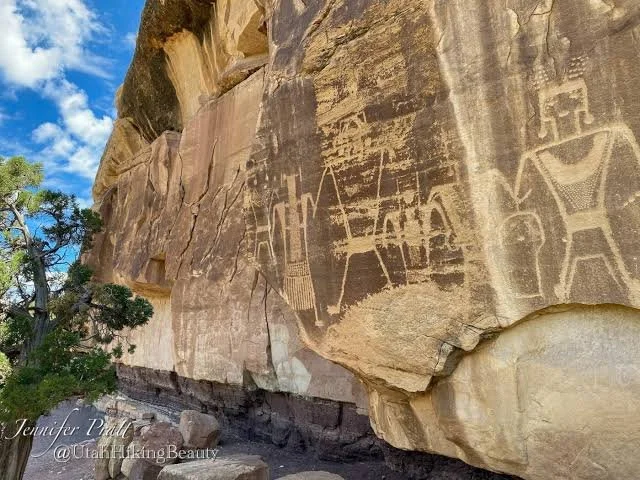
The rock-art panels at McConkie Ranch are particularly notable for their relatively large and well-preserved figures.
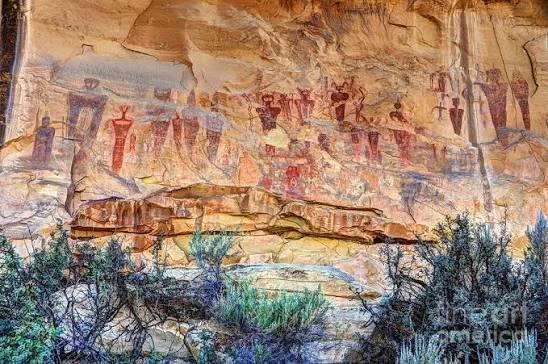
Anthropomorphic images appear alongside animals.
Some figures have elaborate headgear.
Others appear to carry objects.
The combination creates a visually complex record.
The Fremont Anthropomorphic Figure
The Fremont anthropomorphic figure is one of the most recognizable forms of Utah rock art.
Many figures have:
trapezoidal bodies
narrow waists
large heads
elaborate headdresses
necklaces
earrings
shields or weapons
Their exact meaning remains uncertain.
They may represent people, supernatural beings, ancestors, or combinations of these concepts.
Hunting Scenes
Some panels appear to show hunters and animals.
Archaeologists can compare these images with physical evidence of hunting.
Projectile points found elsewhere demonstrate the use of bows, darts, and other hunting technologies.
Animal bones reveal what species people consumed.
But rock art cannot necessarily be treated as literal documentation.
An animal may be symbolic rather than prey.
The Importance of Headdresses
Elaborate headgear appears on some Fremont figures.
This has generated considerable interpretation.
Possible explanations include:
ceremonial identity
social status
supernatural representation
ritual costume
hunting disguise
None can be confirmed universally.
The headdresses are nevertheless significant because they suggest that visual representations carried social information.
Nine Mile Canyon
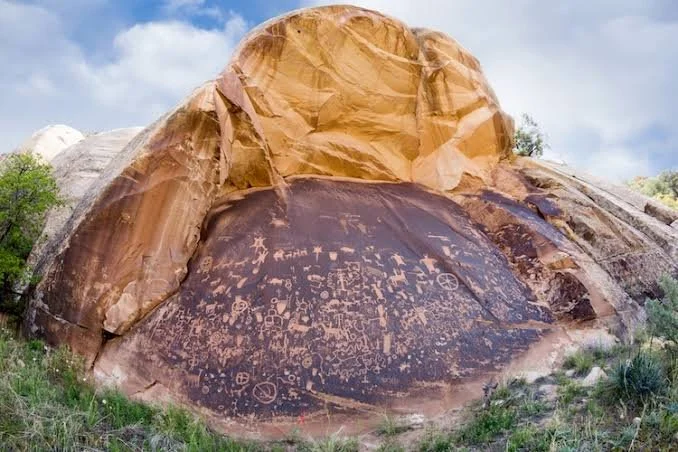
The canyon itself provides the setting.
Its sandstone walls created natural surfaces for carving.
Water and vegetation made parts of the canyon habitable.
Travel through the canyon connected different areas.
This combination of movement, resources, and dramatic rock surfaces may have contributed to its importance.
Petroglyph Technique
Artists created petroglyphs through direct modification of rock.
Pecking is one common technique.
The artist repeatedly struck the surface with a harder stone.
This removed small pieces of the weathered surface.
The resulting lighter image contrasted with the darker surrounding rock.
Over time, the exposed area gradually darkened again.
Archaeological Dating
Dating petroglyphs is difficult.
Researchers use:
superimposition
weathering
stylistic comparisons
archaeological association
pigment analysis where applicable
The absence of a precise date does not make the image scientifically useless.
It simply requires archaeologists to express conclusions in terms of probability and relative chronology.
Modern Preservation
McConkie Ranch is accessible to visitors.
This creates preservation challenges.
Foot traffic can cause erosion.
People sometimes touch or climb near panels.
Modern graffiti can damage ancient images.
Photography is generally harmless when done responsibly.
Touching is not.
Cultural Significance
Fremont rock art represents the cultural heritage of Indigenous peoples.
Modern interpretation should therefore avoid portraying the artists as an anonymous "mysterious race."
The people who made the images lived in organized communities.
They had languages, families, beliefs, technologies, and relationships with the landscape.
Conclusion
McConkie Ranch preserves some of the most recognizable examples of Fremont rock art in Utah.
The images provide evidence of artistic skill and symbolic behavior.
They also reveal the importance of animals, human identity, and the surrounding landscape.
But the greatest lesson is one of archaeological humility.
We can see what the artists created.
We can study how the images were made.
We can compare them with other archaeological evidence.
But we cannot automatically know what every figure meant.
The mystery is not a failure of archaeology.
It is a reminder that archaeological evidence often preserves fragments of human experience rather than complete explanations.